
On August 29, the Dominion Society of Canada hosted Dom Con 2026, a claimed first annual conference which was originally set to take place in Hamilton, ON. The Dominion Society, a white supremacist group, claims to advance the interests of white “Heritage Canadians” — specifically those of English, French, Scottish, and Irish descent — through “remigration,” which advocates for mass deportations and the elimination of immigration pathways.
Like other white nationalist groups who are mobilizing in Canada, the Dominion Society pushes the “Great Replacement Theory.” This conspiracy believes that white people in Western countries are slowly being “replaced” through racialized immigration, and that immigrants are culpable for inadequate housing, healthcare, education, and other services in Canada.
Public white supremacist activity in Hamilton is not unprecedented. Incidents of harassment and demonstrations of masked individuals holding anti-immigration banners have been popping up in Hamilton and across Canada. But this time, Hamiltonians were able to respond with a strong community showing that eventually drove the Dominion Society conference out of Hamilton.
Community response
As word spread that a local venue would be hosting this conference, Hamiltonians and their allies did not take this lightly.
Multiple community groups developed an open letter and community petition for Hamiltonians to sign (as individuals or on behalf of a local group) to publicly oppose bigotry and violent extremism. Calls to action included safely removing or making illegible posters promoting hate or gatherings for hate groups, and denying these hate groups meeting space by creating A Guide for Businesses, Venues, & Staff Recognizing & Responding to Extremist Activity.
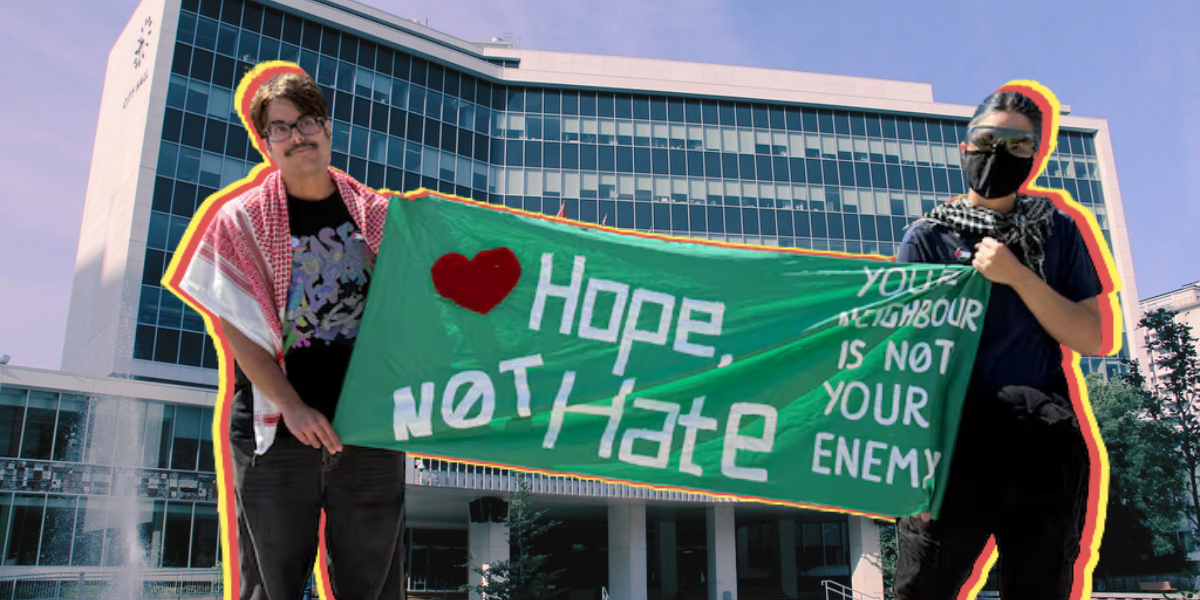
On the day of the proposed Dom Con event on August 29, a coalition of local labour groups including members of the Hamilton Labour District Council, Hamilton Centre for Civic Inclusion, grassroots activists, and community groups organized an anti-hate rally against racism and bigotry. Named “Hope Not Hate Rally: Hamilton Stands Up to Bigotry,” the groups congregated at Hamilton City Hall to host a family-friendly event geared toward community-building and inclusion, with resources, refreshments, and children’s activities.
Buses were organized to bring activists and other community members from Toronto and other municipalities to show their solidarity and support Hamilton’s efforts in promoting the message that white nationalism is not welcome here (or elsewhere).
While the Dominion Society was able to secure a last-minute booking at Atrium centre in Burlington for their event, the mass response and mobilization from wide layers of labour and civil society helped to put pressure on Hamilton venues, leading to the Dominion Society being unable to book venues inside the city (including cancellations by a minimum of two other venues). Public pressure and collective organizing helped to win this small, but notable, victory.
Finding common ground is the key to building movements
The Dominion Society’s website points to the struggles of working class people in Canada from the housing crisis to unemployment, noting that wage stagnation and lack of supply of jobs “benefits large corporations at the expense of workers.”
Both the right and left acknowledge that working class people are affected by the policy failures of our current governments. Everyday people know and understand their reality — that economic struggle comes from inadequate working conditions and a disregard for the working class.
One of the founding principles of Spring is the concept of organizing from below, which involves having one-on-one conversations with ordinary, working class people as an essential part of building mass solidarity movements.
The “Hope Not Hate” protest provided a space for a wide demographic of people to have a united front against hate in Hamilton. A family-friendly event provides an entry point for ordinary people to become politically involved and feel empowered in the face of growing fascism. As revolutionary socialists, these spaces are a vital organizing tool to connect with, and relate to, working class people.
Having these essential conversations and winning people over means thinking through important questions: What can we agree upon? What is our common goal that we can achieve through struggle? What is the key link — the central and current issue that can be collectively focused on so we may move forward, together? How are our struggles interlinked?
The role of labour
Racism and white supremacy are labour issues. The normalization of right-wing rhetoric lays the groundwork for further harassment and discrimination for racialized workers on an individual and systemic level.
During a recent Hamilton community roundtable discussion, Kate from the Building Power Network spoke about how the far-right ecosystem systematically fuels conservative propaganda in order to scapegoat marginalized people for the crisis of capitalism. An organized labour response is necessary to not only denounce this violence, but address the deepening austerity which fuels its existence.
The Hamilton and District Labour Council (HDLC) has 58 union local affiliates which aim to represent members as well as address community-related concerns. While HDLC involvement is a promising starting point, it is our role as revolutionary socialists to engage rank-and-file workers to advocate for their unions and workplaces to become politically engaged in the struggle against white supremacy in Hamilton.
In an interview with Minnesota General Strike organizers, Aminah Sheikh, an elected member of the Steering Committee of the Twin Cities Democratic Socialists of America, shared:
[The mass community response] wasn’t spontaneous. It had been culminating from the pandemic, the killing of George Floyd, the hyper alienation and surveillance by the state. So, the events rapidly unfolding here were not spontaneous but actually developed into possibilities of struggle.
Sheikh also referenced the importance of rank-and-file members laying the groundwork for large political actions such as a general strike through the use of engaging ordinary people to work towards direct action in the workplace. These lessons are important as a guide for organizing around white supremacy as a labour issue.
The grassroots organizers responsible for the Hope Not Hate Rally continue to discuss how to sustain and build an anti-hate coalition in Hamilton.
Authors

Did you like this article? Help us produce more like it by donating $1, $2, or $5. Donate