
In mid-January, two white supremacists stood on a street corner at the busy intersection of Main Street and Queen Street in Hamilton distributing flyers to pedestrians passing by. A community member took photographs of the perpetrators and their poster, titled “White Canada,” detailing their principles of organizing white Canadians against “non-White immigrants” along with contact information to get involved. One perpetrator was identified as having a Totenkopf tattoo on his left hand—a symbol used by the Nazi Schutzstaffel (SS) who were responsible for guarding concentration camps during the Holocaust.
These images were circulated on social media by concerned Hamiltonians, who are well aware of the growing sightings of white nationalist impudence in the area. It was also reported that one of the perpetrators was again spotted posting flyers in Gage Park—a greenspace frequented by many young families in the neighbourhood, and located within walking-distance of multiple elementary schools.
This incident is far from isolated. Just over a year ago, Spring Hamilton member Sarah Jessica covered the Spring-organized action calling for support to migrants in response to a small demonstration of masked individuals holding a banner stating “MASS DEPORTATIONS NOW” the previous month on November 4, 2024.
Since then, reports of white nationalist demonstrations have been reported at an overpass in London, Niagara, and recently, a larger neo-Nazi rally in Hamilton’s Gore Park on November 29. The masked men called for mass deportations, holding a banner with the message “White Men, Fight Back” with one individual appearing to show a Nazi salute.
In response, the Hamilton Immigration Partnership Council (HIPC), Hamilton Centre for Civic Inclusion, Hamilton Anti-Racist Resource Centre, and the Hamilton Anti-Hate Coalition released a statement to condemn the incident and provide resources for anti-racist education and toolkits for reporting hate crimes in the city.
Immigration in Canada
In the era of Trump and the ever-growing push toward far-right conservatism, immigrants continue to be the scapegoat for the cost of living and problems facing communities, bearing the blame for everything from housing prices to drug trafficking.
In Canada, this rhetoric is not reserved for Conservatives. Even as a Liberal leader, Carney contributes to the fearmongering of ‘mass migration.’ Carney’s Bill C-12 gives the government vast control over immigration, including the power to cancel immigration permits, prevent refugees from applying for asylum if they have been in Canada over a year, and the ability to share immigration data with other governments (under the guise of protecting Canadians from transnational criminal activity). With the recent ICE raids in Minneapolis, we must be vigilant and proactive in addressing the anti-immigration sentiment within Canada’s borders.
In a majority-white and Canadian-born population, the 2021 Canadian census records that racialized persons living in Hamilton only account for 25% of the total population. Hamilton Immigration Partnership Council’s June 2024 Demographic Profile documents only 3 out of 10 Hamiltonians as being born outside of Canada—and those 3 in 10 are twice as likely as non-immigrants to live in low-income situations. Over 85% of immigrants in Hamilton come from racialized communities.
On top of the emotional turmoil that comes with xenophobia, racism, language barriers, and adjustment to life in another country, migrants are suffering economically. Yet, immigration continues to be at the forefront of the conservative right as the reason for declining job opportunities and the rising cost of living.
The realities of living in Hamilton
Certainly, all Canadians (Hamiltonians included) are struggling with the current housing crisis and soaring grocery prices.
Known as the Steel City, Hamilton’s population has long been a part of Canada’s working class history. This working class city culture has led Hamilton Centre to elect the Ontario NDP in every provincial election since the creation of its riding over twenty years ago. Stelco and ArcelorMittal Dofasco have been critical to Canada’s steel industry since the 1910s, and essential to the employment of a significant portion of Hamilton’s population. Today, CBC reports that 4,500 Hamiltonians are employed by Dofasco, with upwards to 10,000 employees overall, which makes the topic of Trump’s tariff threats all the more threatening to job security.
Despite costly living conditions, wages are not keeping up. The provincial minimum wage increased to only $17.60 in October 2025, while the Ontario Living Wage Network’s calculated wage to live in Hamilton has increased over 6% to $22.60 as of November 2025. Their calculations are modeled on three household categories (a single adult, a single adult with a child, and two 35-year-old parents with a young child) and consider all the potential expenses that come with day-to-day life. However, this wage excludes the prospect of saving for buying a home or paying off any debts—$22.60 per hour wouldn’t even be enough for someone trying to pay off their student debt, and the Ontario minimum wage still falls considerably below that number.
At the same time, the Workers’ Action Centre’s recent report on wage theft found that 60% of workers in Ontario have experienced at least one form of wage theft, while the Ministry of Justice has found almost $200 million unpaid by employers to Ontario workers (which may still only represent a fraction of what is owed by employers in unpaid wages). Despite this, ordinary, working class white folks continue to be enticed to join the far-right’s racist, capitalist movement, rather than a labour-focused socialist movement on the left.
In the Hamilton context, the Proposed City Budget 2026 is set to be drafted by Mayor Horwath by February 1. Concerned with addressing the current cost of living, City Councillor Cameron Kroetsch of Ward 2 shared an infographic to his official office Instagram account with a pie graph outlining how the average household’s taxes are allocated. Per the infographic, the average household will spend $936 of taxes on policing – the largest increase in spending at a total of $290 million – compared to $391 on housing and $169 on social services. State security receives over twice as much funding as is allotted to address the housing crisis, even as homelessness continues to increase across the city (and country as a whole).
Not only does the city budget fail to address the housing crisis facing all Hamiltonians, but this city budget’s focus on police funding only increases the systemic oppression of racialized and immigrant communities. Race-based data submitted by the Hamilton Police showed disproportionate use of force against Black people for five years in a row, despite only making up 5% of Hamilton. This data also shows individuals who are “perceived to be Middle Eastern” have seen an increase in disproportionate use of force. In mid-2025, the Hamilton Police suspended an officer who showed support for white supremacist group, Diagalon.
The future of movement-building
There is a serious lack of class consciousness with the rise of white supremacist groups, who are unhappy with their livelihoods and lack of a future for themselves.
How do we move forward? How do we unite against hate, while addressing policy shortfalls that are making Hamiltonians and Canadians struggle?
The future of building a class-conscious, intersectionality-focused movement is to prioritize families and community. Many people are rightfully concerned for their safety to counter-protest a demonstration such as a white nationalist, anti-immigrant rally.
The organization of the counterprotest against the Canada First rally held in Toronto’s Christie Pits on September 13 is a prime example of building unity. In response to a white nationalist demonstration, a counterprotest (whose participants vastly outnumbered the hate demonstration) was organized to both discourage anti-immigrant sentiment and provide a safe space for community members to bond, socialize, and stand against hate. The organizers – a coalition of educators, migrant solidarity, and labour groups – called for people to spend an ‘afternoon in the park’ with art supplies, food and drink. Spring’s Tahira Newaz, who covered the counterprotest at Christie Pits, names the strategies for building a collective movement which include unity, community safety, remaining calm, and providing solutions to the demands of the far-right.
In the face of ICE raids and a general strike in Minneapolis, solidarity-building is being brought to the mainstream. Neighbours are caring for one another and organizing against ICE’s presence in their city on an unprecedented level.
We must continue to push towards the return to being in community in any way we can. Building movements begins with mutual care and safety. Mamas 4 Palestine, a group that was recently nominated for the YMCA Peace Medal, is another such example. A community centred around mothers and families and based in Hamilton and Burlington, the group supports local refugee families from Gaza through solidarity event fundraisers that are family-friendly, yet still rooted in resistance. Their work is “centred on family-oriented activism.” Branching from this group is Kiddos 4 Palestine, a group of children and their families seeking to learn and participate in movement-building for a liberated Palestine through art and crafts and other activities. Developing a safe community where children are empowered to be informed and outspoken about injustice is the precedent for a new generation of empathetic individuals who are active in their communities. Instead of turning solidarity into something that only a select few strong and bold activists can practice, these groups create spaces for everyday people of all ages and walks of life to get involved in politics. In a world where people are turning rightward instead of left, creating accessible solidarity actions and activities is a must.
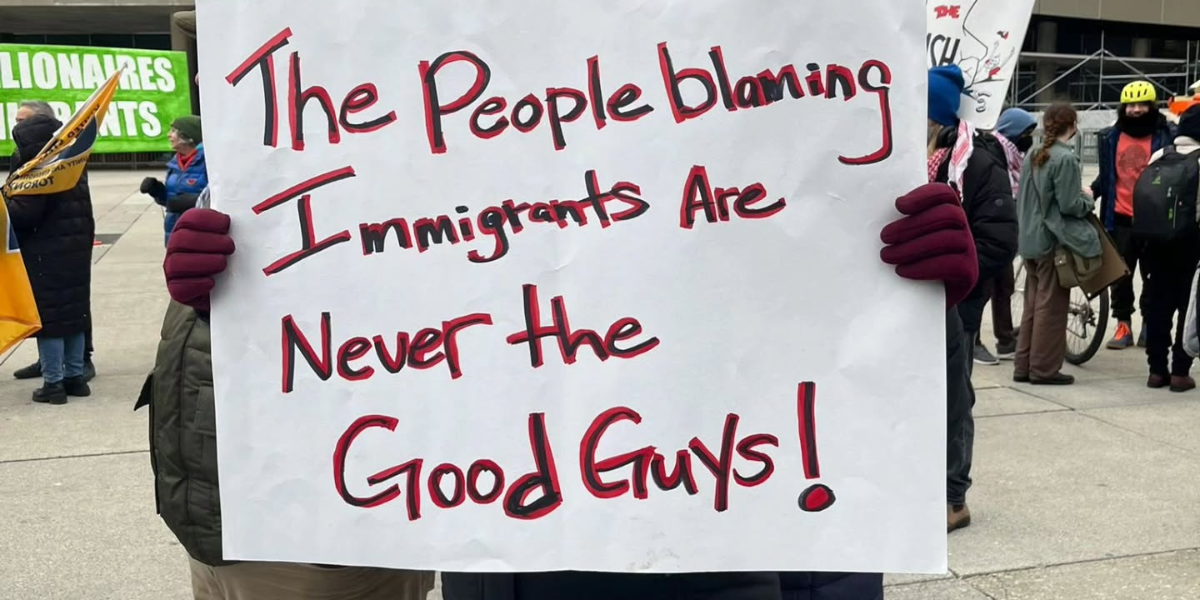
As we organize on the micro and macro levels, signaling that white supremacy is not welcome in our neighbourhoods is as critical as ever. We once again encourage everyone to post Spring’s Blame Billionaires, Not Immigrants posters around your neighbourhood and greater community. Through anger and grief, we must stay grounded in creating connections to the community out of love and care.
Author

Did you like this article? Help us produce more like it by donating $1, $2, or $5. Donate