
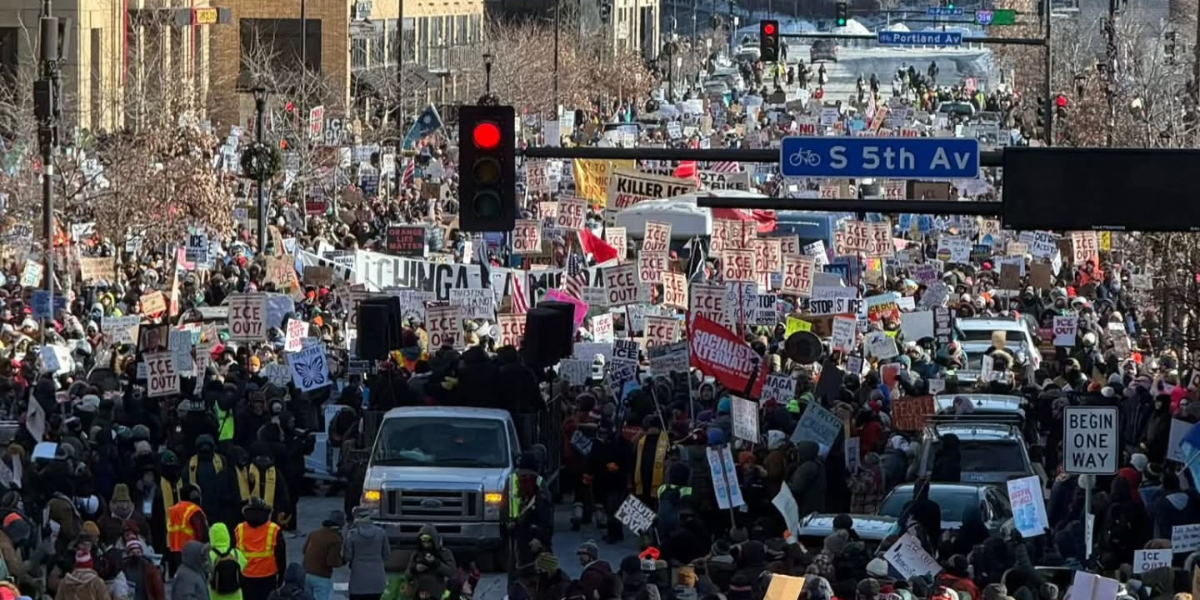
Two shutdowns against ICE organized by Minnesota labour unions and student groups shook the United States in January. These protests came about after the killings of Renée Good and Alex Pretti, a legal observer and a nurse respectively, by federal ICE officers during Operation Metro Surge in Minnesota. Six people have been killed by ICE since the beginning of the year.
Spring sat down with two organizers involved in the shutdowns, Aminah Sheikh and Dan Troccoli, to talk about ICE, the political climate in Minnesota, and the potential for a general strike.
Aminah Sheikh is an elected member of the Steering Committee of the Twin Cities Democratic Socialists of America. Her experiences as a union member at York University and the fight for pay equity for temporary workers led her towards socialism. Her experiences as a Muslim also led to her belief in socialized health care and education. She supports the DSA because they are the largest socialist organization in the U.S.A., and are always growing and organizing. Within the DSA, Sheikh participates in the National Afro Socialists and Socialists of Color Caucus and International Committee.
Dan Troccoli is a Twin Cities DSA Labor branch co-chair, as well as a steward and rank-and-file member leader with Minneapolis Federation of Educators Local 59. He was also a Twin Cities DSA delegate to the January 23rd planning committee.
We know that there were too many other groups involved in organizing the strikes to list them all, but who, in your estimation, played the biggest roles?
Aminah Sheikh: The biggest roles were played by the unions themselves, like SEIU Local 26, Unite Here 17, Amalgamated Transit Union 1005, Minneapolis Federation of Teachers, St. Paul Federation of Teachers, and Trader Joe’s United—but also we saw the meaningful impact of the Minnesota Federation of Labor. This is why January 23rd was so successful. You saw about 100,000 people taking part in various direct actions including the protest that all happened during working hours. I think you cannot belittle the fact that it was during working hours. Many non-union workers approached their managers and bosses to tell them they are not reporting to work.
Can you speak to the spontaneity and grassroots aspect of the response to the killings of both Renée Good and Alex Pretti?
AS: I would say it wasn’t spontaneous. It had been culminating from the pandemic, the killing of George Floyd, the hyper alienation and surveillance by the state. So, the events rapidly unfolding here were not spontaneous but actually developed into possibilities of struggle. Class struggle is part of the struggles currently manifesting. The workplace will always be central, because we have not abolished work, so as the state continues to terrorize people through ICE and DHS it is deliberately using workplaces, public places, to enact this terror. It is so the bourgeois remind people that they have nothing, own nothing and that they are owned.
Some Black radicals have even been likening the ICE patrols to slave patrols. Black and Native people living here understand fully well what it is happening, and their struggle is linked to all the resistance happening here. Native people here live in the major cities, and Minneapolis is the home to the largest urban native community in America. This is the birthplace of the American Indian Movement that, like the Black Power movement, fought the United States government through food programs, education, community centred work, and of course demands for landback, reparations, and more. These movements were anti-capitalist, and these communities are the antithesis of the vulgarity of capitalism. That is why I believe none of this is spontaneous, neither the response to the terror or the Trump administration’s use of terror itself.
This is a test—a structure test, as organizers call it—to see where the working people are at. So I think we have to go beyond talking about “non-union” or “union,” because the reality on the ground for millions of workers is bleak in America. There are very few workers’ rights enforcement mechanisms for non-union workers, who are the majority of the work force in America. America is a dictatorship of CEOs, billionaires and oligarchs. So, this moment in history is about going beyond systems that simply don’t work for the majority of people living in this country. Moreover, the murders of Renée Good and, after the strike, of Alex Pretti prove that there are no rules for the rich.
What reaction have people had to government officials claiming that Renée Good and Alex Pretti were threats to ICE officers? All of the following have claimed this in one way or another: Stephen Miller, Kash Patel, Kristi Noem, Pam Bondi, Bill Essayli, and Randy Fine.
Dan Troccoli: Anger and outrage of course. Even people that haven’t participated in rapid response are furious. The feeling is palpable here and all across the country.
What was the general feeling felt by the public in Minnesota after the January 23rd march?
DT: Elation and newfound awareness of our strength and power, which was followed by a mix of shock and horror after Alex Pretti’s killing, but also by determination. It’s not often that ordinary people witness such brutality like the murders of Renée and Alex and not only continue the fight, but show increased participation, both numerically and qualitatively.
It seems like Trump is going to de-escalate the situation now, and has called both killings “terrible” (while at the same time maintaining that Pretti was carrying a gun). What role do you believe the shutdown played in changing government response, and will it go beyond simple lip service?
DT: The January 23rd strike was pivotal in shifting the narrative. Of course, Alex Pretti’s murder did as well, but without the action the day before the mood would likely have been more one of demoralization. Instead, Minnesotans are that much more committed to struggling for justice.
In an interview with Socialist Worker, you (Aminah Sheikh) mentioned that the DSA is attempting to build towards a general strike. Can you tell us more about these efforts?
AS: We need to be willing to defy the law. Strikes like the recent wave of teacher strikes in America before the pandemic and strikes around the world were deemed illegal and threatened by the corporate state as illegal. So we can’t allow the logic of business unionism to guide our imagination of what a general strike looks like.
However, does it take a lot of work to get there? Absolutely. I saw January 23rd as a structure test, to see where the working class is. What are they ready for? Do they understand what a general strike is? I would say they do, but they need to be led into it, and they can be if the rank-and-file from large unions lead. That’s where January 23rd did benefit from local unions leading the way, but they deliberated and chose to tell members to participate but use their own vacation days, or schools and businesses shut down. That’s great—we want them on our side—and if we can get them to shut down, that’s great.
It’s obviously not going to look the same everywhere. We saw large scale strikes in Italy recently, in India in the pandemic. We also have seen so many teacher strikes, and the nurses on strike in New York City. So the strike is a weapon, it’s a tactic, and we need to be using it more. We will always have the nay sayers, the powerful in institutions telling us it is not possible. We know when strikes happened there were always those working for the opposing side to sedate our movements, co-opt them and purge out the radicals. We need to reject those politics, we need clarity.
We hope the DSA can bring back the energy for another strike day (or days). We have an event coming up to debrief January 23rd. We also have our labor branch in the DSA that is committed to organizing rank-and-file and non-union workers to push for more direct actions in the workplace and to plan for another general strike. Our chapter is leading and since then many other chapters have come to learn from our fight. Internally there is tons of debate around different tactics, and I would say we are committed to a variety.
But we can’t just do a corporate campaign and mobilizations for the tyranny to end. Whether ICE claims to leave, we know they have not left, and the terror will not end. Things are getting worse, not better. So we can’t just ask for modest reforms. We did that through the pandemic, where the government found “our money” in EI funds etc, and gave people funds to eat and live. We saw that they enacted some temporary rent eviction laws, but nothing sustained itself, and it actually got worse afterwards. People are working all the time, the cost of everything never declined, no one actually raised wages. The young worker owns nothing, lives in debt, precarity, shifting between jobs in the service economy and really the National Labor Relations Board is a weak body with very little enforcement power. So, in order for us to make gains and shift the structure, we have to use the tactic of the strike—a general strike like we saw in the past.
We saw during the Civil Rights Movement that strikes were part of the tactics—the organizing of ordinary people was part of the work. In order for people to actually take control and make real change, they have to go beyond weekend protests, social media campaigns, influencer culture, and unsustainable corporate boycotts. We need workers to withdraw their labor to actually stop business as usual. Ordinary people have to be the centre of their own freedom: they have to take the risk, they have to be involved, they have to wage the class battle. We can no longer forgo the option to strike; the strike has to be something we work towards.
DT: We are focusing on building a workers’ assembly of people from unions, neighborhood rapid response groups, and activists on February 15th to discuss next steps and another potential mass strike on Friday the 27th. The people of the Twin Cities have shown a tremendous capacity to show up day in and day out to dog ICE and keep the pressure on. I’ve no doubt we can outlast them, but a question lingers about where do we go from here? How much more abuse and lawlessness can we take from the president? As we witness his rise to fascist demagoguery we have to ask ourselves when is the right time to stand up. If we don’t take that step now we may not be able to in the future.
Author

Did you like this article? Help us produce more like it by donating $1, $2, or $5. Donate