
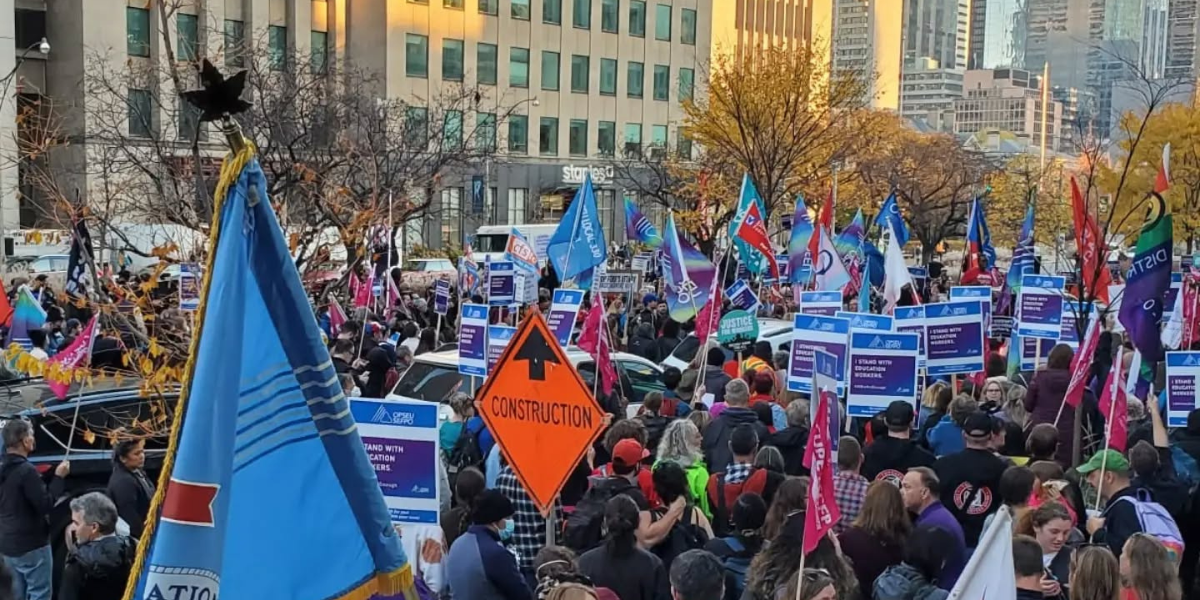
Alberta’s teachers stand at a fork in the road, between accepting a forced deal after being legislated back-to-work and a potential general strike as hinted at by AFL president Gil McGowan. Which way forward and what could tip the balance? The Alberta teachers strike saw massive support for a fightback against the provincial government’s underfunding of education. In June, roughly 39,000 members of the 51,000 members of the Alberta Teachers’s Association (ATA) voted 94.5 percent in favour of strike action.
The main issues in bargaining have been wages, improved conditions in schools, and teachers wanting a manageable workload. When it comes to wages, inflation in Alberta has risen approximately 21 percent since 2019. The ATA says that over that time they’ve wages have only risen by about 3.8 percent. So what they want is some kind of legal mechanism written, like a student-teacher ratio or class size or complexity cap. And the Alberta government has refused to talk about it, saying the ATA has been very inflexible on this point. Alberta also has the highest level of public investment in private education, as the government has funded “school choice,” giving tax breaks to parents that take their students out of the public school system.
The teachers have twice voted down tentative agreements that Danielle Smith has touted as generous; claiming that teachers would be getting a 12 percent wage increase. However the devil is in the details. The numbers she’s quoting are for teachers who have six years of post-secondary education. And that is not most teachers. As well, there are 61 school boards in Alberta that have 61 different salary grids. In an attempt to move to a unified grid based on the Grand Prairie School Board’s grid, there are some teachers that would see a 5 percent increase, while others would get zero. There are also real doubts about the promise of 3,000 extra teachers and 1500 educational assistants by the government’s offer, considering there are 3,000 schools across Alberta.
Ontario’s Bill 28 fight
In this context it is worth remembering the 2022 CUPE education workers strike. The strike involved 55,000 education workers represented by CUPE’s OSBCU and led by then president Laura Walton, Over the previous two years, inspired by Jane McAlevy and some of the public sector strikes in the US, the education workers’ took a systematic approach to engaging, organizing, and mobilizing their members. This produced a record-breaking strike mandate vote in early October 2022, 96.5 percent in favouir with an 83 percent turnout.
With a month-long runway to a potential strike against the anti-education premier Doug Ford, socialists and far-sighted activists worked to build solidarity amongst parents and community to increase the public pressure on Ford and make the workers confident to take on whatever came their way. Outside the union, Justice for Workers (J4W) launched an impressive solidarity campaign, including numerous calls to “paint the province purple,” which created opportunities for trade unionists, non-union workers and parents to build support for education workers in their workplaces and communities. Across the province, people were adopting local schools and covering the area with posters of support and purple ribbons to show their support for the education workers. Parents used pick up and drop off to sign up others to pledge their support.
In the same spirit, the Ontario Parent Action Network (OPAN) began to organize supportive parents and pushed back on Education Minister Stephen Lecce’s attempts to pit students and their families against education workers. These initiatives, coupled with the union’s success in bargaining for the public good, produced a wave of support for education workers that swept the province. By the time they went on strike on November 4, the public was firmly in their corner.
Ford and Lecce’s introduction of Bill 28, the so-called Keeping Students in Class Act, became a rallying point. Similar to Danielle Smith’s back-to-work legislation, the Bill imposed a concessionary contract on the lowest-paid workers in Ontario’s education system, it stripped them of their right to strike and invoked Section 33 of the Canadian Charter of Rights and Freedoms (the notwithstanding clause) to prevent any challenge to the bill, to criminalize all strike activity, and to override rights protected in Ontario’s Labour Relations Act and the Ontario Human Rights Code. Ford assumed he would get no backlash from labour, but he was dead wrong.
From backlash to escalation
The backlash was immediate. Within hours of Bill 28’s introduction on October 31, the Ontario Federation of Labour (OFL) launched its “Hands Off Workers’ Rights” campaign and called an emergency rally for the next day at the Ministry of Labour in downtown Toronto. Almost 4,000 people turned up, giving confidence to labour’s most progressive leaders to push for an escalation. The rally marched to Queen’s Park where thousands chanted for Ford and Lecce to resign.
The ONDP Caucus joined the rally and march, gave speeches at the Ministry and at Queen’s Park (from the back of a pick-up truck), and fuelled protesters’ demands. The next day, they called Ford a liar in Question Period and, one by one, were kicked out of the Assembly. You got the feeling that a real movement was growing in anger against Ford.
Throughout the week, thousands joined online and in-person events to support education workers: almost 600 people participated in a J4W phone zap; tens of thousands sent emails to Tory MPPs (over 75,000 on CUPE’s Don’t Be a Bully campaign alone); and hundreds of parents and students rallied outside a downtown Toronto hotel on the eve of the strike.
On Thursday, Ford’s Bill 28 passed, although Ford was conspicuously absent for the vote.
Despite Ford and Lecce’s attempt to intimidate and threaten education workers, their walk-out on Friday was massive: 126 active picket lines, including over 10,000 people at Queen’s Park and tens of thousands in dozens of communities across the province. Parents, students, teachers, and other trade unionists flooded the lines throughout the day.
OPSEU, the largest public sector union in Ontario, sent a letter to its 8,000 members in the education sector, encouraging them to walk off the job and join CUPE’s pickets. OPSEU’s move led to the closure of schools that initially tried to stay open despite the strike.
General strike
The groundswell of support was growing rapidly, both among the wider public and within Ontario’s unions, where rank-and-file members were calling on their leaders to join the strike. The pressure was so intense that the OFL Executive Board (its main decision-making body) held an emergency meeting on Saturday morning where it voted unanimously to call a mass protest at Queen’s Park on Saturday, November 12 and to launch an indefinite general strike on Monday, November 14.Immediately after the vote, labour leaders rushed to “Solidarity Saturday” actions, including one at Yonge-Dundas Square in downtown Toronto where hundreds of protesters occupied the intersection.Hours later, a strike planning committee met to organize actions over the next two weeks. Word of the vote was already leaking on Twitter and Reddit and #GeneralStrikeON was trending upwards all day.
OFL affiliates, including the teachers’ unions, began calling emergency meetings to discuss or vote on joining the strike. Hundreds of CUPE staff representatives joined a conference call to prepare locals–in every sector of the union, not just school boards–to discuss the possibility of walk-outs on Monday. The leadership assured members that the union would protect them from any fines. Commitments to strike immediately came from large locals in the post-secondary and municipal sectors. Unifor made public a letter it sent to Ford’s office, hinting at wildcats by its members in the auto sector.
Backpedaling
Ford announced that he would have a press conference on the Monday before the CUPE presser. By the time Ford spoke, it was clear he had been disciplined. His tone was conciliatory and he said Bill 28 would be repealed, but only if education workers called off their strike. The threat of united action and the solidarity in the community forced Ford to back down. The bill was repealed and no one was punished for Friday’s “illegal strike”, which was no longer illegal thanks to the threat of a general strike.
The leverage that the Ontario workers held in that moment was unprecedented. It forced a massive retreat from an anti-education premier and set the stage for him to quickly settle agreements with the other education unions. It showed a number of things: community solidarity is vital, bad leaders can be defeated outside of elections, illegal strikes are only illegal if you lose and existential threats to labour can be stopped, but they have to be done in the streets and workplaces, not the courts.
Alberta’s labour movement can defeat Smith’s attacks if they learn the lessons from Ontario’s education strike. When workers have the confidence to take job action despite threats, when unions are united to defend the rights of all workers, and when board based community support is organized, workers are unstoppable.
Author

Did you like this article? Help us produce more like it by donating $1, $2, or $5. Donate