
This is the second in a two-part series on the developing situation in Venezuela, following the Jan. 3 kidnapping of President Nicolás Maduro and his wife Cilia Flores, first lady and former president of the National Assembly. The previous article looked at the historical context of Venezuela’s challenge to capitalism, and this article considers what could arise from the present moment.
The current situation in Venezuela is extremely fluid. The balance of forces—between Trump’s Donroe doctrine, Venezuela’s largely intact government under interim president Delcy Rodríguez, right-wing opposition to the government both from outside (spearheaded by María Corina Machado) and within the country, plus resolute left-wing opposition—is unclear.
If we are to take President Trump at his word when he claimed the U.S. would “run the country,” then there are at least three broad possibilities, logically speaking: 1) direct U.S. military occupation of Venezuelan soil, 2) installation of a puppet regime subordinate to U.S. directives, and 3) a mere extension of long-established U.S. imperialism in the region.
These have different implications for the left, and leave at least some room for hope.
“Boots on the ground”
The first and most extreme option may seem unlikely, but it is certainly not impossible. While Trump insists that the “boots on the ground” approach remains an option, he would face significant opposition. The obvious failures of the U.S. “War on Terror” have led segments of Trump’s base to reject military exploits that have (as always) disproportionately taken working-class lives. Moreover, forced regime change has proven so disastrous that even some hawkish liberal elites now disapprove.
Socialists need to build on this opposition. With Trump still threatening military action against Cuba, Mexico, Iran, and Greenland, those of us in imperialist countries must revive the powerful anti-war movement that swelled against the 2003 invasion of Iraq—including a labour-, anti-racist, and anti-war coalition that successfully prevented Canada from joining the “coalition of the willing.”
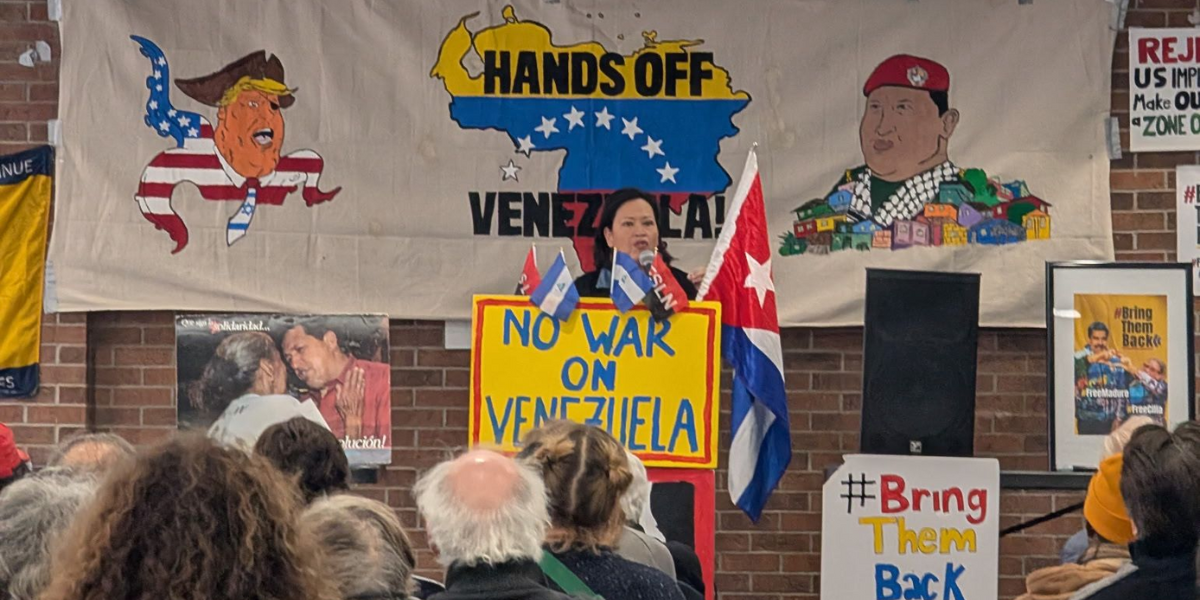
The ever-widening pro-Palestine movement against Israeli and U.S. war crimes is a powerful foundation upon which we can build. Indeed, at a recent rally of hundreds called by the Venezuela Solidarity Coalition who gathered in Toronto on mere hours’ notice, speakers included those from the Palestinian Youth Movement, Labour for Palestine, and Latinx for Palestine. They emphasized Canadian military complicity in the attacks on Gaza and Caracas, the universal quest of capitalists for absolute control over workers, and how methods of surveillance and repression aimed against supporters of Palestine are being generalized to everyone who resists the system.
No puppet regime yet
The second option, interestingly, does not seem to be in motion either. To the shock of many, Trump declined to endorse María Corina Machado as leader. Trump (perhaps also feeling slighted by her winning the Nobel Peace Prize that he so covets) seemed aware of an important reality: she has very little support within Venezuela. Hence installing her would likely require a bloody, costly, unpredictable military engagement to prop up the new government. Instead, likely in the interest of stability, Trump and Rodríguez appear quite willing to cooperate.
However, those familiar with Venezuela’s history should not blindly accept Trump’s boast that Rodríguez is passively submitting to U.S. control. Her bland promise to promote an “agenda of cooperation” and “shared development within the framework of international law” is about as much as one could expect at this point—and her apparent collusion in Maduro’s removal doesn’t necessarily signal abandonment of her socialist roots. It has been obvious for a while that 1) Maduro would remain unpopular domestically, 2) Trump would refuse any concessions to his longtime foe, and yet 3) the country desperately needed better economic prospects—which required something precisely like the deal that Rodríguez has just struck, and which Maduro had already offered.
Rodríguez’s government is in a highly precarious position, insofar as it must navigate two contending forces. On the one hand, the shameless kidnapping of Venezuela’s leaders represents the apex of coercive imperialist forces that have long besieged and contributed to the demise of Venezuela’s 21st-century socialism. The only difference is that these forces can now exert an even stronger rightward pull. On the other hand, Venezuelans’ overwhelming distaste for Maduro does not equate to a desire for a reactionary return to neoliberalism. Regaining mass support, in the face of an emboldened rightwing opposition, depends on reconnecting with Chávez’s project.
It must be stressed that leftist opposition to the Maduro government is far more complex than most commentators realize. Socialists know that change requires not only “subjective” factors (e.g. the level of people’s political consciousness and the strength of working-class organizations), but also “objective” factors (e.g. commodity prices, war, and whether capitalism is in crisis). The latter changed significantly over the course of Chávez’s and Maduro’s governments. Most significantly, plummeting oil prices—on which Venezuela’s economy, and hence Chávez’s project, depended almost entirely—spelled disaster.
Another factor is the continent’s highly volatile left-right split. At the moment, the left tide includes several regional powerhouses: Mexico, Colombia, and Brazil (which kicked out Trump’s far-right crony Jair Bolsonaro). But Chile, Honduras, and Argentina have turned sharply right (in the latter cases after strong pressure from Trump).
These pendulum swings represent longstanding left-right dynamics. Most people prefer policies that improve average people’s lives. But when leftist leaders espousing this platform get elected and then fall short—for reasons both within and beyond their control—the same people turn to right-wing leaders who blame immigrants (in these cases, often from Venezuela) and promise change.
Additionally, aggression against Venezuela is itself a sign of weakness. Trump’s tariffs and erratic foreign policy shifts, especially around Ukraine, has increasingly alienated formerly unshakeable U.S. allies. The rebranding of the Monroe Doctrine into the “Donroe Doctrine” reveals that the U.S. empire is actually in decline: it is a retreat from the global stage where American domination once appeared impregnable.
A new leader, however ensconced Rodríguez is in the old administration, represents a fresh opportunity for the Venezuelan left to gather its forces. The brazenness of the U.S. kidnapping might be so appalling that it could have a unifying effect—not in favor of Maduro, but against foreign imperialism. One could even imagine knock-on effects throughout Latin America, which is already undertaking economic reorientation towards China and Europe, while strengthening regional trade agreements.
Socialists around the world must reiterate this message in the strongest possible terms, by communicating that the world stands behind Venezuelan self-determination. We must redouble our efforts to prevent our own governments from complicity with U.S. imperialism, so as to weaken the objective factors that thwarted Venezuela’s historic endeavor to transition out of capitalism.
50 million barrels of oil
The final option is for the U.S. to simply resume “business as usual”—just in a particularly draconian fashion. Indeed, the clearest picture so far of the Trump administration’s plans came from U.S. Secretary of State Marco Rubio’s presentation (during a private meeting of the Senate) of a three-step strategy for stabilization, recovery, and transition.
Stabilization hinges on controlling the money from sales of 50 million barrels of oil, which the U.S. has effectively seized already. Recovery will amount to foreign investors gaining market access to a U.S.-controlled oil industry, alongside amnesty and release for political prisoners. As for transition, Rubio purported that it would be led by the Venezuelan people, but provided no details.
This suggests that Trump’s proclaiming he would “run the country” is mostly bluster (in line with his penchant for self-aggrandizement and spectacle). Having asserted his plan to control the oil industry, that might be as far as his intentions go.
His proposal for Venezuela is consistent with his approaches to other major conflicts. In Ukraine, he made a deal for privileged access to minerals, followed by a push for free-trade agreements and a demilitarized “free economic zone.” In Gaza, his 20-point plan includes a “special economic zone” granting preferential access and tariffs, alongside his son-in-law’s dream of turning it into a high-tech luxury resort. In effect, Trump is personally more interested in making lucrative business deals than he is ideologically driven toward system change, unlike others around him.
But profiting off Venezuela will not be straightforward. Though Venezuela’s oil reserves are the world’s largest, the crude is costly to refine. Renovating infrastructure takes time and tremendous sums of money. Large investors are already balking at assuming such risks under unpredictable conditions. And oil prices are falling, alongside expanding efforts to generate climate-friendly sustainable energy.
Again, this takeover is in some ways exactly what Maduro’s government was already asking the U.S. to do (and one reason the left felt betrayed by him). In effect, it is an abatement of the near-total blockade that has strangled Venezuela’s economy. Thus, at least for a while, foreign investment is likely to provide some relief for the bitterly suffering Venezuelans who remain in the country.
If they can find some respite from their desperate situation, Venezuela’s working class might recover enough strength to resume a challenge against both their authoritarian leaders and their imperialist oppressors. We might adopt a stance of what could be called “critical sympathy” for the government: something less than support, but an attitude of solidaristic understanding coming from hope that their socialist project is not forgotten. This would not justify Maduro’s actions but contextualize them in relation to the underemphasized fact that U.S. interference has crushed his government’s every effort to salvage its economy.
Indeed, with more breathing room, it is conceivable that Rodríguez could lessen the repression against leftists who disagreed with the conciliatory measures that Maduro’s defenders argued were necessary for economic rescue. An economy on the mend, in turn, could revive the participatory democracy that originally bolstered Hugo Chávez’s popularity, and enable greater defense against reactionary forces—inside and outside the country—that have unrelentingly attacked the country’s attempt at 21st-century socialism.
At present, this is nothing more than a hope. Yet it is a necessary hope, located not in world leaders but in Venezuela’s working and oppressed classes, whose memory and experience of transformative struggle runs deeper than most. They know firsthand that their own collective power—if they can muster it—is the one thing that can actually better their lives.
To reiterate, our role as socialists is to nurture Venezuela’s struggle against imperialism by building our own collective power against our own capitalists and complicit governments. We must demonstrate clearly that the masses reject war and neoliberalism; that organized labour and community-led social movements can win; and that we should blame billionaires and not immigrants. By doing so, we can strengthen the subjective factors that the Venezuelan people need to find their way back to democracy and socialist liberation.
Author

Did you like this article? Help us produce more like it by donating $1, $2, or $5. Donate