
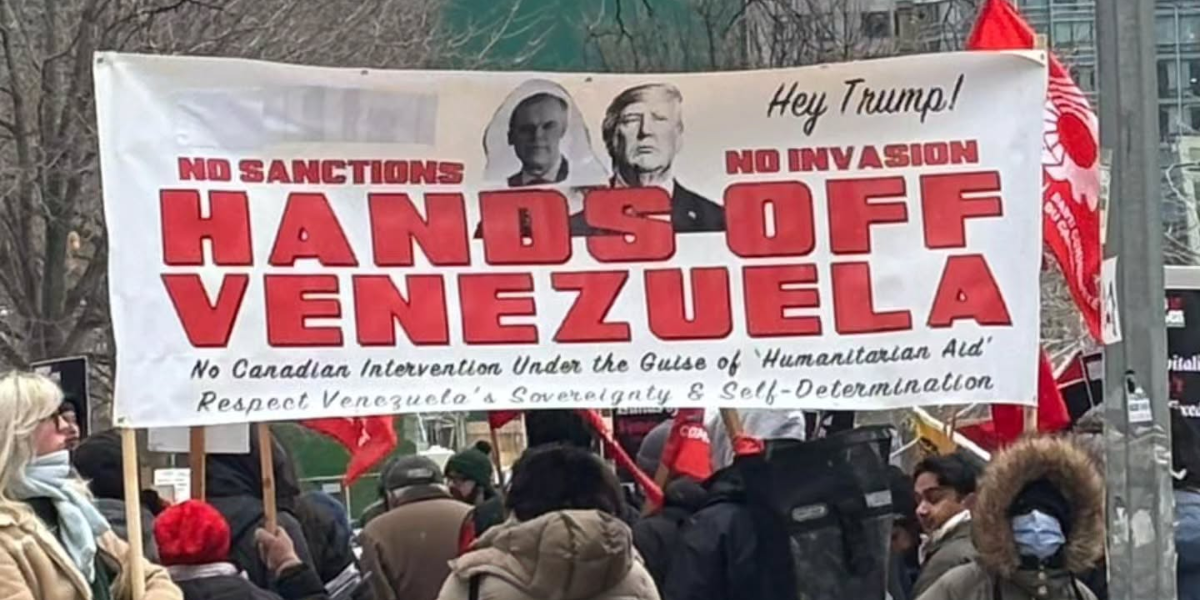
This is the first in a two-part series on the developing situation in Venezuela, following the Jan. 3 kidnapping of President Nicolás Maduro and his wife Cilia Flores, first lady and former president of the National Assembly. This article provides historical background on Venezuela’s decades-long challenge to capitalism, and the next article examines the current moment.
Donald Trump’s internationally condemned January 3rd kidnapping of Venezuelan President Nicolás Maduro and former President of the National Assembly Cilia Flores was followed by a stream of outrageous statements—chief among them, his naked admission that the purpose of the attack was to establish U.S. control over a sovereign nation by plundering its resources. Other U.S. presidents, while acting no differently, have been loath to admit this. “We are going to run the country,” he declared.
Meanwhile, Maduro is so universally unpopular that even some on the left have greeted his removal with relief—though the right wing celebrations featured prominently in the international media are only to be expected. But revolutionary socialists know that this focus on the two leaders, however crucial, misses something even more important.
Ultimately, the fate of the country lies not in their hands. It will be decided by the Venezuelan people—specifically, its working and oppressed classes, alongside those around the world.
The long memory of Latin America and the Caribbean
Before jumping into an analysis of current events, we must reckon with the powerful history of Latin American and Caribbean resistance to foreign domination. For a vivid and accessible introduction, and for all its weaknesses, one could do worse than to pick up Eduardo Galeano’s classic Open Veins of Latin America, which Hugo Chávez once gifted former U.S. President Obama. For five centuries, Europe and North America have subjugated the peoples of Latin America in order to loot their resources. First through outright colonization, and later via more indirect mechanisms of imperialism, such as: exhausting the soil through monocropping, sanctions and other economic interference, inciting and funding military coups with money and weapons, and even assassinations.
Bolivia, Chile, Colombia, Brazil, Peru, Guatemala, Honduras, Panama, El Salvador, Haiti, Antigua, and so on—indeed, the entire continent—have been stripped of their copper, tin, gold, silver, and minerals (even guano, otherwise known as bird poop); and they have been pressured to sell bananas, cacao, rubber, coffee, and sugar at the expense of growing their own food.
What this means is that Latin Americans understand their economies, like those everywhere in the global South, to be shackled to the whims of U.S. and European-dominated markets. When a country’s export commodities fetch high prices, its industries boom and its cities explode in size. But when prices fall, jobs disappear and populations plummet.
Venezuela is no exception, and unlikely to have forgotten this past.
Chavismo: Venezuela’s challenge to capitalism
Why are North American imperialists—here we must include Canada—so fixated on Venezuela, when all evidence shows it is at best a minor player in regional drug trafficking? Actually, the U.S. is a far bigger druglord.
Because Venezuela, like Cuba, is one of the countries that has come closest to driving out capitalism. Venezuela showed the world, again, that socialism is possible. Now, as before with Cuba, and like a big neighborhood bully, the U.S. is trying to bring Venezuela to its knees.
In this, the U.S. is backed by a global gang of capitalist states, who have together long ensured that socialism cannot survive in one country alone. Canada has been a prominent sidekick, as co-founder and de facto leader of the Lima Group, an international body formed specifically to confront the Venezuelan government.
But Venezuelans have been here before, more than once. In 2002, hundreds of thousands of Venezuelans defended Hugo Chávez’s government against a U.S.-backed attempt at a military coup, which they reversed in 47 hours. In 2019, opposition figure Juan Guaidó—whose leadership was in part facilitated by Canadian diplomats—proclaimed himself president, and was immediately recognized by the first Trump administration and many of its allies. But Guaidó’s attempt to oust Maduro, which included a brief military uprising, ended in ignominious failure.
At its best, Chavismo (a moniker for the political project that Chávez dubbed the “Bolivarian Revolution” and then “21st-century socialism”) was a true challenge to capitalism, grounded in the understanding that socialist liberation must be carried out from below—which Chávez recognized was key to his own popularity.
Probably the most emblematic success of 21st-century socialism is Venezuela’s communal councils. These were decentralized neighborhood-based organizations, typically of 200-400 families (fewer for rural and indigenous councils), that received direct public funding for community projects, which itself could be further granted or loaned by the council. Projects were researched, debated, ratified, administered, and independently monitored by the teams of residents themselves, rather than the Chávez government.
Yet communal councils were preceded by and sometimes co-existed with social missions (highly accessible health, education, and food programs); Urban Land Committees (associations for legalizing squatter homes), and worker cooperatives. Without idealizing its results, it’s no exaggeration to say that Chavismo was a living laboratory of experiments in participatory democracy and socialist transition.
Concretely, the Chávez government cut poverty by a third, eliminated illiteracy, and sharply reduced homelessness. Unfortunately, however, these successes relied on an oil-based economy: a dependence the government never managed to overcome. After Chávez died, corruption mushroomed. And when oil prices crashed, the government became increasingly authoritarian.
For reasons both internal and external to the country, 21st-century socialism—on which left opinion remains divided—is barely limping along. Its gains have effectively been wiped out, and Venezuela’s misery is weaponised to frighten people away from socialism.
But is 21st-century socialism dead? Yes, Maduro and his corrupt, authoritarian regime are profoundly and rightly despised. Still, for all that, is he more despicable than U.S. imperialism?
Hope lies in the masses
As socialists, we know that people are transformed by first-hand experience of collective struggle—most decisively so, when their demonstrations, campaigns, and projects successfully produce felt changes in daily life.
Thanks to 21st-century socialism, Venezuelans have tasted more of this collective power, and more recently, than the majority of people in the world. It is hard to believe that they have forgotten or no longer desire it. And even setting Maduro aside, anti-imperialism runs deep in the bones of the continent’s peoples.
All of this is to say that we should not underestimate what masses of ordinary people, organized in solidarity, can accomplish even in the face of terrible odds. It is not too much hope that Venezuelans can still rally themselves to beat back this latest capitalist assault, becoming once more an example to the world.
Author

Did you like this article? Help us produce more like it by donating $1, $2, or $5. Donate