
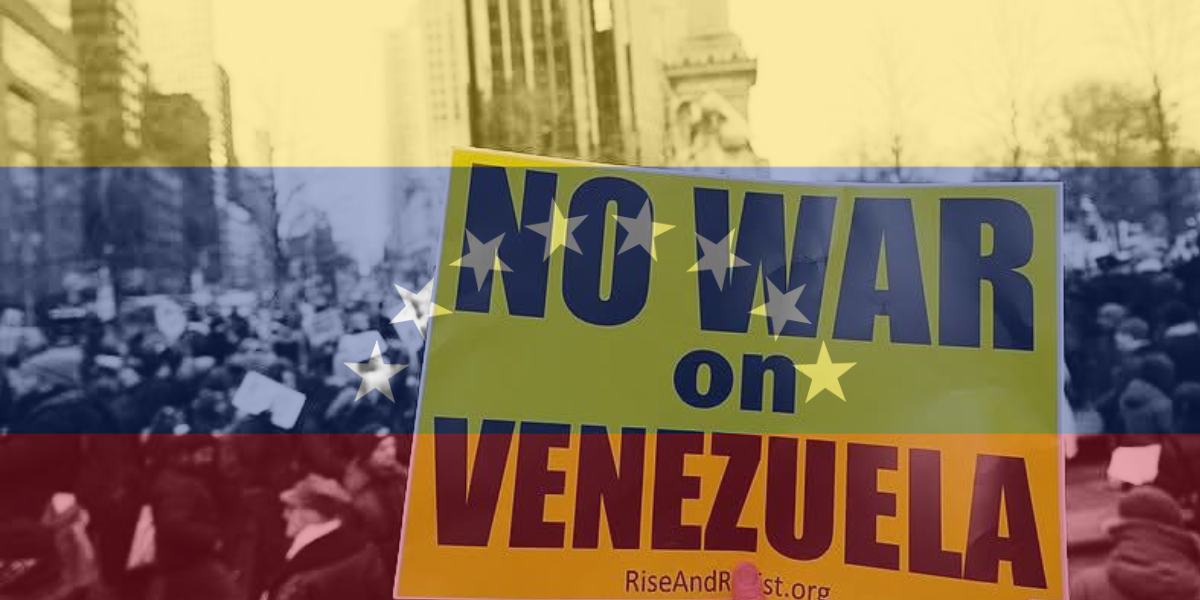
In the early hours of January 3rd, the United States of America attacked Caracas, kidnapping both Venezuelan President Nicolas Maduro and National Assembly deputy Cilia Flores, his wife. Both of them are presently detained in New York awaiting trials for “Narco-Terrorism Conspiracy, Cocaine Importation Conspiracy, Possession of Machineguns and Destructive Devices, and Conspiracy to Possess Machine Guns and Destructive Devices against the United States.”
In both their attempts to respond to events, Mark Carney and Anita Anand failed to reach even the low bar set by Nancy Pelosi, using many words to condemn the Venezuelan government while never addressing the breach of international law. As the U.S. attempts to remain the hegemonic global power, the rest of the Americas need solidarity.
Trump’s Corollary
In the closing weeks of 2025, Trump made two announcements. The latter, the end-of-the-year address, made in December, received much attention. Yet, the former, the release of the U.S. National Security Strategy two weeks earlier, received very little coverage. Although full of the usual Trump bluster, there are two major takeaways from the document: the Trump Corollary to the Monroe Doctrine and the tacit admission of the United States’s crumbling hegemony.
The Monroe Doctrine has long been the policy position used by the U.S. government to secure and expand its empire: from its inception in 1823, when the United States took a more defensive stance against European powers (most notably Britain and France), to Roosevelt’s corollary in 1904, formalizing American imperialism in Latin America. In the same vein as his tariffs, Trump’s Corollary is the amalgam of his bedtime stories of past Republican presidents and his last gasp at defibrillating the national economy. The section on the Western Hemisphere titled “Expand” reads,
“The United States must be preeminent in the Western Hemisphere as a condition of our security and prosperity—a condition that allows us to assert ourselves confidently where and when we need to in the region.”
Unlike past iterations of the Monroe Doctrine—and Trump’s hopes laid bare in the title of the section—this is not expansive, at least not in the ways that Trump hopes. With the United States’s poor economic projections and an increasing cost-of-living crisis as two issues that Trump cannot hide, no matter how many times he claims they’re not real (as he did in his end-of-year address), they are hoping that Latin America will be his solution. Although it may appear orthogonal to Venezuela, the National Security Statement’s references to China (or lack thereof) demonstrate that Trump is aware that the United States’s bully pulpit does not reverberate as far as it once had. To the dismay of many liberals, the National Security Statement appears soft on China, and they are correct to feel this way. They are mistaken, however, to see this as a mistake.
Unlike his predecessors, Trump recognizes that the American economy lacks the means to be the hegemonic power in Asia and is looking to assert power in the Western Hemisphere, closer to home, for self-preservation. Unfortunately, as outlined in the National Security Strategy, this means a more aggressive policy in the Americas against the ideological threats that reside in the West.
South America divided
Jacobin columnist Ben Burgis argues that this attack is tied to a broader assault on the left in Latin America; however, unlike Kissinger’s obsession with Salvador Allende, ideology is not the only cause. Resources are also a primary factor. Burgis understands this as well, citing the Venezuela and Iraq comparison in depth. Ideology and resources are connected in a dialectical sense: the United States desires resources, and countries like Venezuela, Cuba, Brazil, Colombia, and Mexico provide the greatest barrier to those resources because they refuse to genuflect to the U.S. The idea that ideology is the primary motivator is stuck in the memory of the pink tide. But the pink tide is simply that—a recent memory. Right-wing governments like the ones in Chile—now under the leadership of the Pinochet and Nazi apologist Joseph Antonio Kast— and El Salvador, under Bukele, remain more than willing to offer support to the U.S. Similarly, past allies on the left are fleeting: Bolivia is no longer a bastion of support since the Movement Toward Socialism’s (MAS) electoral loss last fall, and Colombia and Brazil remain powerless on their own to act beyond the rhetorical, even if Gustavo Petro’s response touches on Latin American solidarity.
The reality is that many of the left projects have failed. The Bolivian people became disenchanted with the economic situation resulting from sanctions, as well as party infighting and an inability to progress the movement beyond Evo Morales. Likewise, Chileans were left unimpressed by the second iteration of the left project under Boric, who was elected in 2021 and failed to meet many of the workers’ goals they set. The remaining Latin American left-leaning projects are only strong because they have the support of the people, while demonstrating an ability to push a workers’ agenda in earlier iterations, like the Brazilian Workers’ Party’s first stint in office. This is where the Bolivarian Revolution has had its greatest successes.
In an interview with Baskar Sankara, former Venezuelan diplomat Carlos Ron spoke about how greater worker control has been crucial to the revolution’s survival. This is the key and something that other governments must keep at the forefront. It is great that some left leaders remain popular, like Claudia Scheinbaum, but this doesn’t matter unless people on the ground feel that they have control over their material circumstances. This allows movements to get through downturns or challenges from abroad.
The United Front of the Americas
The responses to the attack from various leaders have been empty, at best. Those who deplore the attacks do so because they are against international law, which isn’t saying much; others, like Anita Anand’s and Mark Carney’s responses, hope for peace at the end of a gun and fail to acknowledge the lives lost in these attacks and the ones that occurred before 2025 turned to 2026. Implicit in these statements is the notion that they know what is best for the Venezuelan people. It is the same reasoning that guides Marco Rubio’s comments about whether the U.S. will control Venezuela: they believe they understand what Venezuelans need. They know nothing of the desires of the Venezuelan people— they choose to listen to Prince John rather than the townsfolk who benefit from Robin Hood’s bounty. I do not claim to know what the Venezuelan people want, but if the demonstrations in Caracas are any indication, it is not what occurred in the early hours of January 3rd.
In the hours following the attack, hundreds in Toronto showed up to protest at the U.S. Consulate. Despite the lack of notice, due to the spontaneity, support was there to show the warmongers in Washington that this would not stand. This sentiment is shared globally. As I wrote back in November, if we want to help the Venezuelan people, we must ensure that our government does not get involved. Moreover, we must do what we can to ensure that we support the people in Venezuela and that those in the U.S. who disagree with their government’s military action know they can rely on us for support. That is what it means to have solidarity.
Much remains unknown: will the U.S. take control of Venezuela? Regime change: is it afoot? Or is Jakarta closer to Caracas than anyone would think when looking at a map? What we do know is that the capitalist heart at the base of the American Empire is anxious, with good reason. The economy is suffering, and nothing they do will remedy the situation.
Solidarity doesn’t start when we are at risk. There is no on/off switch. We must move forward and ensure that across the Americas, people know where the workers of Canada stand: with the workers of the Americas and beyond. We are Venezuelan, we are Cuban, they are Canadian. Our struggles may be distinct, but they are united.
Hands off Venezuela!
Author

Did you like this article? Help us produce more like it by donating $1, $2, or $5. Donate