
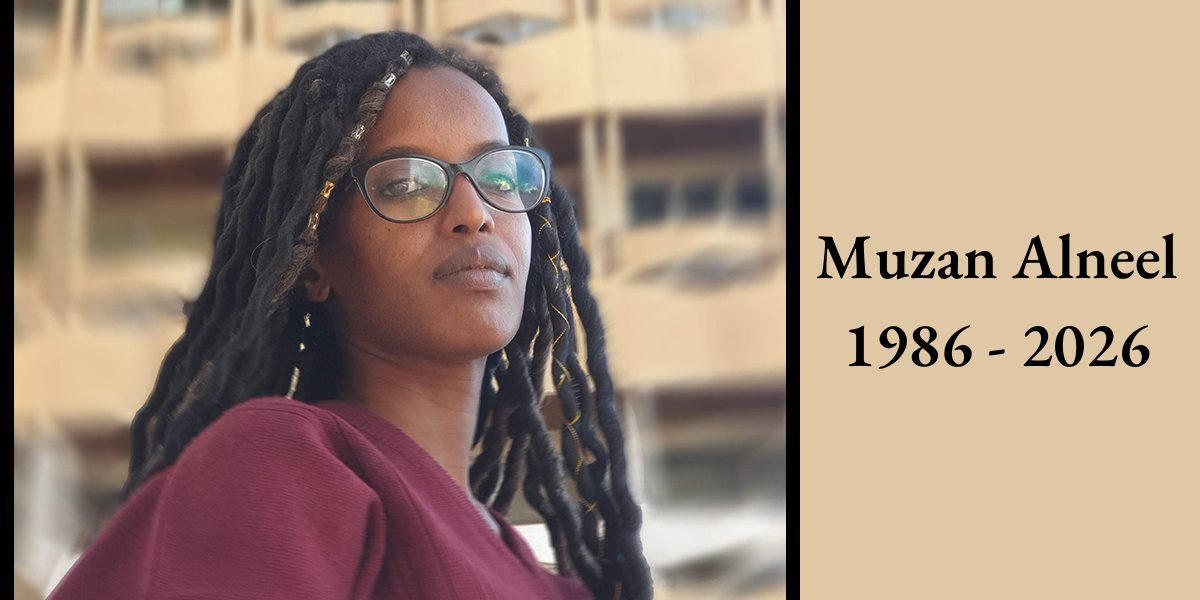
Due to their shared history, there are many links between the Egyptian and Sudanese peoples, including on the revolutionary left. So it is fitting that it was through an Egyptian activist living in London, UK, that our organization first learned about Sudanese activist Muzan Alneel as someone we should get to know.
Shortly after learning her name, I happened to be out for a walk with my Sudanese friend Iman and asked, “Now this might be a long shot, as there are 80 million Sudanese, but by any chance do you know the name Muzan Alneel?” Iman paused, then chuckled and replied, “I have known her since our youth.” And so it was that we in Spring were easily able to reach out to Muzan for information on the latest news about the Sudanese struggle, using revolutionary name-dropping if you will.
Revolutionary politics
While Egypt is well-known for its strong role in the Arab Spring (and for the brutal state suppression that followed), Sudan did not have an uprising during the Arab Spring. However, its militants were put to the test with the 2019 overthrow of the dictator Bashir, the subsequent establishment of shared government power, the formation of local Resistance Committees, and the tragic degeneration into civil war between the two main armed forces that rip the country apart to this day.
Muzan was in the thick of it all. Growing up in Khartoum, she began speaking out against injustice from an early age and never looked back. She had an interdisciplinary educational background in engineering, socioeconomics and public policy, and she was co-founder of the Innovation, Science and Technology Think Tank for People-Centred Development.
But it was her active engagement with revolutionary politics that helped her become a prolific writer and internationally sought-after speaker. She was able to sift through the on-the-ground complexities to deliver a clear analysis of the class forces at play, the failures of the traditional left in Sudan, and the need for revolutionary socialist organization in Sudan. Her death on April 15, 2026 at the age of only 39 is a huge loss for all of us.
Muzan gave generously of her time and experience with others involved in struggles around the world. She understood the necessity for international working class solidarity on all matters, including the need to support the Sudanese masses as they took on the military-dominated government. Her command of both Arabic and English meant she could perfectly share her analyses with many audiences around the world.
Her generosity included several engagements with Spring Magazine, with interviews, panel discussions, a podcast, and permission to republish articles she had written in Arabic that appeared in other publications.
The role of Revolutionary Committees
By December 2020 in Sudan, local Revolutionary Committees were pressing for fuller democracy and justice than what was on offer from the joint government of the military and the Forces for Freedom and Change (civilian professionals and some civic leaders). In this interview, Muzan stated:
The Revolutionary Committees — RCs — haven’t been able to form their own narrative yet. The RCs are created geographically so they are less able to have a single clear political set of interests to represent. They came together for the revolution in 2018 and 2019, but the situation got more sophisticated than they were able to deal with…We have a bad history with political parties, which makes the RCs wary of developing political stances.
But things are now changing. The RCs have been doing political education and economics education workshops…So it’s a good start but not sufficient, as they lack a political compass. They are spending a lot of energy not in the right place.
…We need to clarify our political stance and move away from just being “no to government” but “yes to something.”, i.e. the way is to strike not only so government listens but we should strike so we can show our economic power (and then government will listen).
Why we need to take power
On October 25, 2021, the Sudanese military staged a coup and took over complete control of the Sudanese government, with no further pretense of civilian participation. In March 2022, Muzan provided an analysis of resistance to the coup. She noted the positive evolution of the Resistance Committees exemplified by their ability to engage with local workers and communities to articulate — in documents called “Charters” — their vision of what a free and just Sudan would look like in both economic and political terms.
She stated:
There is more talk now on how to come together as coordinating bodies in and from different states… we should start working on local councils now and not wait for the national military to be overthrown…But once local bodies are created they will draw from the concept of “dual power.” We still see a lot of RCs and other opposition forces seeing resistance as a means of pressuring those in power, not as a means of taking power. This is the most important change of mind set that we need to achieve.
The need for revolutionary organization
But this cautious optimism would be thrown out when Sudan’s two main military forces – the Sudanese Armed Forces and the Rapid Support Forces – declared war on one another on April 15, 2023, sending the country into its current morass. More than eleven million people have been displaced, with an estimated 400,000 killed.
In this context, Muzan spoke on an episode of our Spring Radio podcast early in 2024, giving a clear-eyed description of the hopeless situation facing an unarmed and split resistance, with some members of the Resistance Committees going to fight for the Sudanese Armed Forces with the illusion of “fighting for the people.” As Muzan told us:
We’re not seeing, or at least I’m not seeing, the beginning of a revolutionary party. We were, I think we were much closer to that prior to the war than we are right now. We did see how the service provision actions that the Resistance Front took at the beginning of the war, it made the resistance more trustworthy to the people. Even, I would argue, there was a chance, and there still is a chance, although less right now, to build from that into a more solid imagination of these new forms of self-governance, and new forms of distribution of resources. But that did not happen. That did not happen because we did not have a revolutionary party that can theorize around that or allow the space to theorize around that because that’s the thing, right? Doing the work without a party will just consume you. And having a party without the work will make you sound like, you know, you’re on cloud nine, and no one is there to listen. So it needs to be both of them somehow, and it doesn’t seem like that is happening. I mean, the need for a Revolutionary Party is something that has been repeated again and again, and it couldn’t have been clearer than it is right now.
Tributes from Canada-based Sudanese activists
Since Muzan’s tragic death, a number of tributes have rolled in from those who knew her and are involved in the Sudanese struggle.
A participant at the April 16, 2026 tribute to Muzan in Toronto said:
The word “muzan” means cloud. Muzan’s name is like Muzan herself. Her Arabic name can be translated to “cloud(of rain) (over) the Nile” which, for us in Sudan, means hope and growth. And she represented that to all of us.
Duha Elmardi is a Montreal-based member of the Sudan Solidarity Collective and shared her thoughts with Spring:
One of the quiet violences of the war machine is its relentless effort to reshape narratives and retell history in ways that soften, obscure, or altogether erase the accountability of militias, states and empires. Against this tide, Muzan stood as a compass for so many of us. She called us back, again and again, to our responsibility: to hold fast to our collective memory, to refuse the erasure of past and ongoing injustices, and to speak them plainly, as she did. She reminds us that a radical imagination of a decolonial future is not a distant ideal or a luxury reserved for calmer and better times. Rather, it is a condition for survival. Muzan, Roya, Muna Jadelrab, and so many other brilliant revolutionary Sudanese women lit torches for us so that we might find our way forward. Like many of my peers and comrades, I carry deep gratitude for them. And I carry pain, knowing that in different ways, they were made to bear the cost of this work with their own bodies.
Toronto-based Dr. Iman Ahmed, who helped Spring get to know Muzan, said:
Muzan was a beacon and known by every generation. I’ve known her since she was a teenager and always looked up to her, even though she’s younger than I am. I echo the sentiment of my friends about her clarity of vision, bravery and unwavering commitment. She was like a shooting star but she leaves us with a lot if we can reflect on that and carry the torch forward.
Rest in power, dearest rafeqa/comrade Muzan!
Author

Did you like this article? Help us produce more like it by donating $1, $2, or $5. Donate