
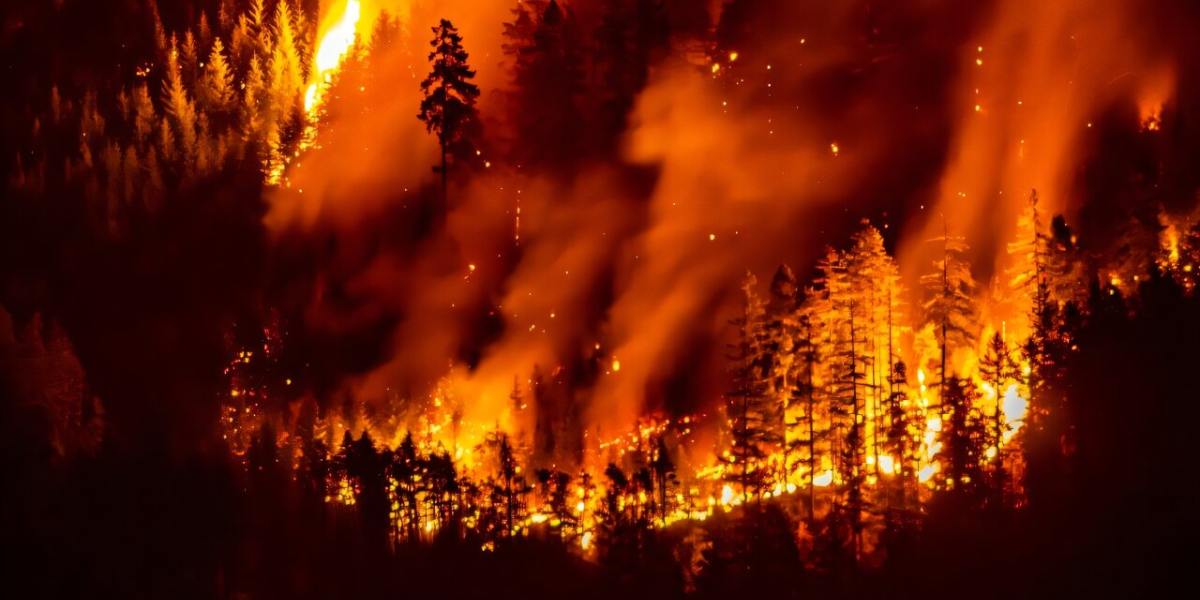
Canada’s forests are burning. There are more than 600 active wildfires ablaze in the country. Already this year, 4 million hectares have been scorched. In British Columbia alone there are 106 active wildfires. Of these fires, four spread so explosively that 20,000 people were forced to leave their homes.
Nearly 10,000 more are on alert to evacuate at any moment. Hundreds of homes, small businesses, farms, ranches and vineyards in the region have been impacted. 50,000 farm animals are threatened. The province has declared a state of emergency. The military is on standby. Canadians in the direct path of fire have no choice but to flee. Evacuation is one of the most immediate impacts of wildfires. Displacement causes anxiety and uncertainty.
Displacement impacts are not felt equally
While wildfires are a national concern, their effects are not experienced equally. Wildfires and subsequent evacuations have disproportionate effects on vulnerable populations (e.g., children, seniors) and remote and Indigenous communities.
In Canada, Indigenous peoples are more likely than others to be evacuated, often experiencing repeated and prolonged displacement. Preliminary data for 2025 shows that of 70,000 wildfire-related displacements across Canada, 56% of those impacted were Indigenous peoples.
Socioeconomic factors can also make it more difficult for some people to respond to and recover from wildfires, affecting communities in the long term.
Wildfire risk spiralling out of control
Given the changing climate, wildfire risk is expected to drastically worsen in the coming decades. While forest fires are a natural part of the forest life cycle and ecosystem, the warming climate means that fires are now less controllable than in the past, and are burning hotter and longer . Parts of the northwestern boreal are now burning at rates that appear to exceed anything in thousands of years.
So far, the 2023 wildfire season was the most destructive season on record, with nearly 5,500 fires burning 17.3 million hectares of land. For perspective, the burned area was larger than the land area of the three Maritime provinces. Nationally, insured damage for severe weather events reached over $3.1 billion in 2023. In 2024, about 5.3 million hectares burned, and in 2025 roughly 8.92 million hectares burned due to over 6,100 fires, making it the second-worst ever year for wildfires this century. 2026 is ahead of historical norms as well.
Human and financial costs worsening
With the worsening wildfire seasons, the financial costs of fire management have increased over the past two decades, with billions of dollars spent on average on response and recovery efforts.
Along with the increasing cost, there is a significant human toll. The smoke spread by wildfires in Canada in 2023 caused 82,000 premature deaths, a study in Nature found, with a third of the mortality burden passed onto the US and another quarter on Europe. Fine particles represent the main health risk from wildfire smoke. There is no known safe level of exposure for some of these pollutants which have been linked to a wide range of health effects. Wildfire smoke can negatively impact health, even at very low levels. The socioeconomic and health consequences of climate change will only get worse as emissions of heat-trapping gases in the atmosphere increase.
Plenty of blame — and cuts — to go around
As the catastrophic consequences of climate change continue to escalate, leaders around the world have been likening the wildfires, and the battles fought to control them, to an existential threat — a war. Fingers are being pointed and blame thrown about by political leaders.
U.S. President Donald Trump’s claim that Canada is failing to manage its forests, and that the cost of the plumes of wildfire smoke should be accounted for by raising tariffs on Canadian goods, has prompted questions on how Canadian governments are faring when it comes to preventing and managing forest fire risks.
Under the federal government, investments have increased since the record 2023 wildfire season. Spending included $346.1 million over five years (2022–23 onward) for training and equipment, and $316.7 million over five years for new national aerial firefighting capacity.
At the same time, federally, about half of the 100 positions at the Government Operations Centre (GOC) responsible for coordinating national emergency responses have been eliminated, according to the Public Service Alliance of Canada (PSAC), Canada’s largest public sector union.
Sharon DeSousa, national president of PSAC, released a statement pointing out that “…gutting [GOC] by almost half puts people across the country at risk, including frontline workers who are battling wildfires, supporting evacuations and risking their lives.”
According to the union, the workforce adjustment notices were rolled out as part of the “comprehensive expenditure review” — the government’s plan to find $60 billion in “savings” (i.e. $60 billion in cuts) over five years. The cuts are a part of a larger plan to shrink the public service.
At the provincial level there have been issues as well. Although governments have raised their spending above historical levels to keep up with the scale of demand, provinces have been accused of underbudgeting. Ontario has underbudgeted for firefighting for at least a decade, sometimes spending double what it planned, and in June 2026 budgeted just $150 million despite having spent almost twice that last year. This leads to reactive planning and poor resources and staffing allocation.
“The fact is that Ontario’s fire seasons have changed, but our staffing hasn’t kept pace,” said Jeremy Rouse, the OPSEU chair representing Ministry of Natural Resources employees. “We cannot continue to respond to increasingly severe fire seasons with fewer resources than the situation demands.”
Across the different levels of government, there has also been a discernible lack of coordination of resources and capabilities to fight fires. Communities affected by wildfires have noticed the lack of available expertise, planning, and resources allocated in times of emergency.
In Ontario, First Nations chiefs called for a public inquiry after Whitewater First Nation was destroyed by the wildfires in July. In that instance, the community received no notice from the province about the approaching wildfires. They were forced to evacuate so quickly that they had to leave behind many of their valued belongings. They call for improved real-time fire monitoring, the establishment of First Nations authorities to help prevent and fight fires, and a permanent economic recovery and compensation fund.
But even with more resources, traditional forest management methods are not working. The system is crackling under the stress of the climate crisis.
Climate crisis is driving worsening wildfires
Wildfire experts have detailed that megafires are occurring in landscapes so remote they cannot be reached by car, and these fires are not the fault of forest management. As Stanford’s Michael Wara put it, “Wildfire smoke, particularly from the boreal forests of Canada, cannot be controlled.”
“Wildfire seasons,” periods where we can reasonably expect wildfires to occur during the year, are becoming a year-round phenomenon as climate change increases the risk of fires. Anabela Bonada, Managing Director of Climate Science at the Intact Centre on Climate Adaptation at the University of Waterloo, said, “What’s really changing here is that, with climate change, we have longer wildfire seasons. We have more dry vegetation on the ground. We have more hot, dry, windy days that help spread the fires.”
The fires are destroying natural ways of controlling emissions, and rapidly increasing the release of emissions in the process. Sarah Styler, an associate professor of environmental chemistry in McMaster University’s Department of Chemistry and Chemical Biology, said, “The majority of these emissions are coming from burning of the forest floor and the peat that’s underneath them,” rather than a single location where emissions can be controlled. “Peatlands typically remain wet and act as major carbon stores,” Styler added, “but hotter and drier conditions are making it easier for them to burn.”
According to new research from McMaster University, most of the carbon released during Canada’s record-breaking 2023 wildfire season came from burning soil and peat, not trees. Bonada said thinning the forest and controlled burns are important wildfire management tools, especially near communities where they can reduce fuel loads and help protect infrastructure. Canada has applied these practices for years, she said, as Indigenous communities have done the same with cultural burning. But using those methods over vast stretches of boreal forest is unrealistic. “Wildfires, smoke, climate change, they don’t respect these political boundaries that humans have put in place,” she said.
Proactive solutions required
If this is a war, governments have failed to adopt the real lessons of pre-emptive wartime action — that of addressing the underlying cause of intensifying wildfires, which is a changing, warming climate. The best solution is to reduce greenhouse gas (GHG) emissions, and help communities adapt to the worst consequences of climate change.
This must be done at a time when governments, both federally and provincially, have been walking back on their climate commitments. Prime Minister Mark Carney recently announced that Canada’s GHG emissions targets are out of reach, and that the country will not curb oil and gas sector growth. Similarly, in Ontario, the Ford government quietly repealed its climate targets nine months before the province experienced its worst wildfire season on record. Instead, Ontario will prioritize the development and extraction of resources in the Ring of Fire, and building a proposed 3,300-kilometer cross-Canada oil pipeline.
Ignoring the burning fire in the room is not a solution. Nor is ignoring the communities desperately seeking help to adapt to increasingly smoky summers and extreme weather emergencies. Social abandonment, characterized by the systemic failure of governments to protect vulnerable populations from the effects of wildfires, leading to displacement is becoming a part of the climate crisis story that must be challenged. Under capitalism, the drive for never-ending profit is creating an uninhabitable planet. Society must come together to save the earth — whether the struggle is led by workers calling for clean energy and sustainable jobs, or the elderly calling for cleaner air, or the youth fighting for a livable future.
As Canada’s forests burn, we see that the old ways of profit-driven capitalism and environmental destruction are not working. It will require creativity and compassion to address the worsening effects of climate change. Governments, and society as a whole, will need to think beyond firefighting on how to manage their forests.
Author

Did you like this article? Help us produce more like it by donating $1, $2, or $5. Donate