
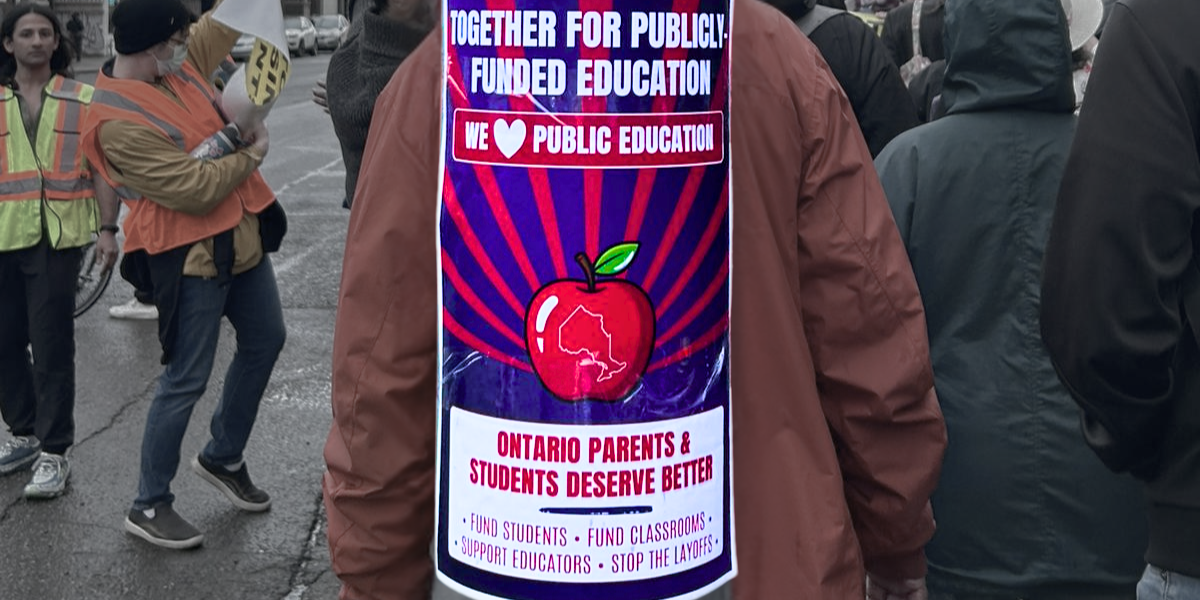
Across Ontario, education workers are preparing for a province-wide Day of Action: a day to show that the people who make schools run every single day are ready to stand together. This moment isn’t about speeches or official statements. It’s about the power that comes from classrooms, hallways, staff rooms, and schoolyards — the places where education workers live the realities of underfunding, oversized classes, and unmet student needs.
Rank-and-file educators know that meaningful change doesn’t start at the top. It starts with us.
What we’re fighting for
Education workers have been clear about what’s at stake. People in schools see firsthand what students need and what they’re not getting. Workers are calling for:
- Real support for students with special education needs, so no child is left waiting for help that should already be there.
- Smaller class sizes, allowing students to get the one-on-one attention they deserve.
- Adequate resources in every classroom, so teachers, ECEs, custodians, and support staff aren’t forced to “make do” with less every year.
- Stronger mental health supports, because the rise in student needs is real and cannot be ignored.
- Better reporting systems and safer working conditions, especially as violence in schools continues to be a major concern.
- Stability for long-term teachers and education workers, whose yearly turnover disrupts learning and undermines safe, consistent school environments.
These aren’t abstract demands. They come directly from the people who see the impact of underfunding every single day.
Why worker-led organizing works
Rank-and-file organizing is powerful because it’s rooted in lived experience. When classroom educators, ECEs, custodians, office staff, and support workers talk to each other directly, something shifts. The issues become clearer. The solutions become collective. And the sense of isolation that so many workers feel begins to break apart.
Worker-led organizing creates:
- Cross-role unity when all school workers act together, it becomes impossible to ignore their shared message.
- Visible collective action simple acts like wearing red or sharing stories show that workers are united and paying attention.
- Authentic voices instead of filtered messaging, the public hears real stories about real classrooms.
- Pressure from the ground up when enough workers are engaged, it pushes institutions and decision-makers to respond.
This is how movements grow: not from directives, but from connection.
What do Days of Action do?
A Day of Action isn’t symbolic; it’s strategic. When thousands of workers take visible, coordinated action, several things happen at once:
- Workers see each other. The sense of isolation breaks, replaced by a feeling of collective strength.
- The routine is disrupted. Systems rely on quiet compliance; coordinated action interrupts that.
- Invisible problems become visible. The public and media are forced to confront issues that are usually hidden inside classrooms.
- Fear shifts. Instead of workers fearing consequences, leaders begin to fear escalation.
- Confidence grows. Taking action together builds relationships and makes future organizing easier.
- Possibility expands. Even one successful day can change what workers believe they’re capable of.
A Day of Action is a test of unity, readiness, and collective power.
April 29: Lighting up Ontario in red and purple
On the Day of Action, teachers across the province will be wearing red, sharing stories, and making their presence impossible to ignore. Education workers will be doing the same while wearing purple. This isn’t just a show of solidarity; it’s a declaration that the people who keep schools running are ready to stand together for the future of public education.
Every hallway filled with red, every staff room conversation, every shared photo sends the message that we are united, we are paying attention, and we are ready to act.
Reached for comment, Ontario English Catholic Teachers’ Association (OECTA) President René Jansen in de Wal added the following:
“There is something powerful about 255,000 teachers and education workers, in schools across Ontario, coming together in collective action. It is a movement this government won’t be able to ignore. We care deeply about our students, our schools, and our communities. We see the harm this government’s active neglect of publicly funded education is causing them.“
“The government’s political theatre does not effectively address the issues impacting Ontario schools, students. $750 spending cards, restricted to only some elementary teachers, does not fix the $6.3 billion funding gap that forces every teachers to spend their own time and money to stock their classrooms. Tying high school student attendance and participation to their final grades does not ensure these kids will be meaningfully engaged in the classroom, especially when the school programs they enjoyed attending and the staff that supported them are cut to balance shrinking school board budgets. By wearing red and purple, we are sparking a province-wide conversation around the impact that eight years of underfunding has had on our education system, including ballooning class sizes, increased violence, aging infrastructure, outdated classroom resources, and dwindling student supports.“
“There is so much buzz and excitement around the province-wide Day of Action. Many teachers and education workers have already started taking the lead in promoting it in their own communities by organizing local events, rallies, and sharing information online.“
“This movement goes beyond a single day. These conversations will continue at dinner tables, between parents at soccer practice, and among friends and families – and we hope that they reach the Minister of Education as well. Our education system is under strain, and this government has the power to fix it. Ontario students deserve better than the band-aid solutions this government has rolled out. We see this Day of Action as an opportunity to call for a sustainable resolution: education funding that actually meets the needs of today’s classrooms, so we can prepare our students for tomorrow.”
Our schools and our students deserve better
Ontario’s publicly-funded schools need investment, stability, and respect. Students deserve safe, well-supported learning environments. Workers deserve conditions that allow them to do their jobs without burning out.
Rank-and-file educators know that no one will fight for these things harder than the people who live them every day.
Author

Did you like this article? Help us produce more like it by donating $1, $2, or $5. Donate