
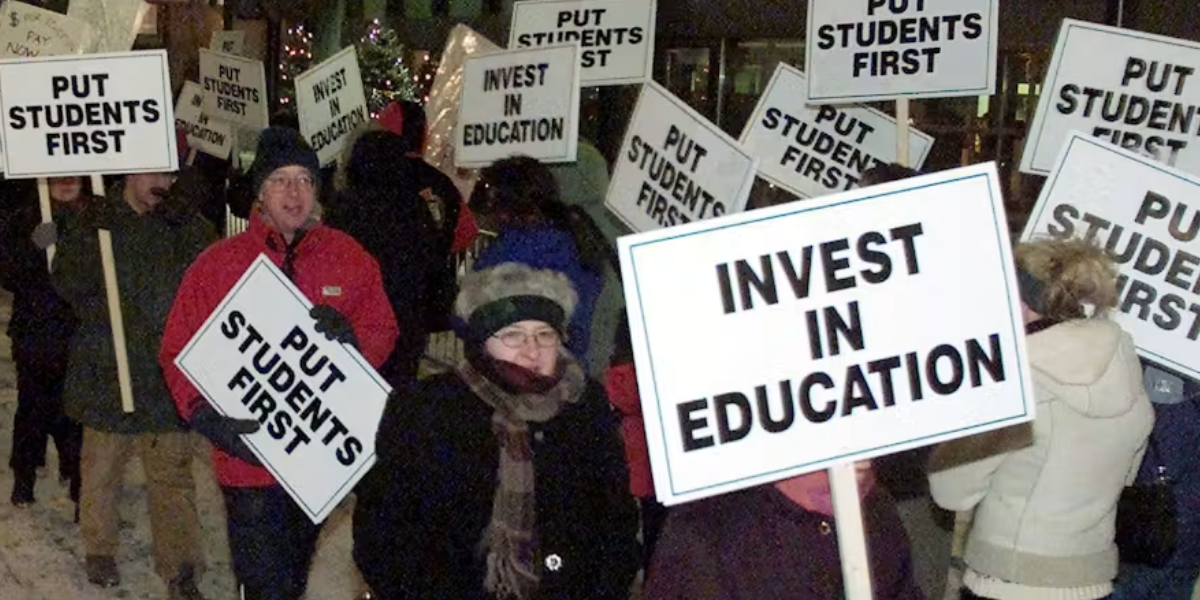
In 2022, education workers represented by the Ontario School Board Council of Unions (CUPE-OSBCU) forced Doug Ford and Ontario Education Minister Lecce to withdraw Bill 28. Ford’s legislation had used the notwithstanding clause to impose a contract, thereby making any strike illegal. The education workers went out anyway. Schools closed, rallies were organized, and labour leaders expressed support. Education workers were threatened with individual fines of $4000 per day and $500,000 per day for their union.
Other unions promised contributions to help cover any fines. With the threat of a general strike held over its head, the government withdrew its legislation. The illegal strike had lasted two days. No fines were levied.
These workers were not afraid to stand up to the Ford government. As their president Laura Walton told the CCPA, OSBCU first took time to build strong community connections and develop tight-knit alliances with other labour organizations. When the strike came, community and labour support pushed the government back.
1973: Illegal strike gives Ontario teachers the right to strike
Teachers in Ontario have used similar tactics. On December 18, 1973, all five teachers’ unions went on strike for one day. Through that single action they achieved the right to strike, something they had not had previously. The teachers’ strike was illegal, but the public and labour organizations supported them. Even the doctors stood with them.
December 18 was the first province-wide teachers’ strike in the province. It showed teachers that they could stand up and demand to be treated fairly. December 18 opened the door to collective bargaining for teachers, expanding collective agreements from what had been a very thin document that included a salary grid and some basic benefits to today’s much thicker collective agreements prescribing everything from pregnancy/parental leave to minutes of preparation time. The right to strike changed everything for Ontario teachers, but it took an illegal strike to achieve it.
Teachers care about the children they teach. In a very real way, teachers contribute to their students’ futures. When making the decision to strike, teachers have always identified their deepest concern as being their students.
When do illegal strikes happen?
Strikes have a high degree of risk. While the success of a strike is never certain, the loss of income during a strike is inevitable. Regularly, workers have been threatened with fines if they do not return to their workplace, although few governments have followed through with that threat. A strike builds union strength. Strikes are a collective demand for a fairer redistribution of power and resources.
Teachers have to consider these contingencies when approaching a strike vote. In the act of voting for or against a strike, teachers become aware of their place in society and the structures, strategies, and goals of their union. Strikes embolden and politicize teachers. Strike votes supporting the possibility of a strike, put governments on notice that teachers have some agency in determining the conditions of their employment; that they have the means to resist the demands of the party in power. Historically, when governments have gone too far in opposing a strike, the public and the legal system have supported teachers.
Teachers have engaged in illegal strikes when the government has been viewed as having violated the work relationship to such a degree that they have no alternative but to refuse to work and leave their classrooms. Illegal strikes have occurred when a government has attempted to force teachers to accept an imposed resolution through a back-to-work order, an injunction, or some form of punitive legislation. Those strikes have been an expression of frustration when negotiations have yielded few results or negotiated agreements have been reversed.
1997: Ontario teachers walk out on Mike Harris
On October 27, 1997, 126,000 teachers walked out, shutting down Ontario’s education system. The teachers were confronting the Mike Harris government’s passage of Bill 61, legislation that targeted teachers’ salaries and working conditions. Although the strike was technically illegal, the courts refused to issue an injunction against the teachers, saying the strike was a legitimate political protest.
The 1997 teachers’ strike lasted two weeks. Its collapse was bitter for the elementary teachers on the picket lines. They had not had a chance to vote on ending the strike, rather their leaders had simply appeared on television screens and announced a return to work. That misstep would not be repeated in the future.
Two billion dollars was eventually cut from the education budget. However, the strike forced Harris to downgrade his assault. The right to strike and preparation time remained in collective agreements. At the local level, trustees realized that their teachers were willing to push back with conviction.
A year later, the two elementary teachers’ unions, FWTAO (Federation of Women’s Teachers Organization) and OPSTF (Ontario Public School Teachers Federation), united under the ETFO flag, a process made easier after sharing two-weeks on the picket line. Notably, the ETFO constitution contained a requirement for an all-member vote before beginning or ending a strike.
Having found their voice in the province-wide strike, in a relatively short time, elementary teachers were able to negotiate 200 minutes of preparation time, a proper lunch break, and salaries on par with the secondary teachers. Having stood up to an intractable government, elementary teachers were no longer timid about strike votes or strike action.
2005: BC teachers force the government to back down
The Ontario teachers were not alone in daring to stand up to a bullying government. In British Columbia, the austerity-driven Campbell government cut 2,600 teaching jobs, slashed the education budget, and imposed a two-year contract on the teachers of the British Columbia Teachers Federation (BCTF). Their contract held no salary increases and swept aside years of negotiated improvements to working conditions. BC Supreme Court Justice Brenda Brown sided with the government and froze the teachers’ strike fund leaving them without strike pay. Nonetheless, the teachers voted 90.5 percent to strike. On October 7, 2005, they went out.
Their illegal strike defied both the government and the courts. After two weeks the government backed down and accepted a mediator. The teachers voted 77 percent to go back to work. No fines were levied.
What does it take to build an illegal strike?
Illegal strikes have proven to be an effective strategy for teachers, but it takes time to engage members and to build alliances with community and labour organizations. In a time of weakened support for public education, strategically organized illegal strikes that demonstrate member solidarity and are aligned with labour and community allies can be successful in disrupting neoliberal governments’ narrative of the need to control teachers and reduce spending on behalf of the public good.
This article is based on another article by the author published in Alternate Routes.
Author

Did you like this article? Help us produce more like it by donating $1, $2, or $5. Donate