
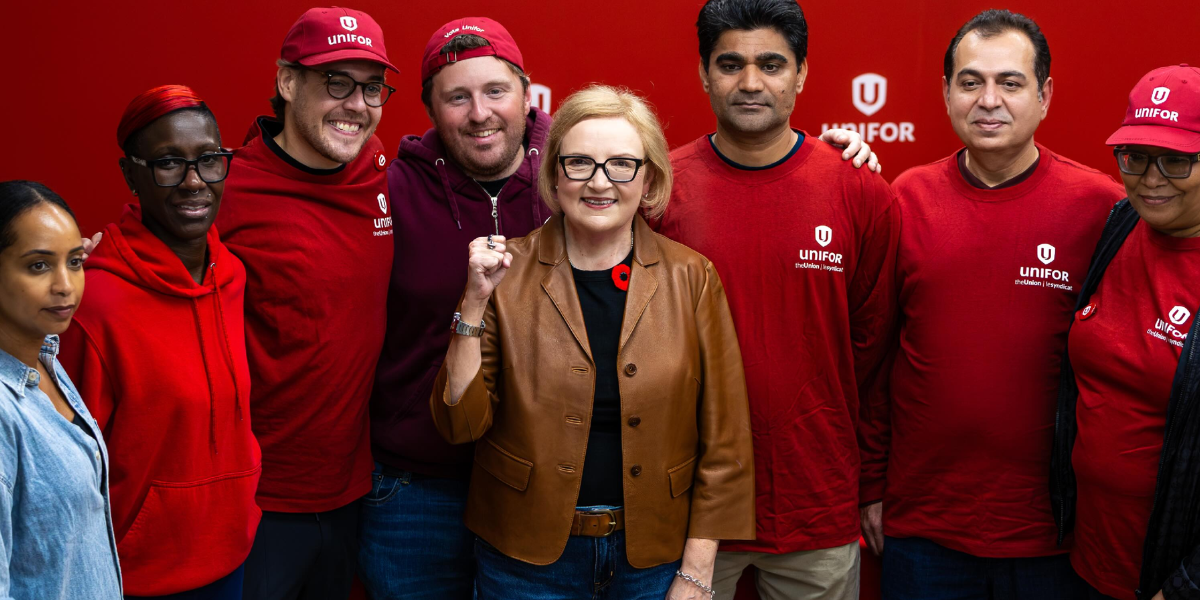
On November 4, 2026, Ontario Amazon workers publicly launched a campaign to unionize their workplace. The announcement was made in partnership with Unifor — Canada’s largest private sector union with over 320,000 members. A couple days after this historic announcement, Spring Magazine sat down with Amazon worker and organizer Jack Cobb to talk about: why they are unionizing, the importance of this fight, and the role every one of us can play to ensure the workers win.
Thank you for speaking with Spring Magazine. Can you tell us a bit about who you are?
Cobb: I’ve been working at Amazon YYZ9 in Scarborough for over six years. Since the day I started, I’ve noticed how little respect the bosses have for us workers, and the many issues we face on a daily basis. It was obvious that we needed to organize. This is one point I really want to stress: we may have only recently launched our official unionization campaign, but Amazon workers have always been organizing and pushing back on the employer — both in my warehouse and in warehouses across the country and internationally.
Can you tell us more about the issues you and your coworkers are dealing with in the workplace?
We have a program that lists our full set of our demands, but I’ll focus on what I’d say are our three top issues.
The first is health and safety. Amazon has a horrible record on this. They push people to work at a pace and intensity that causes widespread suffering and injuries, and they know it. An internal report was leaked which showed that executives were aware that their productivity quotas were increasing worker injuries. They chose to ignore the report and put profit over our health and safety.
My coworker, Sukanya Rajbavan, is one of many people I know who’s been injured on the job. The relentless pace at which they make us work has left her with a lifelong shoulder injury that’s severely reduced her range of motion. She has to take painkillers every day and her husband and children do most of the cooking because it’s too painful for her to hold up her arm for long periods of time. Amazon has refused to modify her duties to accommodate the injury that she acquired because of those same duties. You can read more about Sukanya and other injured Amazon workers in the interview they did with Toronto Today.
There are also many heartbreaking examples of pregnant workers who have faced the impossible choice between performing duties that are unsafe for them and their babies, or being fired. Some of these workers have had miscarriages because their bosses wouldn’t modify their duties. This is so common that, in the US, there is now a nationwide class action lawsuit of pregnant warehouse workers claiming abusive treatment from Amazon.
The second major issue is job security. Right now you can get fired for anything at Amazon — if you check your phone, if you have an earbud in, if you get tired and work a little too slow. No warning, no prior discipline. It’s ridiculous. I’ve seen it happen many times.
We need better job security, fairness in how promotions happen, and a system that values workers with a long tenure at the company. Right now we’re treated like we’re disposable. I’ve seen workers who’ve worked for years get fired for the smallest thing. It’s shameful.
The third major issue is pay. This fall our wage increase was pathetic, it barely covered the cost of inflation. Like many people, we’re struggling to afford basic necessities — food, gas, rent. Especially in a city like Toronto, it’s almost impossible to raise a family and live a dignified life on the wages we’re paid right now.
Amazon is the second largest company in the world. They have a market value of $2.8 trillion dollars. Amazon founder Jeff Bezos has a net worth of $378 billion. This level of wealth is obscene and almost impossible to wrap your head around. They can afford to pay us a few dollars more for all the wealth we create for them.
How will forming a union help address these issues and more generally improve life for the workers?
As I said before, Amazon workers have always been fighting back against the employer. Not just at my warehouse but at warehouses everywhere. I’ve heard stories of organizing committees, marches on the boss, mass refusals of unsafe work, mini-sit down strikes in the breakroom, education sessions, and much more. And we’ve achieved real material wins through these actions. At my workplace we held a big petition campaign that led to the increase of the safety shoe voucher.
But there are limitations to this kind of issue-based organizing. It’s hard to maintain organizing structures and momentum over time. Having a formal union not only makes it easier for us to take mass job action to address the issues I mentioned earlier — health and safety, job security, and pay — it also expands our visibility and capacity.
One of the issues we’ve experienced with our underground organizing is that even when we achieve wins — like the increase to the safety shoe voucher — it’s difficult to communicate widely that the win came from worker power. The bosses are quick to take credit for any improvement, when the truth is that they never would have made the change if workers hadn’t pressured them. With a union, we can publicly communicate our wins not only to our coworkers but to workers in other warehouses as well. This will make it easier to build the confidence of our fellow warehouse workers so we can achieve bigger and better wins in the future.
I also think it’s significant that we’re organizing with Unifor. Having the biggest private-sector union in the country in our corner gives us confidence. They have experience taking on — and winning — unionization campaigns against big private companies. An example of this, which has been particularly inspiring for us, is the unionization of Mississauga Walmart warehouse workers with Unifor.
Amazon is famous for its anti-union practices. What tactics are they using to push back against this campaign and how are you combatting those tactics?
The biggest weapon the employer has is fear. This is the weapon they use most often to try to thwart our unionization efforts. I’ve already mentioned the culture of retribution. Management creates a thousand rules and then fires or disciplines workers for any small infraction. For this reason, many workers are afraid to do anything connected to the union because they think they’ll get fired.
Fear works best when workers feel alone and in the dark. That’s why we’ve taken the unionization campaign public. We’re showing them that they’re not alone. We’re in this together, and together we’re powerful. It’s showing the workers the power of solidarity. And not only solidarity among themselves, but solidarity from Unifor, the rest of the labour movement, and the wider public. When Amazon workers see that not only do we have each other’s back, but Unifor has our back, other unions have our back, and millions of ordinary people have our back… that transforms fear into confidence.
There are labour laws in this country that Amazon has to follow. We have the right to form a union and the power to make it a reality.
You mention the power of bringing in wider layers of solidarity, how can the labour movement and the general public support your unionization efforts?
The first thing I’d stress is the importance of this campaign not only for us, but for the entire labour movement and international working class. If we unionize it will be a historic win.
Amazon is a global company. I’ve spoken with warehouse workers in India, Germany, Poland, France, Spain, Mexico, the US, and more. If we can connect our struggles and build off each other’s wins, we can make an impact that goes beyond our workplaces and expands what’s possible for the entire working class. We can show that workers can take on big corporations and win.
But we need help. It will take all of us to bring Amazon’s power to heel. There are already amazing examples of comrades in other unions showing up in solidarity. Canada Post workers in CUPW have helped spread the word through leafleting. Bus drivers with ATU have shared their encouragement and pro-union perspective when driving along routes that stop by the warehouse.
I would love to see more unions get involved in whatever way they can to amplify the campaign. Leafletting, social media, posters — there’s really no shortage of ways people can support. That extends beyond unionized workers as well. When you’re speaking with friends, family, or coworkers, tell them about what we’re doing and why it’s important. Chances are that they’ve gotten an Amazon delivery before. They should know that the workers behind that package are fighting for better working conditions and need their support.
Thank you again for speaking with Spring Magazine. Is there anything else you want to leave our readers with?
This unionization campaign is part of a larger fight. As I’ve already mentioned, Amazon workers have been fighting long before November 4, 2026. I’ve found that some people think that, because they can’t see the fight, they assume there is no fight. This can lead to the view that the workers are too scared or too precarious to unionize. I’ve seen this misconception not only with Amazon workers but also gig, migrant, and precarious workers.
It’s not true. Workers are organizing everywhere — often it’s underground because their situation demands it. We’re an example of workers who have been organizing themselves underground for years and are now in a position to go public. Another example is the incredible demonstration by Delivery Drivers United that we saw on November 2.
It’s important for the labour movement and general public to recognize that just because a section of the working class hasn’t been unionized yet, it doesn’t mean they’re not willing to. We’re ready to fight and we need your support to win.
Follow AmazonUnifor on Instagram for more information on their unionization campaign and how you can support it.
Author

Did you like this article? Help us produce more like it by donating $1, $2, or $5. Donate