
Ontario Education Minister Paul Calandra named supervisors to run the Peel District School Board (PDSB) and the York Catholic District School Board (YCDSB) this past week. Calandra said in a news release “After careful review, it is clear that both Peel and York Catholic are facing serious challenges that they cannot resolve on their own…I have appointed supervisors to restore sound management, strengthen oversight and ensure every decision is focused on protecting student learning and success.”
The move comes as no surprise to teachers in the districts who have been sounding the alarm that Bill 33 and the six previous school board takeovers were a sign of things to come. The province has been underfunding education for years. This has created a financial crisis at the boards, which is used as an excuse to place them under supervision to undermine local democracy. The result has been a systematic strengthening of the provincial government over education vis a vis local boards. ETFO and other education unions have warned that this could be a prelude to creeping privatization and corruption, two features of the Ford government over the years.
Provincial take over
When the province announced it was taking over the PDSB in January, Calandra insisted it was to stop job loss and make sure students were not reorganized in the middle of the school year. His government’s stated goal is to end financial instability “that risks disrupting learning and undermining student outcomes.” It will be interesting to see how they respond as the PDSB also announced the lay off of more than 160 teachers last week.
The Ontario government has appointed Heather Watt as supervisor of PDSB and Carrie Kormos as supervisor of the YCDSB. PDSB Chair David Green expressed shock at the decisions, telling CTV News that “we provided a comprehensive plan addressing all the minister’s concerns, there was no other concern of the minister or his team and they keep looking, keep digging and asking for more stuff.”
The takeover of PDSB and YCDSB means that eight school boards are now under provincial supervision. Ontario NDP education critic, Chandra Pasma released a statement criticizing the decision, “instead of bringing in experienced educators who understand classrooms and student needs, Minister Calandra has handed control to former Conservative government staffers, one of whom is a casino executive and the other being a Harris-era chief of staff.”
The hiring of Conservative insider management consultant/private equity and gambling executives for $350,000 a piece will do nothing to alleviate the concerns of parents and educators who are worried about being silenced and controlled by the provincial government all while being deprived of the resources they need to do their jobs. Reporting from The Local has noted that the funding formula at the heart of the education budgeting in the province is broken and has only gotten worse under Ford’s leadership. Ontario’s school boards have faced a $6.35 billion dollar funding gap since 2018. Funding has not kept up with inflation or enrollment. As the Local notes “The largest board, the Toronto District School Board (TDSB), for example, which has close to a quarter of a million students, received $14,650 per student…By comparison, one of the smallest boards in the province, Conseil scolaire de district catholique des Aurores boréales, which had 841 students, received the highest amount per student in Core Education Funding at $37,501.”
Coordinating bargaining
With so many education contracts set to expire within the year (CUPE education workers, OECTA, OSSTF and others) a coordinated approach to bargaining will be necessary to address the underfunding of education in the province. Rising to the occasion, L’Association des enseignantes et des enseignants franco-ontariens (AEFO), Elementary Teachers’ Federation of Ontario (ETFO), Ontario English Catholic Teachers’ Association (OECTA), Ontario School Board Council of Unions (CUPE-OSBCU), and Ontario Secondary School Teachers’ Federation (OSSTF/FEESO) have called on the Ford government and Minister of Education Paul Calandra to start the bargaining process as soon as possible, to best support students, families, teachers, and education workers.
The statement reads: “Chronic underfunding and understaffing are having a devastating impact on students. We see this reality every day in our schools, through overcrowded classrooms, a growing shortage of qualified and certified teachers and education workers, inadequate supports for students with Special Education needs, rising incidents of violence, and a lack of basic school supplies, like paper, pencils, and textbooks. Minister Calandra has the authority to issue a regulation allowing bargaining to begin up to 180 days before the current agreements expire on August 31.”
The unions are signalling they are united. And ready to fight for not only education workers but parents, students, teachers at the bargaining table.
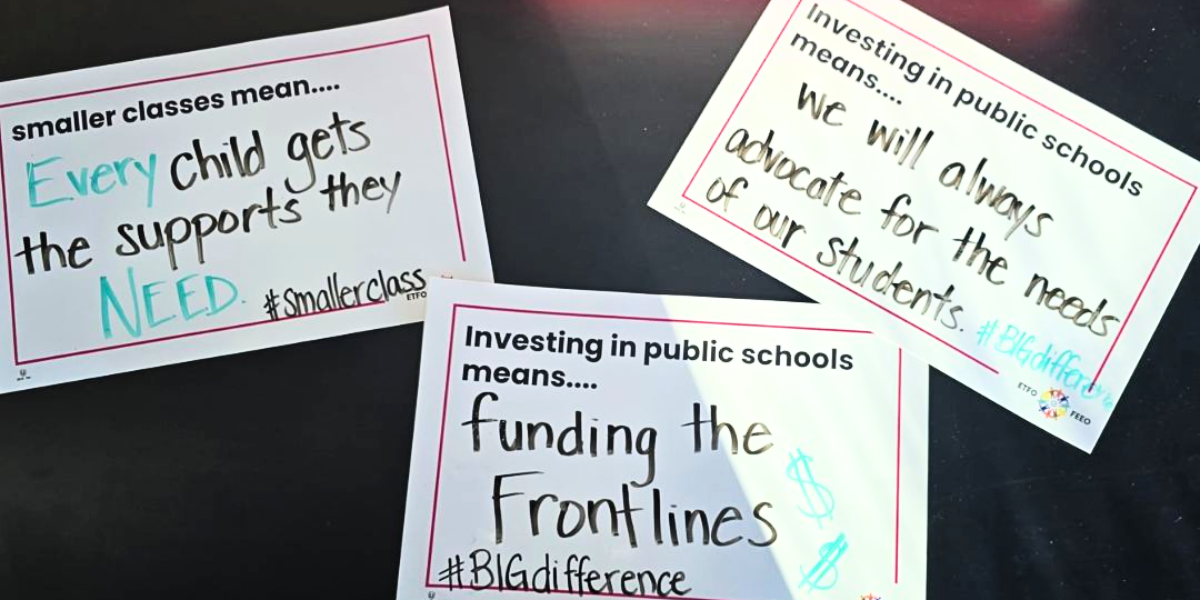
Maintaining this united approach and bargaining for the common is essential. The united movement of CUPE education workers beat Ford when he tried to force through a bad contract with Bill 28. Bargaining for the common good of smaller class sizes and better funded education will be essential to turning this into a political crisis for the Ford government and ensuring the future Ontario students deserve.
Author

Did you like this article? Help us produce more like it by donating $1, $2, or $5. Donate