
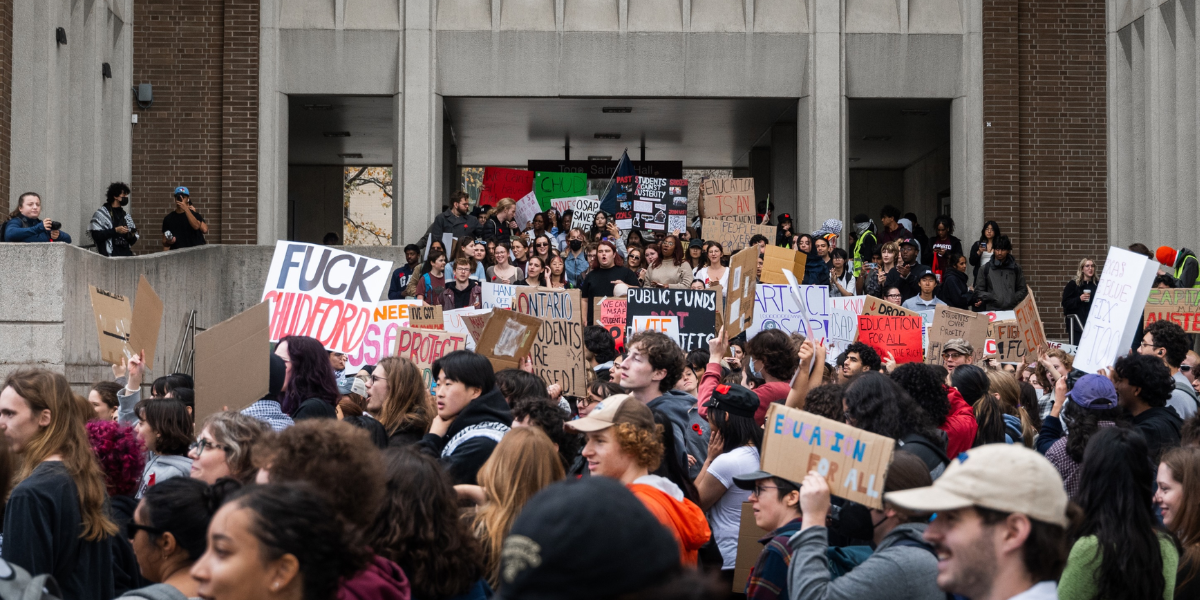
On November 5, thousands of students from at least 19 post-secondary campuses across Ontario went on strike to protest the Ontario government’s changes to Ontario Student Assistance Program (OSAP) funding and rising tuition fees.
Earlier this year the Ford government announced a slew of changes set to affect the higher education sector. In addition to ending a seven-year tuition freeze, the province announced that the non-repayable grants portion of OSAP will be reduced by 60 per cent. This means that at a time of deep affordability crisis, the cost of post-secondary education will shoot up. Austerity measures like these disproportionately impact students from working-class families, many of whom are racialized or belong to immigrant households.
The province-wide strike coordinated by Students Against Austerity and the Canadian Federation of Students was widely endorsed by student unions and saw students across Ontario from Sault Ste. Marie, North Bay, Windsor, Toronto and Ottawa heeding the call. Rally signs shared across social media included “Education for all!”, “OSAP ASAP”, and “Hands off OSAP!”
Organizations across the country expressed solidarity including the Alliance of BC Students, CUPE, OPSEU, OCUFA and others making the connection between worker struggles and student struggles. Amidst the rising cost of living, many students are working to make ends meet and are themselves members of trade unions.
Hamilton
At McMaster University, Spring members witnessed hundreds of students participate in the walk-out, march across campus and rally as part of the province-wide student strike.
Leah, an organizer with Students Against Austerity Hamilton, stated the student demands include “reverse the OSAP cuts and fully fund education.” “You don’t have to be affected by OSAP cuts to understand that [the cuts] are about a broader set of attacks on education. This is a fight for all students in education and for those entering an uncertain labour market with thousands of dollars of debt,” she said, emphasizing the importance of solidarity.
In the last round of education worker bargaining in 2022, strikes across Ontario forced the government to drop proposed “back to work” legislation and unions were on the verge of calling for a general strike. As workers continue their fight with the government in this round of bargaining, Leah highlighted that post-secondary students should also show solidarity with the nearly 250,000 education workers preparing to strike. She further stated that she hopes future student strikes link up with upcoming education worker actions.
Sim and Rushan, medical students at McMaster shared their motivations for attending the action. “Advocating for funding for Canadians is extremely important, especially that I use my voice as a student for others’ education opportunities,” Sim said. “People value education,” said Rushan. “Making cuts to grants and increasing student debt increases barriers for people who already face inequities in accessing higher education,” he said.
An undergraduate student who relies on the Ontario Disability Support Program and OSAP spoke at the rally expressing their anger about the cuts, explaining that the reduction in funds has substantially affected their cost of living amidst the affordability crisis. They lamented struggling to afford food while trying to live on “$200 a month after rent and bills”.
Students also made clear that they do not want universities investing student’s tuition dollars on war and genocide. “We want McMaster to invest in its students and not in genocide,” Leah said.
Other speakers included reps from CUPE 3906 and McMaster professors who emphasized the need for solidarity with students, including international students, and between students and workers.
Toronto
Across Toronto, participating campuses included University of Toronto (all three campuses: St. George, Scarborough, and Mississauga), Toronto Metropolitan University, York University, and George Brown College.
Students at large are already experiencing cuts to programs, funding packages, and grants. Doug Ford’s post-secondary policies have jeopardized thousands of futures of young Ontarians.
Spring members were at the University of Toronto’s St. George campus where several students, as well as speakers at the rally, made links between rising cost of living and the province’s austerity budget. One graduate student that spoke with Spring mentioned that they were only able to go through undergraduate studies because of OSAP.
Speakers from Occupy UofT were also at the rally highlighting that the university administration has spent a disproportionate amount of resources policing dissent on campus while not adequately challenging the province about funding cuts. University of Toronto Students Association recently passed a motion in support of academic boycott of Israeli universities. Students were enraged about the university platforming Israeli Occupation Forces (IOF) soldiers while ignoring the material reality of their own students. “Drop fees, not bombs” signs were seen at the rally.
Guelph
Over a hundred students and community members participated in the walk-out at the University of Guelph’s Branion Plaza.
As part of the Hands Off Our Education campaign, passerbys were invited to declare their student debt and how it impacts them on the “Wall of Debt,” an exhibit set-up by the organizers. Posted notes listed tens of thousands of dollars and shared stress, anxiety, and the reality of not being able to continue their studies without the support of OSAP grants, even while working one or multiple jobs.
Spring spoke with Kayla, University of Guelph alumnus and staff member at CFS-Ontario, the oldest and largest student organization in Canada. She explained that the Hands Off Our Education campaign seeks to “fight back against Bill 33, OSAP cuts, and intuition fee increases … as part of a larger strategy to push back against the Ford government and oppose their privatization of our education system.”
Emilie Dudgeon, President of Guelph’s undergraduate student union, the Central Student Association (CSA), and fourth year student at the University of Guelph, has also personally been affected by the cuts in OSAP. She shared a similar sentiment, urging the community to speak out. “Speaking about it and coming together is the only way that we have a fighting chance at reversing these OSAP changes,” she said.
Kayla further stressed the importance of one-on-one conversations in building movements, “we also need to talk to people in our communities, parents, grandparents, aunts, uncles — Because that’s Doug Ford’s base.” When it comes to decision-making, public opinion and mass action can sway politicians, “when Doug Ford is not popular, he changes his mind.” Spring’s pillar of Socialism From Below is key to building mass movements, where communities will demonstrate solidarity to one anothers’ struggles.
What’s next: building a bigger and stronger student movement
The cuts to OSAP have ignited a new fight across the province. The sheer amount of campuses participating demonstrates how much the cuts are felt by the student population, both at the graduate and undergraduate level. But to be truly effective in challenging the provincial government, this movement needs to be bigger and stronger.
The organizers of the walkout have announced there will be a follow-up action next semester. This is an opportunity for socialists to engage wider layers of the student body on campus and also make links with campus workers, education workers, and high school students. The runway between now and the next action must be utilized to not just mobilize the already-engaged audience, but to build new relationships with people who are feeling the impacts of this cut.
The November 5 walkout was a good indication of the appetite that exists amongst the student body. It is clear that the cuts are unpopular. It is time to organize that sentiment.
Authors


Did you like this article? Help us produce more like it by donating $1, $2, or $5. Donate