
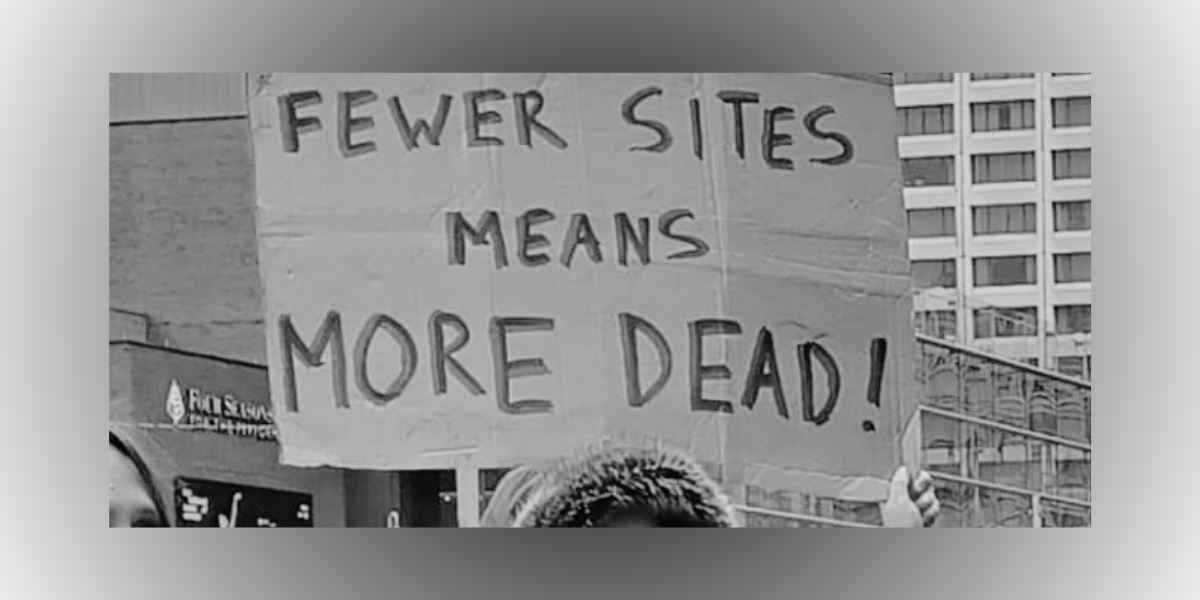
Ontario’s decision to end funding for supervised consumption sites has sent shockwaves through service users, service providers, and harm reduction advocates across the province. In London, Ontario, the potential that Carepoint Consumption and Treatment Services will close has ignited grief, frustration, and deep fear within the community.
Ontario’s Ministry of Health informed agencies on March 15 that funding will end on June 13, 2026, giving operators just 90 days to wind down services. The move, presented by Premier Doug Ford as a shift toward “public safety” and “a recovery-oriented model,” will shut down a service that reversed 218 overdoses last year and recorded more than 15,000 visits, according to the Regional HIV/AIDS Connection, which operates Carepoint, a safe consumption site based in London, Ontario.
“Immediate sadness and devastation”
Reflecting on the moment they saw a screenshot of the news on Facebook, a former Carepoint worker and harm reduction advocate, who chose to remain anonymous, described their reaction.
“Just immediate sadness and devastation.” Recalling the tension that began a year earlier when Ford’s government introduced stricter location restrictions on such facilities, they said, “It brought me back to that uncertainty.”
The Ford government has framed the closures as a step toward public safety and abstinence-based recovery, emphasizing new Homeless and Addiction Recovery Treatment (HART) hubs, which operate under a strict recovery model. But those who work front-line see things differently.
“I see harm reduction services like safe consumption sites as a means to help people stay alive long enough to decide whether or not they want to go into treatment”, they said.
“We’ll see a lot more of our friends die”
When asked what will happen if the site closes, the worker didn’t hesitate. “We’ll see a lot more of our friends die, an increase in overdoses, a decrease in social support and connection amongst people who use drugs, and more trauma in the community.” Health experts have echoed that warning, predicting that emergency services will face greater strain and overdose deaths will rise.
“There’s going to be more public safety concerns if the site closes,” added the worker. “You’re putting people in the community in situations where they might have to respond to overdoses when there are people who are literally trained to support people who are using drugs in a space that’s supervised”.
“Moments of joy”
Beyond medical intervention, Carepoint provides system navigation, peer support, community, and dignity. The worker spoke about the moments of joy they experienced supporting folks at Carepoint. “When you’re in that space, you really get to know people. There’s laughter, connection, and moments of joy,” the worker reflected. “Sometimes people tell you how much you’ve made a difference just by being there,” they added.
These connections, they argued, are part of why harm reduction saves lives. “It tells people they’re not bad, there are people who believe in them and want to support them and care for them, no matter where they are in their drug use journey.” People who use drugs are highly stigmatized in mainstream discourse, which leads to a deep sense of isolation.
“It’s not only like relationships with the staff there, but it’s relationships with their peers, because the space isn’t where you go into a single room by yourself, it’s an open space. So there are several people, and they’re using together,” they said. “It helps them establish relationships with their peers that they can then also have outside of that space, and that creates a network for them to be able to rely on each other.”
The toll on workers
The decision also threatens the livelihoods and mental health of frontline staff, many of whom have lived or living experience with substance use. “Frontline workers are already such an undervalued, underrepresented, and underpaid workforce that does such important work.”
“I feel deeply for the folks that use the services, but my mind also went to the people who are working there and what it will mean for them moving forward if the site does close.” They further shared, “working in a space where you can bring yourself into the work and have a social connection, where you can like talk about the fact that you use or used drugs, and you can use that as a way to connect with people is so valuable to the people who are using that service, but I think it’s also quite valuable to the workers themselves”.
They reflected on what the coming months will be like for workers at Carepoint, knowing the service may close. “It’s so morally distressing. They’re going to be so focused on the fact that the folks that they were serving might die because the service is no longer available”.
Moral distress refers to the sense of impaired well-being that stems from the inability to take actions that one considers morally right. In social service professions, where workers experience the realities of underfunding on a daily basis, moral distress is increasingly common.
“The type of people that do this work care so deeply, and my heart breaks for them because they’ve put so much of themselves in this work, for it to just be pushed aside, like it’s nothing, like it’s not important.”
Despite political setbacks, the worker is hopeful
“I think about the community, in terms of the workforce, knowing how much they care and how passionate they are about this work. I feel like that keeps me motivated to be in this fight with them,” the worker said.
Harm reduction is about safety, connection, and respecting individual choice. As Ford’s government continues to dismantle programs like Carepoint in the name of public safety, those most affected are left questioning what “public safety” really means.
“We talk about recovery, but you can’t recover if you’re dead.”
Author

Did you like this article? Help us produce more like it by donating $1, $2, or $5. Donate