
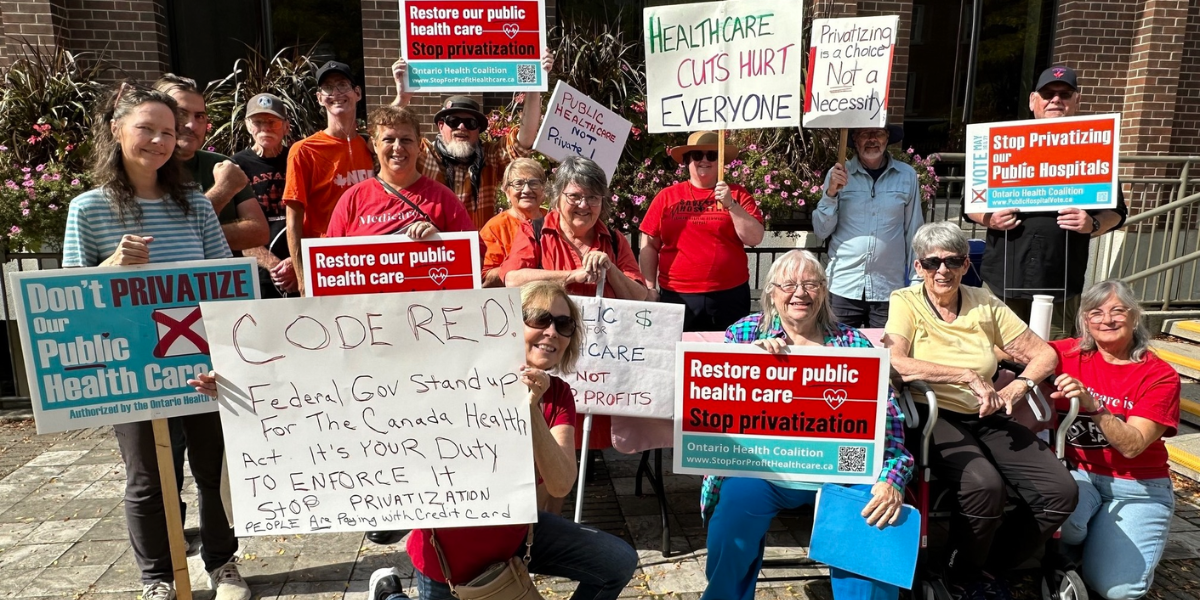
On Thursday, May 28, thousands of Ontarians will be taking to the rails and converging on Union Station in downtown Toronto. In addition to their bags, these passengers will be carrying a key message for the government of Ontario: “Stop Ford’s hospital privatization train wreck.” Organized by the Ontario Health Coalition, attendees expected from as far as Ottawa and Kingston. The train-themed rally aims to drive home the message that Doug Ford’s privatization agenda has gone completely off the rails.
Healthcare in crisis
Relentless defunding of public health care has been a hallmark of the Progressive Conservative government over the last eight years. Ontario has endured a tactical dismantling of health services resulting in mounting emergency room wait times, nursing wage freezes and layoffs, and hallway medicine run rampant. Ontario now has the lowest per capita health care funding of any province in the country. The majority of Ontario’s 136 hospitals have been running at operating deficits for the past three years, despite having the smallest ratio of hospital beds and hospital staff per patient.
In classic conservative fashion, Ford himself has enlisted so-called “policy solutions” to the crisis he created with this slash-and-burn approach. While his left hand has been shuttering rural emergency rooms, his right has opened the door for a suite of private health services to set up shop. Under his privatization agenda, more than a billion dollars per year in public funding has been re-directed to for-profit corporations or “private pay” health care providers. Increasing numbers of surgeries and procedures are now delivered at (publicly funded) private clinics, with the province announcing an investment of 155 million taxpayer dollars toward the creation of 57 new centres for diagnostic and endoscopic services last year.
Advancing privatization
As Ontarians become increasingly frustrated and disillusioned by jockeying for basic health services, private options might sound like a tantalizing fix for those who can pay out-of-pocket. Unfortunately, all evidence points toward catastrophe. Private health care services cost taxpayers substantially more than public ones; in fact, they have already cost Ontarian taxpayers more than their public counterparts. Two-tier style health care also leads to longer wait times for services and startlingly worse patient outcomes. This was most evident when looking at the increased mortality rates in private versus public care homes. Private services are subject to less public accountability and oversight, and, at their worst, have proven to be predatory against the most vulnerable patients.
Ford might be feeling emboldened by recent developments in Alberta. Two steps ahead in the conservative race to the bottom, the death knell for medicare is echoing throughout that province since the passing of Bill 11 by Danielle Smith and her band of insurance giants. Introducing an American-style two-tier system, physicians and for-profit facilities can now, for the first time since the Medical Care Act of 1968, charge patients for medically necessary health care. With Canadian insurance corporations already preparing to sell products in this new private health insurance market, this sets a dangerous precedent for the rest of the country.
Alberta’s Bill 11 is in direct contravention of the Canada Health Act, the law that ties federal health funding to the provision of universal, public services by the provinces. The act stipulates that single-payer health insurance plans must be administered and operated on a non-profit basis by public authorities (the provinces) and cover all medically necessary services to 100% of the population across the country. Yet, despite Smith’s flagrant disregard for federal law, and country-wide outcry from experts and advocates about Bill 11, Mark Carney has, as yet, done nothing to enforce the federal legislation and remained deafeningly quiet on the subject.
Resisting the attacks on healthcare
Public healthcare workers and advocates are refusing to take these attacks lying down. Earlier this month the Ontario Nurses Association (ONA), the union for Ontario’s nurses and other allied health professions, announced they would be launching a constitutional challenge with the aim of striking down the Hospital Labour Disputes Arbitration Act, which has long inhibited them from undertaking meaningful job action such as labour strikes. Reasserting the right to strike would give healthcare workers a powerful weapon to defend public healthcare and their working conditions.
The Ontario Health Coalition, for their part, is refusing to let Ford off the hook. “Objectively, our health care has never been in such crisis and disarray as it is now”, Natalie Mehra, executive director of the Coalition stated in a media release. “While driving our public system into crisis, the Ford government has shifted billions of dollars in public funding to for-profit privatization.”
With delegations from across the labour sector promising to join the rally next Thursday, the OHC, which represents more than 500 member organizations across the province, is promising to continue the fight for universal public health care.
Author

Did you like this article? Help us produce more like it by donating $1, $2, or $5. Donate