It is a familiar scene in Ontario staff rooms: a teacher stands at a photocopier that has been out of toner for days, holding a pack of paper they bought at Staples with their own money, wondering why the school budget can’t afford workbooks to begin with.
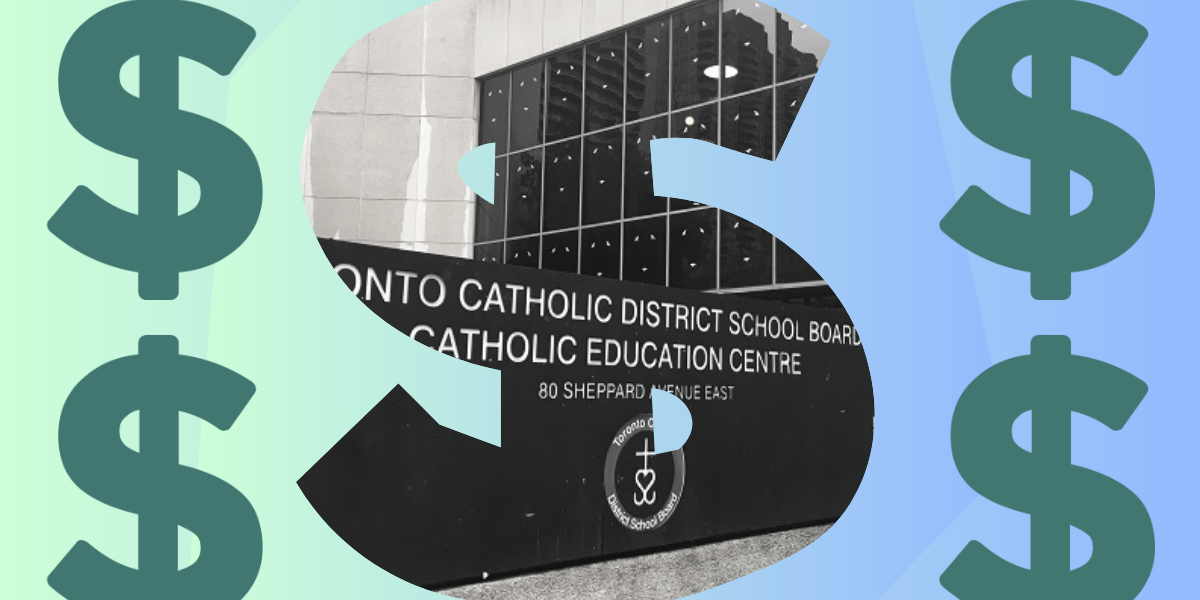
Meanwhile, in north Toronto at the Catholic Education Centre, a pen hits paper on a contract that sends $1.25 million of public money to a private publisher for less than a single year of digital access to mediocre content that few teachers put to good use.
This is not an accident. It is not an accounting error. It is the textbook definition of the neoliberalization of education, a global phenomenon described with chilling accuracy by researchers Gary L. Anderson and Andrea López. And in the Toronto Catholic District School Board (TCDSB), it has a price tag attached.
The two-million-dollar rental
According to public procurement records, the TCDSB awarded a contract worth $1.24 million for a one-year term to purchase “Edwin” for Grades 5 to 10 from September 1, 2021 to June 30, 2022.
Edwin is a digital ‘ecosystem’ by Nelson. It is a slick-on-the-surface, dense-once-inside, multimedia textbook, and it’s a rental. When the subscription ends, the resource vanishes. No more access. Compare this to the library of the past, where a book purchased was a book owned. Textbooks lasted and were relevant for at least a decade before needing replacement. Plus, all those old signatures and love/hate notes on the inside cover provided plenty of intrigue for the average kid. Today, school boards are not building stockpiles of durable learning assets; they are paying subscription fees to private corporations for the ‘privilege’ of accessing their proprietary content.
Microsoft makes over a million a year from the TCDSB. Knowledgehook (mediocre math quizzes) makes at least a quarter million per year. Google, Rubicon, and other private companies command 6 to 7 figure annual contracts as well.
Why does this matter? Because those millions could have hired dozens of full-time support staff. Purchased long-lasting hard-copy learning materials. It could have revitalized school libraries across the city. Instead, it flows out of the public coffers and into the revenue stream of private entities, justified by the buzzwords of ‘innovation’ and ‘modernization.’
The “Knowledgehook” paradox
The situation repeats with mathematics. The TCDSB has spent upwards of $446,500 for a two-year license of Knowledgehook in the past, and is probably spending even more with each passing year.
Knowledgehook is a ‘gamified’ math program. It is colorful and fun. But it exists in a world where Khan Academy — a non-profit, ad-free, world-class platform funded by philanthropy — is available to every student for exactly zero dollars.
Khan Academy offers comprehensive data tracking for teachers, instructional videos and mastery-based learning for students. It is, in the opinion of many educators, superior in its pedagogical depth. Yet, the board chooses to pay. Why?
Anderson and López provide the answer. We have moved from “educational administration” — the boring but necessary work of maintaining public infrastructure — to “entrepreneurial leadership”. In this new world, a good leader isn’t someone who stewards resources carefully; it is someone who forms partnerships, disrupts the status quo, and acts like a CEO. Buying a flashy product like Knowledgehook looks like leadership. Using a free tool like Khan Academy just looks like teaching.
The screener racket
Perhaps the most frustrating example is the use of easyCBM (“deluxe subscription”) for reading screeners. Teachers are required to use this paid platform to assess student reading fluency.
This creates a darkly ironic market. We pay to diagnose the literacy crisis we helped create by underfunding libraries. Meanwhile, DIBELS (Dynamic Indicators of Basic Early Literacy Skills) materials are available from the University of Oregon for free download. The tools to measure whether a child can read should be a public good, not a proprietary product hidden behind a paywall.
And now, we have RISE — the new IEP platform by private vendor LEARNstyle. Teachers describe it as a “disaster,” a glitchy mess that deletes data and complicates Special Education. Yet, we pay for it. Through the teeth. In the neoliberal model, when a private product fails, the public sector doesn’t get a refund; we just pay more for “training” to learn how to navigate the bugs.
The ‘Google’ Tax
Even the air we breathe digitally comes with a bill. While the basic Google apps are free, boards like the TCDSB pay for ‘Education Plus’ licenses to get the security and administrative features teachers actually need. They are effectively paying a ‘Google Tax” of nearly half a million dollars a year to a company that already mines our students’ data for profit.
While these millions flow to software vendors, the Toronto District School Board (TDSB) — which faces similar pressures, and with a much higher price tag — has projected deficits ranging from $34 million to $58 million. They are discussing pausing the distribution of devices to students.
We are running deficits that threaten the stability of our schools (because of consistent underfunding of education by conservative governments), yet we continue to hemorrhage cash on software licenses that duplicate free resources.
Neoliberalization is the model
The neoliberalization of Ontario education is not a conspiracy; it is a business model. It relies on exhausted teachers scrounging for resources, often spending their own money on TPT workbooks, or trusting the powers-that-be and using the next hot app rolling out from the board. But as the invoices for millions of dollars in software pile up next to the broken photocopier, one thing becomes clear: this government is not investing in education. They are investing in products. And it is time we stopped buying it.
Author

Did you like this article? Help us produce more like it by donating $1, $2, or $5. Donate