
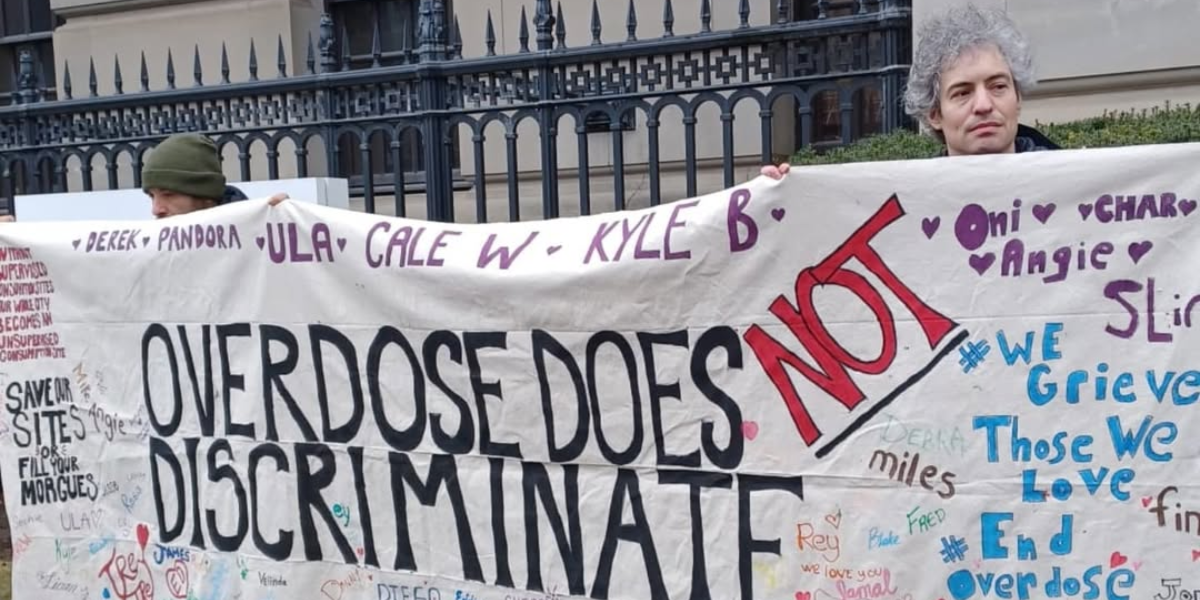
On June 4th, the Ontario government passed Bill 6, the so-called Safer Municipalities Act. Drug users experiencing homelessness can now be removed from encampments and ordered to pay a $10,000 fine or be sentenced up to six months of jail time. Due to the language of the law, this implicitly empowers police to target anyone experiencing homelessness. Making matters more dire for those who use drugs, the Ford government also passed Bill 10, which coerces landlords to evict drug users by holding landlords legally responsible for drug use that occurs on properties they own.
These bills in conjunction are intended to remove those deemed “unacceptable” by Conservatives and their supporters from their housing and society, and funnel them into our own prison industrial complex. This gives Conservatives the political room to build more jails in Ontario instead of supplying housing.
Bill 6
The Conservatives framed Bill 6 as a solution to the housing crisis. Minister of Municipal Affairs and Housing MPP Rob Flack introduced Bill 6—titled “An Act to enact the Restricting Public Consumption of Illegal Substances Act, 2025 and to amend the Trespass to Property Act respecting sentencing.” He repeatedly called this Bill “a balanced approach” on Second Reading. This Bill includes the following paragraph:
6 (1) If an officer believes on reasonable grounds that a person is guilty of an offence under this Act, the officer may do one or both of the following:
1. Immediately seize and remove any substances found in plain view and proximate to the person, and any packages containing those substances, if the officer has reasonable grounds to believe the substances are illegal substances.
2. Destroy any seized substances mentioned in paragraph 1.
With this language, anyone targeted by police under this bill will have to provide eyewitness testimony against the accusations, as there is no evidence required for police to submit a charge under the Act.
This makes anyone living outside a target. Those accused will be required to make bail, or go to Ontario Jail. People who do not have housing and presumably have fewer resources at their disposal will likely have trouble satisfying various bail conditions, which often include having a place to stay as well as a court-approved surety.
The Bill does have one loophole to protect drug users: this law does not apply if the “Substance is used within a supervised consumption site.” But this means little when Doug Ford and the Conservatives are already targeting Safe Consumption Sites for closure, and under Ford’s policies, nine such sites have already closed.
Bill 10
A week after introducing Bill 6, the Ford government introduced Bill 10, which “prohibits a person from knowingly permitting a premises of which the person is a landlord to be used in relation to offences under Acts of Parliament that relate to the production or trafficking of a controlled substance or precursor, or of cannabis.”
There are no definitions in this Bill for what differentiates possession and trafficking. In federal law, simply giving someone a drug without payment can be considered trafficking. Thus, any landlords in Ontario may evict or not rent to a drug user out of fear of criminal charges. These two laws in conjunction further funnel people who use drugs out of their homes, onto the streets and into jail.
Prison labour In Canada
NDP MPP Robin Lennox rightfully asked in debate on Bill 6 how these laws make fiscal sense when we know jails and shelters cost more money than simply housing people. However, the costs are mitigated by exploitation of incarcerated labour—in federal prisons (which cage people serving sentences of two years or longer) via CORCAN, and in Ontario jails (those awaiting bail hearings, trial, or serving sentences of less than two years) via Trilcor.
Those incarcerated in Canada are written out of any employment law, yet they are required to work. In federal prison, it is considered an act of non-compliance to refuse assigned work. In Ontario, it is law that all those incarcerated shall participate in any work assigned.
Federally, the average incarcerated worker is entitled to only $5.80 a day—far less than even one hour of minimum wage. This rate was set in the 1980s and included planned deductions for their own incarceration as “Room and Board.” In 2013, all federally-regulated incarcerated labourers had their bonuses cut back, then had to pay an additional 30% remittance of their wages for “Room and Board.” Meanwhile, CORCAN recorded a revenue of $62,551,130 in 2023.
In Ontario’s jails (which are regulated by the province), no incarcerated person is paid for any type of labour. At most, they might get something from the canteen—a bar of chocolate, or perhaps some chips.
The purported purpose for work is for rehabilitation and skills-building for incarcerated people, but the full picture of incarcerated labour calls this motivation into question. For one, people in provincial detention serving short sentences do not get the opportunity for external work placements. And while Trilcor does not release revenue or auditing information publicly, according to the Ontario government website, incarcerated Ontarians do free labour in the following industries: production of tailored products, such as clothing, bedding and blankets; linen services (laundry for jails and other government institutions); and the production of Ontario license plates. They openly sell these products to federal, provincial and municipal levels of government, as well as school boards and not-for-profit organizations.
Mental health and addiction treatment: prison vs community support
Despite addiction advocacy organizations pleading the government for more mental health funding in the community, the Ontario government is using these Bills to try to sell Ontarians on “Involuntary Treatment”—as if the problem with massively underfunded mental and addiction treatment in Ontario is that people do not seek out treatment. According to the provincial government, when drug users go to jail, they at least have access to the rehabilitative care that is denied by our broken community systems. However, the reality is much different.
I spoke with Rachel Fayter, a Postdoctoral fellow at Carleton University focusing on criminalization and treatment of marginalized people. Rachel was incarcerated in provincial detention and in federal prison. According to Dr. Fayter, those experiencing addiction in jail (especially those serving short-term sentences) do not get any services for addiction. If they are on methadone or related opiate addiction medication, that will be given to them while they are in jail, but only if they are prescribed it while outside of the jail system. No one will come to offer treatment of any type. We also know drugs get into federal prisons and provincial jails, so why does the Ontario government refuse to help treat addiction in jails, even for those who want treatment?
Those incarcerated under this Bill will not have any opportunity to improve their addictions or their homelessness. They will have up to six months away from any community supports they rely upon for housing or addiction treatment. This will create a cycle of repeated jail terms. The Conservative government is trying to hide those they consider to be less than human, away from the public eye that encampments have drawn.
Labour rights, decriminalization and decarceration
Jails are already detaining Ontarians in overcrowded cells, and practices of double and triple bunking are Ontario-wide. The whole system is over capacity by 22% according to December 2024 data obtained by the Toronto Star. There is no doubt that these Bills will be joined by calls to build prisons and expand prisons. Maplehurst Correctional Complex is to be expanded to hold another 430 people—the amount by which it is currently over capacity—by 2026. There is no doubt that when this government moves to build even more space, to imprison more Ontarians, it will be touted as a way to protect “everyday families.” Ford has the money to build housing, but only at the cost of liberty.
As socialists we advocate for all within the working class. That includes those incarcerated. We call for the integration of all those in the class to be protected from exploitation.
Prison abolition is a long-term goal. In the interim we can advocate for the acknowledgement of prison labour as labour, deserving of the same rights as all workers federally and provincially, including pay, health, and safety. We can also advocate for decriminalization and decarceration.
Decriminalization of drugs is not a fringe left idea. Federal lawyers were advised in 2020 by Director of Public Prosecutions Kathleen Rousell to avoid prosecuting drug possession charges unless deemed a major public safety concern. Ontario’s Chief Justice at the time, Gregory Strathy, called for drug use and simple possession to be completely decriminalized and treated as a public health concern in 2020. He cited 100 years of failure of the prohibition model.
Alternatives exist, and the cost of the carceral system shows the money is there. The real way to build safe municipalities is not by further criminalizing drug use and expanding prisons, but by building housing, supporting labour rights, and providing mental health and addiction supports.
The author would like to thank Dr. Rachel Fayter for her interview time and the book Solidarity Behind Bars: Unionizing Prison Labour by Jordan House and Asaf Rashid.
Author

Did you like this article? Help us produce more like it by donating $1, $2, or $5. Donate