
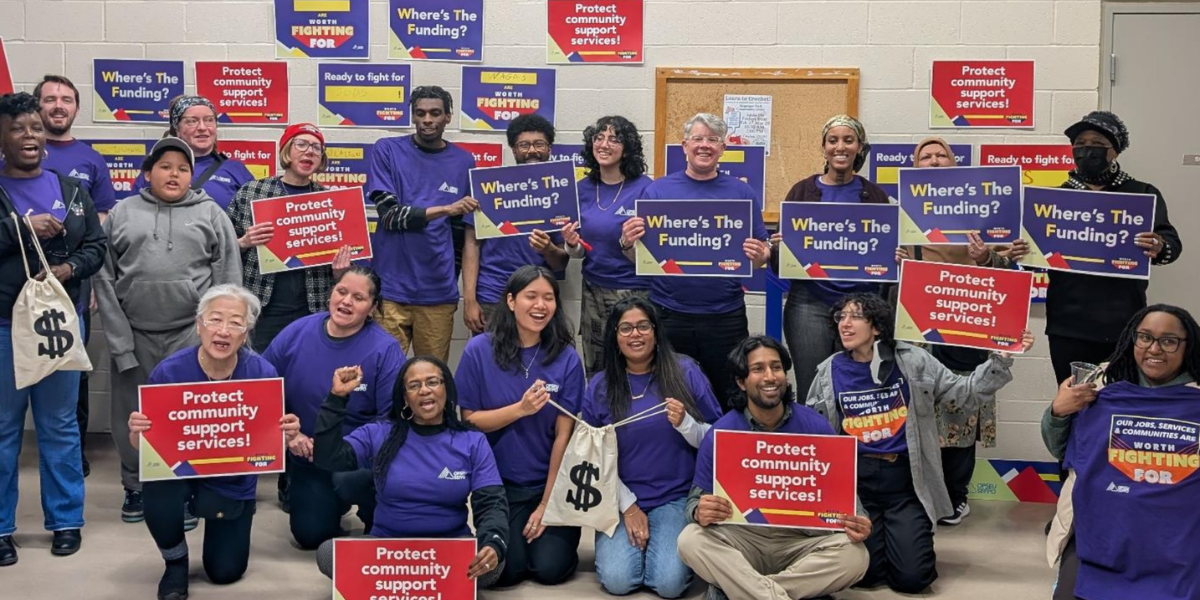
On March 26, workers in the Ontario Public Service Employees Union (OPSEU/SEFPO) hosted watch parties across Ontario, bringing together union members and community allies to analyze and respond to the 2026 Ontario budget. These gatherings — part teach-in, part discussion forum — created space for workers to collectively break down the numbers, share how government decisions impact their daily life and plan actions for change.
The watch party in Scarborough opened with a reconciliation statement by JP Hornick, president of OPSEU/SEFPO, who connected the evening’s discussion to the broader history of struggle and solidarity. “The ongoing impacts of colonization are felt here today,” Hornick reminded the attendees. “It is important for us as trade unionists to remember our struggles are interconnected…Colonization starts with forcible removal of people from the land.” This framing carried through the night: the fight for public services today cannot be separated from histories of dispossession and exploitation, and it is the responsibility of workers to work in community with each other towards more just outcomes.
Watching the budget
For many attendees it was their first time watching a provincial budget announcement. “It’s all a new experience,” said Angel W., a community support worker. “I’m really curious about the budgeting and what the government is willing to put forth for the industry we work in. I want to see if they value the work that we do.“
As Finance Minister Peter Bethlenfalvy delivered the budget at Queen’s Park, attendees in Scarborough followed along with scorecards and bingo sheets. Mentions of “Protect Ontario,” artificial intelligence investments, defence-related infrastructure and privatization were met with roaring boos and calls of “Shame!” The room grew tense as Bethlenfalvy announced tax cuts for landlords. He spoke of “homegrown talent” even as the budget made a $69.2 million cut to post-secondary education, and $141 million to K-12 education, and maintained stagnant funding for social services.
Left out of the plan to “Protect Ontario”
What needs to be kept in mind is that budgets are not neutral; they reflect whose interests come first. “Budgets are choices,” said Hornick. They described the Ford government’s 2026 plan as “a classic conservative budget” of trickle-up economics that directs public funds to business owners and property developers while frontline workers and the people they serve see cuts, stagnant wages, strained food banks and growing waitlists for social supports. “They have deliberately taken this money — our money — and decided to invest in their friends rather than in our community,” they said.
Hornick broke down the numbers: program spending will decline $672 per Ontarian over two years, with post-secondary education dropping $1,085 per young person aged 18-24. Social services, already under severe strain, see a $31 per-person cut. Hornick stated that this figure only seems small because the Ford government’s 2018 cuts were so steep they created a “suffocation effect” — crumbling the sector year after year by slowly and steadily increasing the pressure downward.
The small business tax cut, from 3.2 percent to 2.2 percent, was presented by Bethlenfalvy as a benefit to workers, but as OPSEU/SEFPO Regional Vice President Coleen Houlder noted, “I wish we had a counter for how many times he said ‘business.’ Were there any mentions of community and social services?” Her statements highlighted how the Province’s framing of tax breaks as worker-focused policies rarely matches workers’ reality, who seldom see corresponding gains in their pay, benefits or job security.
The expanded HST rebate on new homes drew similar criticism. Previously only available to first-time homebuyers, the benefit now applies to anyone buying a newly built home valued at $1 million or less. The change, Hornick argued, only helps people privileged enough to enter the real estate market or “buy their second, their third, their fourth home…corporate developers.” It does little for renters or working families, who are priced out entirely, and will likely drive up rents and deepen the housing crisis for those already facing precarity.
Worker realities
Workers at the Scarborough gathering voiced how the Ford budget translates into everyday struggle.
Myriam F., a 12-year veteran frontline worker at a drop-in centre for women, attended with her colleagues and grandchildren. “Even with a full-time job I don’t make enough,” she said. “I’m one paycheque away from being evicted or under the line of poverty. We’re all in the same boat. No one has savings.”
The watch party was the latest action in OPSEU/SEFPO’s Worth Fighting For campaign, a coordinated bargaining effort among workers in government-funded social service agencies. Since 75 percent of the workers in the campaign are women — many racialized or migrant workers — the chronic underfunding leads to what Houlder called a “recruitment and retention crisis” rooted in misogyny and the undervaluation of care work. Migrant and marginalized workers, often excluded from labour protections and social supports, face greater precarity amid these cuts. As living costs climb and social security nets fray, these workers are among those most at risk of housing instability and food insecurity.
One mother shared her fears for the next generation: “I’m very sad,” she said. “My two daughters, they have been on both OSAP and scholarships. What’s my granddaughter going to do? Where will she get help from? You’re not able to put the food on the table without OSAP and scholarships.”
Frustration to action
“When we see with our own eyes how little money, resources, and faith they’ve put into us — the people that actually run the province’s central services — and hear there’s ‘no piece of the pie left,’ we know that is an outright lie,” said Houlder.
As the budget broadcast ended, the room broke out in heated discussion. “We need to start talking about it and not be embarrassed,” said Myriam F. “We need to be more actively involved and be out there in the media so that people can see who we are, because we’re awesome! We’re stronger than the Province. We can make the change!”
The night ended in a call to action, with participants launching into a phone zap, flooding Doug Ford’s and cabinet ministers’ phone lines with condemnations of the budget plan and demands for real investments in public services.
“When we get together,” said Houlder, “and really think things through, it becomes clear how much power we have, how wide and strong our networks are” — a fitting echo of Hornick’s opening message which placed workers’ struggle in historical context. “We live in a country that was built on forced labour, especially of racialized people, against their will. through economic force.” They urged attendees to re-commit “to the agreement to share a dish together, to share the resources of the land, and to leave enough for others.”
Tell your MPP to fund social services using the Worth Fighting For email toolkit.
Author

Did you like this article? Help us produce more like it by donating $1, $2, or $5. Donate