
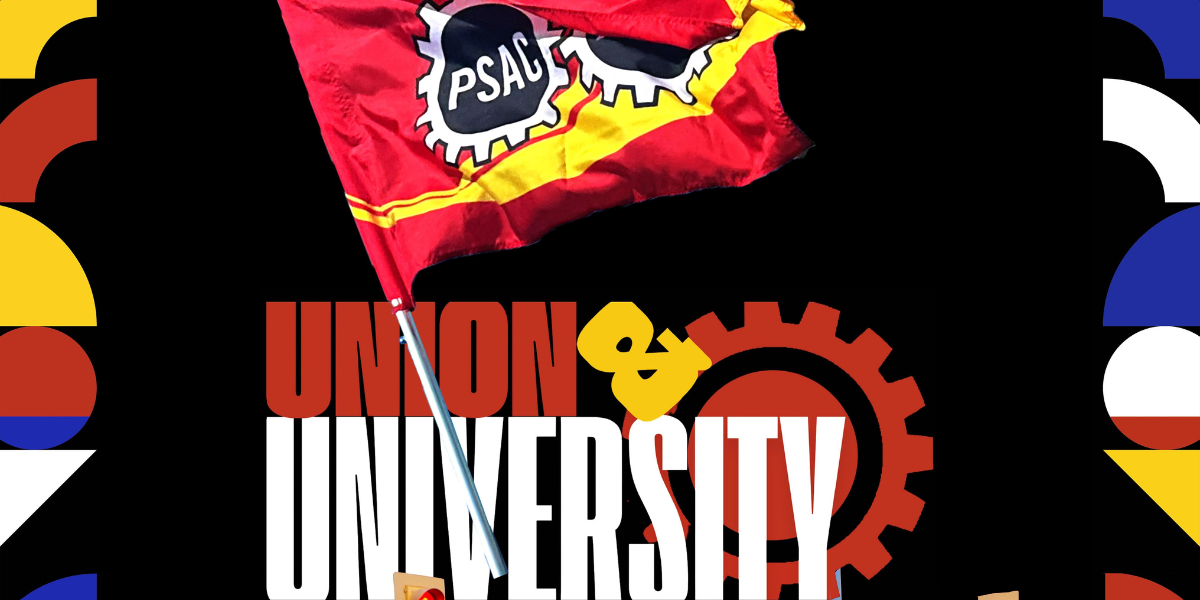
When I sat down to watch Union and University at the Canadian Labour International Film Festival this year in Toronto, I expected a documentary about a strike. What I didn’t expect was one of the clearest, most emotionally grounded accounts of how austerity is reshaping universities, and how workers are building the power needed to fight back.
The 2025 PSAC 901 strike at Queen’s University was not an isolated labour dispute. It was the culmination of years of wage suppression, poverty-level funding packages, and a top-down managerial restructuring that has pushed post-secondary institutions toward corporate logics and away from their public mission. Union and University, directed by Andrei Pora and produced by Elliot Goodell Ugalde, the Canadian Labour Congress and the Kingston & District Labour Council captures this slow-burn crisis as it erupted into one of the largest academic strikes in recent memory, bringing over 2,000 graduate workers to the picket lines during a historic moment of coordinated bargaining across campus.
But the film does more than record the strike. It exposes the fault lines of a university in the grip of austerity, and shows how students, faculty, and staff built solidarity in response.
Poverty wages in an era of record food insecurity
The documentary opens with scenes familiar to anyone living in Kingston: rising rents, impossible grocery bills, and a university town where one in three households faces food insecurity. As Spring previously reported, the City of Kingston declared food insecurity an emergency in 2025, a crisis produced in no small part by Queen’s University itself, the city’s largest employer and a driver of local inequality.
As the film shows: graduate workers earn a guaranteed minimum of $23,000 per year, thousands of which is clawed back as tuition. There is no minimum funding at all for Master’s students. For comparison, a full-time minimum-wage worker in Ontario earns roughly $36,000.
As PSAC 901 President Jake Morrow told Spring:
“This is a class issue. Graduate students who don’t have to worry about food survive. Working-class students don’t.”
The film captures these realities without sensationalism, instead leaning into moments of sharp humour and quiet satire that lay bare the contradictions of campus austerity. In one scene, armed security guards practise baton drills beneath a Thin Blue Line flag, cut immediately against a picketer gently blowing bubbles into the cold morning air. In another, a graduate worker delivers an impassioned plea to city council about escalating police aggression on the picket lines, only for the police chief to dismiss the concern with a curt “no comment.”
These juxtapositions are devastating not because they are exaggerated, but because they are real. This is not the romantic image of university life sold in glossy brochures; it is the lived consequence of austerity, where care, creativity, and solidarity confront the growing militarization of campus space.
Limos for bosses, cuts for workers
The film makes clear that austerity at Queen’s was not a natural occurrence but a manufactured crisis whose consequences were felt most acutely by those with the least power. In 2023, the university announced a budget “crisis,” a now-familiar gesture across the post-secondary sector, yet one that workers immediately questioned.
As the Unity Council observed in its call for a joint workers’ assembly, the more they learned about how the administration presented its finances, the more they doubted both its claims and its motivations. The documentary deepens this skepticism by contrasting the lived poverty of graduate workers with the financial decisions of senior leadership. While student workers absorbed years of unconstitutional wage restraint under Bill 124, Queen’s quietly granted raises of more than four percent to its managerial class. At the same time, the university responded to inflation and declining real wages with a token two-hundred-dollar lump-sum payment and a proposal that offered only twenty-three dollars per member per year for mental-health, food security, and hardship supports. Perhaps most strikingly, the film reveals that Principal Patrick Deane incurred thirty thousand dollars in limousine expenses in a single year, a detail that underscores the gulf between administrative choices and the austerity imposed on the campus community.
The faculty were not silent about these contradictions. In an open letter signed by more than three hundred and fifty professors, librarians, and archivists, faculty members emphasized that graduate workers were living at the poverty line and warned that the administration’s approach was harming both students and faculty. The film sets these statements against scenes of the crisis unfolding in real time: cancelled labs, ungraded assignments, shuttered research facilities, and thousands of undergraduates left in limbo. What emerges is a stark portrait of a university where austerity is not a response to scarcity but a political choice, and one whose costs are borne by those who make the institution function.
Communities of care as class struggle
Perhaps the most powerful contribution of Union and University is its close attention to the emotional and relational labour that sustains collective struggle. Morrow explains to Spring that slowing down to create communities of care, making space for difficult conversations, and allowing people to grow together were essential ingredients in cultivating a confident and militant membership. The film illustrates this beautifully through scenes of late-night organizing meetings, improvised childcare on the picket line, long arguments about tactics, small bursts of joy, and the kinds of friendships that can only emerge when people confront shared danger with shared resolve.
What appears on screen echoes a point Frantz Fanon makes about moments of rupture. For Fanon, collective refusal does not simply reject an oppressive order. It becomes a creative act that forges new forms of social life and new understandings of dignity. In that sense, the strike at Queen’s was not defined solely by its opposition to administrative austerity. It was a constructive experiment in a different kind of university community, one grounded in solidarity, mutual aid, and democratic participation. The film captures this spirit, showing that the picket line was not only a site of withdrawal but also a space where people built new practices of care, decision-making, and belonging.
If the documentary has a notable omission, it is the limited portrayal of the community groups that sustained the strike on a daily basis. Organizations like KMACC, along with their community kitchen, fed picketers and community members every day and played a crucial role in supporting workers who were already stretched thin. Their contributions deserve recognition and should be emphasized whenever the story of this strike is told.
What the film does capture, however, is the underlying truth that strikes are not only about wages or contracts. They are about dignity, a sense of belonging, and a collective vision of the university as a public good rather than a corporate enterprise. They are about workers exercising power and discovering their capacity to transform the institutions that shape their lives.
Union and University is therefore not a neutral documentary. It is a tool for organizing, an archive of working-class resistance, and a testament to the political clarity that emerges when people fight together. It demonstrates that the crisis at Queen’s, like the crisis facing universities across Canada, is not inevitable. It is the outcome of political choices made by people in positions of authority. And like all political choices, these decisions can be challenged.
To watch this short film for free, visit: https://radicalfilmnetwork.com/film/union-and-university/
Author

Did you like this article? Help us produce more like it by donating $1, $2, or $5. Donate