
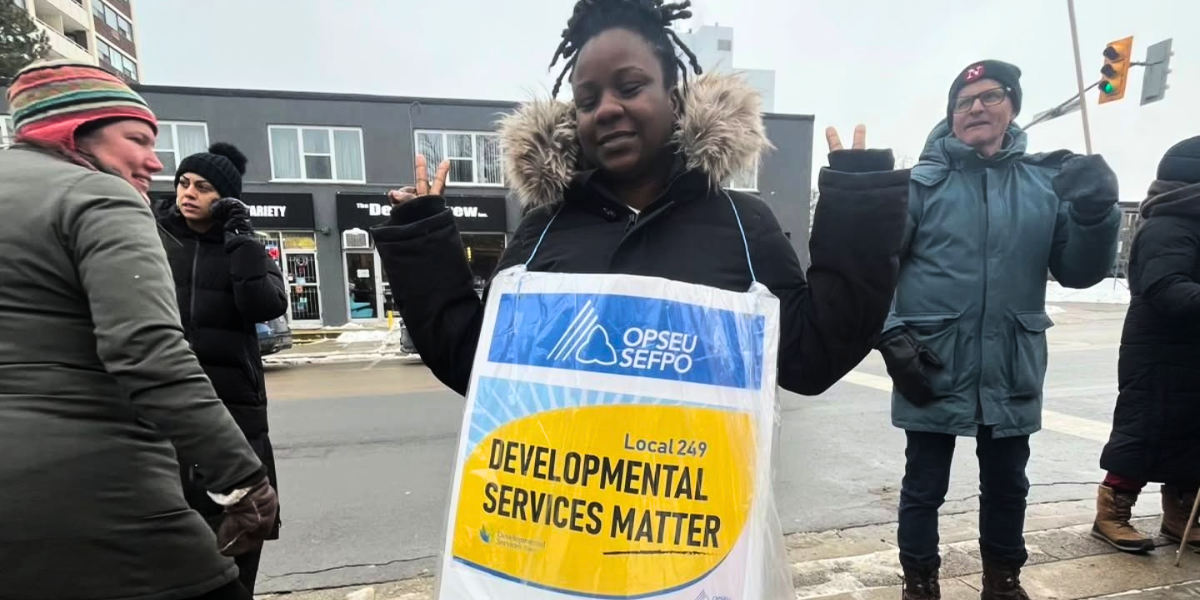
There is a crisis unfolding across Ontario that most people will never see. It is happening inside group homes at three o’clock in the morning when one developmental service worker is trying to safely support several people with complex needs. It is happening in hospital rooms occupied by people who do not need hospital care but have nowhere appropriate to go. It is happening around kitchen tables where aging parents wonder who will support their adult son or daughter when they are no longer able to. And it is happening every time another experienced developmental service worker looks at their paycheque, their workload and their exhaustion and decides they simply cannot do this anymore.
More than 52,000 adults with developmental disabilities are waiting for provincially funded services in Ontario.More than 28,000 people are waiting for housing-related supports. More than 42,000 are waiting for community services. More than 30,000 have not received their full Passport funding allocation. Many people appear on multiple waitlists.
Those are enormous numbers.
But if we talk only about numbers, we miss what this crisis actually looks like. A waitlist means a person waiting years for a place to live. It means a parent in their seventies or eighties who remains a full-time caregiver because no alternative exists. It means someone who wants a job, friendships, independence and a life in their community but cannot access the support necessary to make those things possible.
It means families reaching a breaking point before they finally receive help. For the people we support, waiting is not an administrative inconvenience. Waiting is their life.
Development service workers and disability rights
I work in developmental services, and I serve as president of CUPE Local 2276. I have seen what developmental service workers do every day: we provide personal care, we administer medications and we support people through behavioural and mental-health crises.
We help people communicate, build relationships, find employment, attend appointments, participate in their communities and exercise the independence that most people take for granted. We respond to emergencies and we de-escalate dangerous situations. We support people through grief, illness and some of the most difficult moments of their lives. And very often, we do it while working short staffed.
Ontario has built a developmental services system that depends heavily on the commitment of its workforce while consistently refusing to properly fund that workforce. Low wages, precarious employment, mandatory overtime, burnout and increasingly unsafe workloads have become normalised.
That should concern everyone. When an experienced developmental service worker leaves the sector, we do not simply lose an employee. The person being supported may lose someone who knows how they communicate, who understands what causes them anxiety., who recognizes subtle changes in their health, who has spent years earning their trust and someone they consider a friend.
There is a tendency to discuss staffing shortages as though they are primarily a human-resources problem. In developmental services, staffing instability is also a disability-rights issue. Continuity matters. Relationships matter. Trust matters. You cannot provide truly person-centred support through a revolving door of exhausted, underpaid workers.
Precarious work and gender inequality
Developmental service workers stayed through COVID. We worked through outbreaks, uncertainty and fear. We supported people who often could not understand why their routines disappeared, why they could no longer see family members or why the world around them suddenly changed. Workers were called heroes, but praise is cheap when it is not followed by investment.
The people who were celebrated during the pandemic are now being told that there is not enough money to properly fund their wages or the services they provide. Workers are not leaving developmental services because they suddenly stopped caring. Many leave because wages for caring are no longer enough to pay their mortgage, afford groceries or compensate for the physical and psychological toll of the work. You cannot build a sustainable social-care system on sacrifice.
There is also a gender dimension to this crisis that deserves far more attention. Care work in Ontario has historically been undervalued, particularly work performed primarily by women. When governments rely on the dedication of predominantly female workforces to compensate for inadequate funding, that is not efficiency. It is exploitation dressed up as fiscal restraint.
Ford’s Bill 124 made an existing crisis worse
The Ford government’s Bill 124 legislation restricted compensation increases for many public-sector workers to one percent annually for three years. Those restrictions came at precisely the time when the cost of housing, groceries, fuel and virtually everything else was climbing rapidly.
Developmental service workers were already struggling with wages that failed to reflect the skill, responsibility and risk associated with the job. Bill 124 pushed them further behind. The legislation was eventually struck down, and the Ontario government repealed it in February 2024. But repealing an unconstitutional wage-suppression law does not automatically repair the damage it caused.
For the years it was in place workers lost purchasing power, agencies struggled to recruit as experienced employees left. Vacancies grew and workload for the workers who remained increased. And years later, many developmental services workers are still fighting for meaningful remediation. The impact on the sector made it clear that wages are not separate from service quality. When a government suppresses wages, workers leave and throw the whole sector into crisis. People with developmental disabilities are the one that pay the price.
That is why worker justice and disability justice cannot be separated.
Government announcements about funding hide reality
Whenever developmental services workers raise these concerns, government announcements about funding quickly follow. Ontario has pointed to hundreds of millions of dollars in new social-services spending, including an additional $407 million over three years. Any additional investment is welcome.
But the headline number does not tell the whole story.
That funding is not exclusively dedicated to developmental services. It must also support organisations providing other critical social services, including services for people with special needs and survivors of gender-based violence and human trafficking. And those investments arrive after years in which funding has failed to keep pace with inflation, population growth, increasing service demand and the growing complexity of people’s support needs.
CUPE’s analysis projects that by 2028, Ontario’s social-services spending will represent a 17.8 per cent real reduction compared with 2018 levels — an annual funding gap equivalent to roughly $4.5 billion. Governments can announce increases while the system continues falling behind. Both things can be true: if an agency receives more money but its insurance, food, transportation, utilities and staffing costs have risen even faster, that agency has not actually gained ground. It has simply fallen behind more slowly.
Underfunding and hospital overcrowding
Underfunding does not make people’s needs disappear. It simply pushes those needs somewhere else. When appropriate community housing is unavailable, people end up in hospitals. Ontario’s Ombudsman reported that by December 2024, the recorded number of people with developmental disabilities occupying hospital beds while waiting for more appropriate community placements had risen to 124.
A hospital bed is one of the most expensive forms of care our public system provides. Yet instead of investing enough money to create appropriate community-based supports, Ontario is allowing people to remain in hospitals because nowhere else is available. This contributes to the crisis of overcrowded hospitals and hallway medicine.
The Ombudsman also reported that a proposal to expand a program specifically designed to help people move out of hospitals and into appropriate community placements was not funded. We know what can make the system work, what is missing is the political commitment to implement them at the scale required.
Families cannot be Ontario’s unofficial social-services system
There is another group holding this system together: families. For decades, Ontario has relied on parents, siblings and other relatives — also disproportionately women — to absorb the consequences of inadequate public services. Parents provide care into their sixties, seventies and eighties. They sacrifice retirement savings, reorganize their careers and navigate the bureaucratic processes. The burden on families is immense and they are all confronted with the question: ‘what happens when I am gone?’
A wealthy province should be able to provide a better answer than a waiting list.
We need to stop managing the crisis and start solving it
The solutions are not mysterious. Ontario needs permanent, predictable base funding for developmental service agencies—not temporary funding announcements that leave organisations wondering what will happen next year. Workers affected by Bill 124 deserve meaningful wage remediation. The province needs a serious workforce strategy that addresses wages, training, recruitment and retention.
We need investments in developmental services education and training.We need substantially more supportive housing. We need sufficient Passport and community participation funding. And most importantly, Ontario needs a credible, transparent plan to reduce and ultimately eliminate the developmental services waitlists. Not another study. Not another pilot project. Not another announcement about money spread across multiple years and multiple sectors. We need a plan, with targets, timelines, funding, and accountability.
Something is beginning to change
There is one reason I remain hopeful: workers are organizing, families are speaking out, and self-advocates are demanding to be heard. Unions, disability advocates, community organizations and supportive elected representatives are beginning to connect struggles that have too often been treated separately. That matters, because the fight for decent wages for developmental service workers and the fight for quality services for people with disabilities are not competing interests. They are the same fight.
People deserve stable relationships with the workers who support them. Workers deserve wages that allow them to remain in the profession. Families deserve to know that their loved ones will have somewhere safe to live when they can no longer provide care. People with developmental disabilities deserve something more fundamental still. They deserve the opportunity to belong, to work, to have friendships, to make choices, to participate in their communities, and to live ordinary, meaningful lives.
Ontario can afford to do better
Whenever we discuss social services, we are told about fiscal realities. But budgets are not forces of nature: budgets are political documents that reveal priorities. Ontario’s developmental services crisis did not appear overnight, and it is not the inevitable consequence of an aging population or an unfortunate labour shortage. Governments made decisions about how much money developmental services would receive. They made decisions about workers’ wages, about housing, and about whether tens of thousands of people waiting for support constituted an emergency. And they can make different decisions.
For too long, people with developmental disabilities have been treated as a budgetary afterthought. For too long, families have been expected to fill the gaps. For too long, developmental service workers have been expected to compensate for underfunding with their own exhaustion. The people I work alongside care deeply about the people we support. That is precisely why so many of us are speaking out. Because caring about someone also means refusing to accept a system that continuously fails them.
Ontario does not need developmental service workers to sacrifice more. It does not need families to wait more patiently. And people with developmental disabilities certainly do not need another promise that help will eventually arrive. They need a government prepared to treat developmental services as the essential public infrastructure that they are.
More than 52,000 Ontarians are waiting. The question is no longer whether there is a crisis. The question is how much longer Ontario is prepared to make them wait.
Author

Did you like this article? Help us produce more like it by donating $1, $2, or $5. Donate