
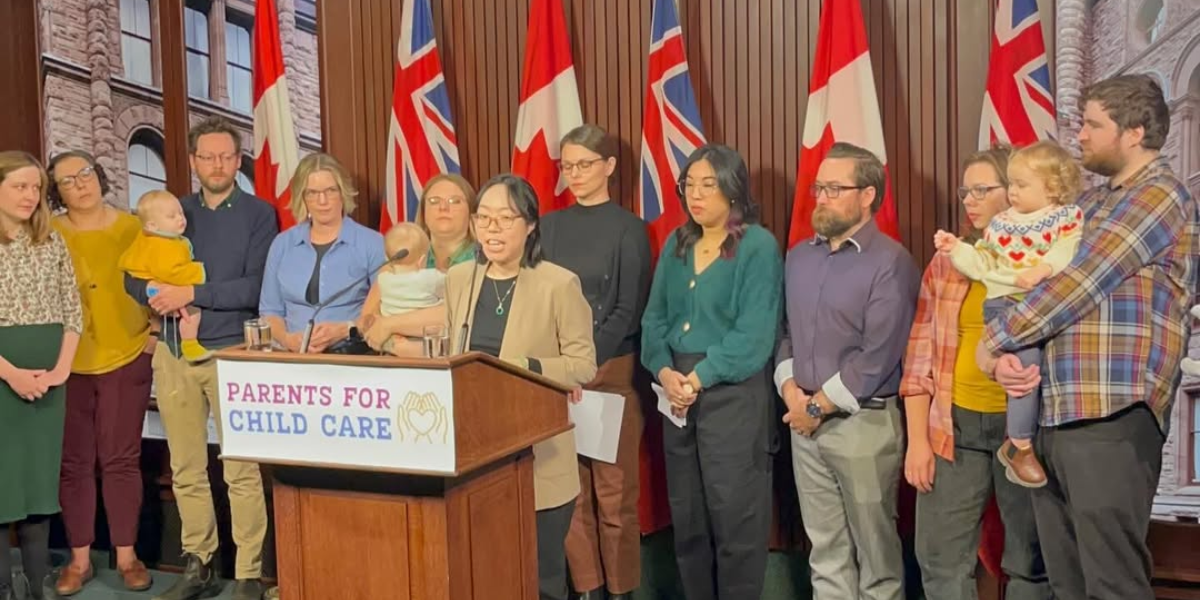
In advance of a January 30 meeting in Ottawa between Canada’s federal, provincial, and territorial ministers responsible for early learning and child care, Child Care Now and more than 100 major organizations issued a joint call urging governments to strengthen the Canada-wide Early Learning and Child Care (CWELCC) program. The groups warned that without renewed political commitment, the promise of $10-a-day child care risks being broken.
These concerns extend beyond the well-documented challenges of insufficient expansion of licensed child care spaces and a severe shortage of qualified early childhood educators, both of which continue to leave many families without access to affordable care. There are also growing indications that some provinces want to move away from the goal of building a primarily not-for-profit child care system that makes high-quality, low-fee programs available to all families across the country.
Ontario’s approach is illustrative. The province agreed to only a one-year extension of the program and committed to maintaining average parent fees at an average of $19 per day, rather than continuing to reduce them toward the $10-a-day target. In Saskatchewan, a newly negotiated funding agreement between the province and the federal government now permits the use of federal funds to expand for-profit child care; an option explicitly excluded under the previous agreement in recognition of longstanding evidence that for-profit provision is associated with lower-quality care.
New funding and concrete commitments needed
Recognizing the precarious position of $10-per-day child care, Child Care Now and its partner organizations called on federal, provincial, and territorial ministers to commit to:
- Increase public funding to meet the real cost of operating high-quality programs and to expand the availability of licensed child care under the $10-per-day child care system;
- Build a primarily non-profit and public system of child care so that public investments advance high quality, equitable services, not profit-making;
- Achieve a maximum parent fee of $10-per-day with further fee reductions for low income families;
- Invest in the early learning and child care workforce to attract and retain qualified educators;
- Develop and implement concrete, proactive child care expansion plans with emphasis on making access more equitable;
- Publicly and promptly share the text of child care agreements, associated action plans and results.
Ministers unwilling to commit to expand support for CWELCC
Following the meeting, the government released a news statement that contained no concrete references to the demands raised by child care advocates, nor any explicit commitments to expand or more effectively direct public funding.
Instead, the release offered only a broad assurance that federal, provincial, and territorial governments had “recommitted to continue working in partnership to ensure the long-term sustainability” of CWELCC, while emphasizing that this work would occur “in the context of current economic realities.” This not-so-subtle invocation of fiscal constraint signals the federal government’s reluctance to shift its existing priorities, namely, the continued channelling of public funds toward corporate handouts and expanded defence spending under Carney’s “Elbows Up” strategy, framed as a response to the United States’ increasingly aggressive trade and foreign policy posture.
Additional funding is essential to remedy structural gaps and implementation deficiencies, as CWELCC has yet to deliver a truly universal child care system. As documented in a new report by the Childcare Resource and Research Unit, many families continue to live in child care deserts, unable to access a licensed space at all. Affordability also remains uneven, as not all jurisdictions are on track to meet the target of an average fee of $10 per day by March 31, 2026. Quality has likewise been compromised: for-profit child care has expanded under CWELCC, despite governments’ stated commitment to building a primarily not-for-profit system. Compounding these gaps, parents in several provinces face additional charges for “extras” such as meals, wait-listing, or outings, further eroding the program’s promise.
As long as large numbers of families remain excluded from $10-per-day child care, the political right will continue to exploit these gaps, framing the system as fundamentally flawed rather than chronically underfunded, and using this narrative to build public support for dismantling it altogether. Should this occur, Canada risks losing hard-won progress toward a more equitable society, one in which women’s access to paid labour is expanded, and governments would forfeit both a significant policy legacy and the long-term economic benefits that flow from it.
Author

Did you like this article? Help us produce more like it by donating $1, $2, or $5. Donate