
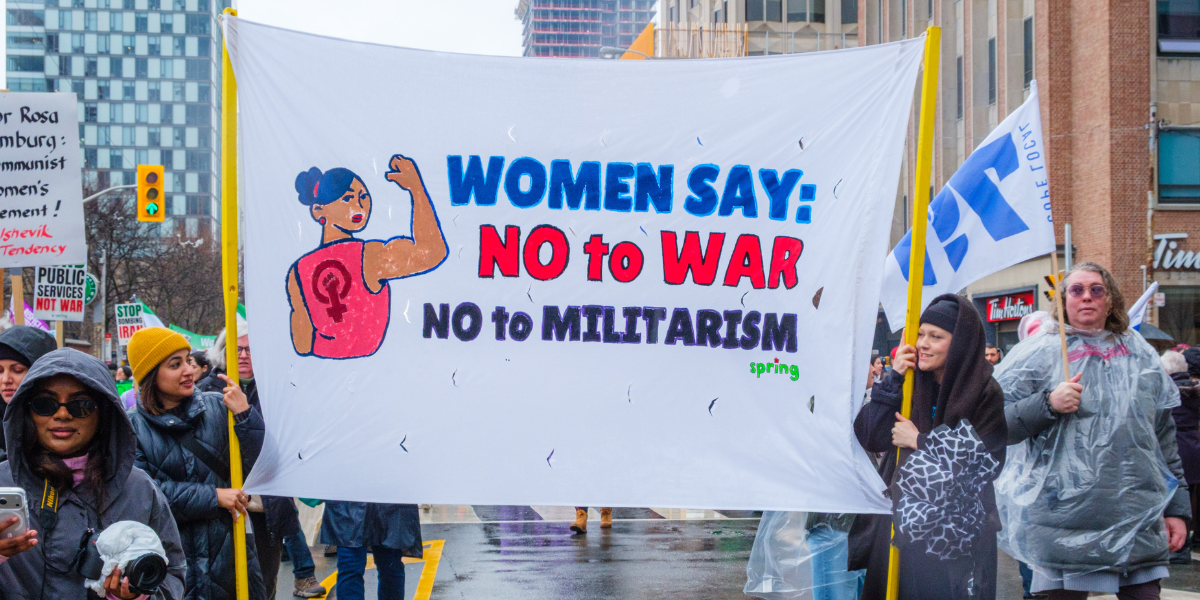
On March 7 in Toronto, International Women’s Day (IWD) was marked by a large rally and march organized by a broad coalition of trade unions, community groups, students, migrant organizations, and socialist groups. Under the theme “Rise and Resist: Uniting for a New World,” the march connected the legacy of IWD with opposition to war, gender‑based violence, and the broader social and political crises facing working‑class communities in the city.
In 1910, long before the feminist movement of the 1960s, socialist feminists Luise Zietz and Clara Zetkin created the first IWD as part of an international working class movement. By its 4th observance in 1914, IWD became a mass call against WWI, with socialist women mobilizing under the banner of international solidarity and “war on war.” Over time, that class focus has been eroded, replaced by a depoliticized celebration of womanhood and “girl power” detached from material conditions.
For Spring, IWD is both a celebration of the gains won through socialist women’s struggles and a call to rebuild working‑class movements today. This year’s rally took place amid the ongoing U.S.-Israeli bombing of Iran, whose early strikes killed 165 girls during class hours.
History shows that American wars of aggression in the Middle East have had devastating impacts on women through displacement, economic collapse, loss of social services, and intensified state and social repression, not to mention the deaths and injuries caused by attacks on civilians. Canada’s increasing alignment with U.S. military strategy toward Iran raises urgent questions about the direction of foreign policy and its consequences.
We interviewed several demonstrators to understand their reasons for attending the rally and what it meant for them.
War is an extension of patriarchy
Luna, a migrant worker from Mexico marching with the Centre for Spanish Speaking People and Círculo Sororo Toronto, said:
“This is my second time attending the IWD march; I first came in 2019 after moving from Mexico. (…) I realized that even when you move, the oppression is still there. When war starts, it is always a war against women. Our bodies are treated like territories; they come and conquer us first. The fact that the media ignores events like the attacks on girls’ schools in Iran just shows that they clearly don’t care. It is still the same patriarchy at work.”
Shifting from a culture of war to peace
Ronny Yaron, a Member of the Canadian Voice of Women for Peace since the 60s, said:
“I wouldn’t want to miss being part of the women’s movement. It’s inspiring to see hundreds of women and men here. (…) the government’s priorities are completely upside down. They are channeling funding into the military while we are in a cost-of-living crisis. (…) I’ve been advocating for peace since the 60s. Today, the anti-war movement is desperately needed, but it doesn’t get enough airtime in the media.”
Reclaiming military spending for public services
Hannah, a public worker and recent organizer, said:
“I’ve been against the bombardment of Palestine since before the genocide began, and I’m equally opposed to the indiscriminate bombing of Iran. (…) It’s a disaster that we see a five percent budget increase for war while our healthcare system is failing and they are taking money away from universities. We need funding for public services, not more war. I want the Canadian government to be explicitly anti-war.”
Moving from theory to on-the-ground actions
Rana Khan, an education worker and long-time IWD attendee, said:
“I’ve been coming to the IWD march for many years. Beyond the rally, I stay active by signing petitions and writing to my MP, and I participate in support groups. (…) While I engage with socialist podcasts and online magazines to learn more, it’s about being on the ground and taking action.”
The IWD rally in Toronto made it clear that the struggle for gender justice does not stop at Canada’s borders. For the many who marched on Saturday, it is no longer just about domestic policy but also against global militarism. Today, as social spending is constrained while military commitments expand, that connection is once again visible.
The interviews and voices emerging from recent rallies reflect a growing concern that foreign war and domestic inequality are deeply intertwined. Revisiting the political meaning of International Women’s Day offers a framework for understanding how opposition to war, solidarity with women affected by conflict, and demands for social justice are part of the same struggle.
Just like Luna, Ronny, Hannah, and Rana, the time is now to stand up against our government’s support of war and spread the message: Stop Bombing Iran!
Authors


Did you like this article? Help us produce more like it by donating $1, $2, or $5. Donate