
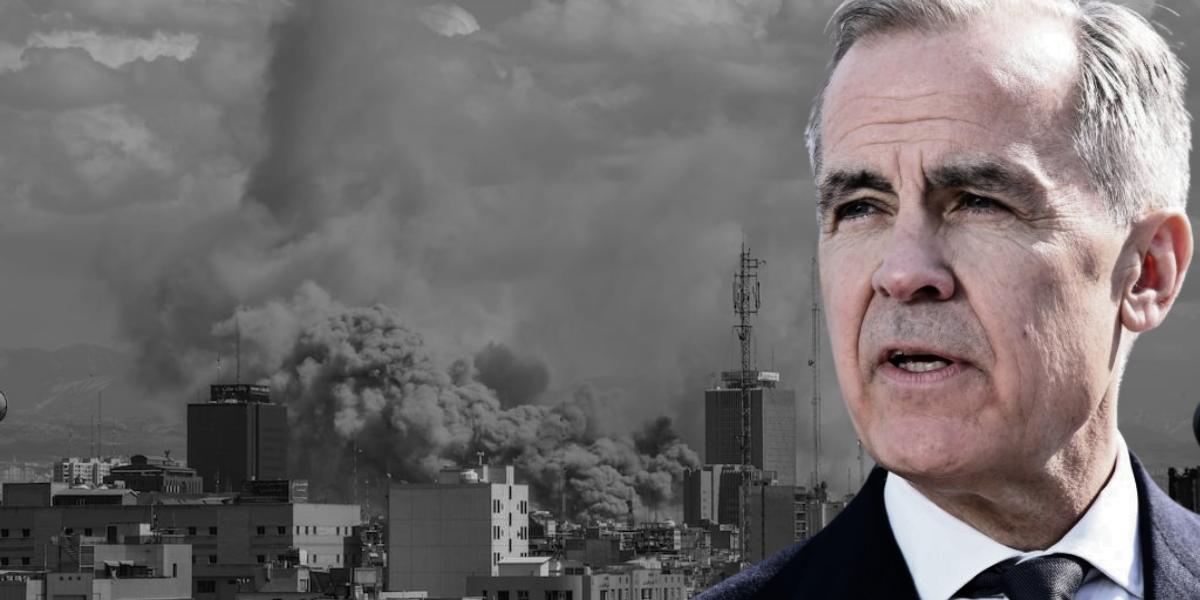
Canada’s stance on the US’s escalating war on Iran has been characterized by confusion, contradictions, and a risky openness to military intervention.
Prime Minister Mark Carney originally signaled Canada’s preference for a diplomatic resolution to the crisis. Yet, within a mere 24 hours amid a trade tour across Asia and a visit to Australia, his tone shifted. When questioned about the possibility of military involvement, he hesitated to exclude it entirely, remarking: “One can never categorically rule out participation. We will stand by our allies when it makes sense.”
This is clearly no act of neutrality. It exposes Canada’s growing inclination to align its military posture with that of the United States in the region.
From the outset, Carney’s messaging proved to be anything but consistent. When the bombing campaign against Iran erupted in late February, he initially backed the strikes, suggesting Iran held responsibility for “de-escalation.” But scarcely had the smoke begun to settle that he expressed a more conflicted stance—support tinged with regret, framing the attacks as yet another chapter in the slow unraveling of the international rules-based order. Simultaneously, he acknowledged the possibility that the strikes may have broken international law.
Despite raising concerns about legality, the Canadian government stopped short of backing calls for an immediate ceasefire. Instead, it issued a series of vague appeals for “de-escalation,” echoing a cautious plea for calm amidst the chaos.
These contradictions reveal a recurring motif in Canadian foreign policy. Ottawa’s self-image as stalwart defenders of international law often clashes with Canada’s active engagement in US-led military alliances. When tensions escalate, Canada’s stance shifts—from measured diplomatic discourse to overt political backing of Washington.
Dramatic escalation
On February 28, the United States and Israel orchestrated a series of coordinated airstrikes across Iran, striking at military infrastructure and key leadership figures. The strikes unfolded amidst ongoing negotiations between Washington and Tehran over Iran’s nuclear ambitions, negotiations conducted through regional intermediaries.
Diplomacy still lingered in the air when the bombs suddenly rained down, and exposed the US call for negotiations as a sham.
The strikes rapidly expanded into wider regional turmoil. Iran retaliated with sweeping missile and drone assaults across the Middle East, while Hezbollah fired rockets from southern Lebanon, opening yet another front. Israel responded with intensified military strikes throughout Lebanon, deepening a conflict that had already ravaged Gaza and much of southern Lebanon. The result is a region being pulled deeper and deeper into a broader war.
The conflict is increasingly spilling beyond the Middle East. In a startling development, a US submarine sank an Iranian naval vessel off Sri Lanka’s coast—reportedly the first confirmed ship sinking by submarine in combat since World War II.
The deployment of formidable naval fleets across the Indian Ocean signals a fragile underside—what may have started as a regional dispute threatens to spiral outward, risking a swift descent into global chaos.
Tensions have flared along the Strait of Hormuz, a vital artery in the world’s energy flow. Nearly 20 per cent of global oil passes through this narrow waterway between Iran and the Gulf states. Recently, the Iranian Revolutionary Guard Corps (IRGC) declared the Strait closed, warning that any ships daring to pass would face fire, effectively bringing maritime traffic to a standstill in one of the planet’s most crucial oil shipping corridors.
The Middle East is once again on fire
The rhetoric coming from Washington increasingly echoes the language used to justify previous wars in the region. President Donald Trump has openly floated the possibility of deploying ground troops while invoking the familiar logic of regime change.
The parallels with the lead-up to the 2003 invasion of Iraq are uncanny. Back then, military escalation was wrapped in the rhetoric of an urgent threat to global security. Those justifications unraveled over time, yet not before they ignited a conflict that claimed hundreds of thousands of lives and left the region in turmoil for generations.
This time, the stakes are raised even higher. Iran, nearly five times the size of Iraq, sits at the heart of regional geopolitics. A full-scale war would threaten catastrophic consequences—not just for the Middle East, but for the stability of the global economy.
Opposing the bombing of Iran does not equate to endorsing the Iranian regime. For years, the Islamic Republic has grappled with relentless internal opposition—waves of protests against repression, economic woes, and authoritarian dominance.
But bombs and regime-change wars imposed from outside will not deliver liberation.
Recent history offers a clear warning. Regime-change interventions in Iraq, Libya, and Afghanistan were all justified using the language of democracy, security, and humanitarian intervention. Instead, they led to humanitarian crises, prolonged instability, and the destruction of entire societies.
Canada was not merely a bystander in those wars.
For over a decade, the Canadian military stood shoulder-to-shoulder in the US-led war in Afghanistan—an enduring chapter in the nation’s history. In that time, 158 Canadian soldiers lost their lives, thousands returned with injuries that would forever alter their lives, and billions of public dollars were poured into the war.
Canadian forces were largely centered in Kandahar province, where some of the fiercest battles of the war raged. The mission was repeatedly sold as a quest to bring stability, security, and democracy. Yet, after two decades of conflict and occupation, the Afghan government crumbled, and the Taliban reclaimed power in 2021.
Afghanistan stood as a stark warning about the perils of following Washington into prolonged, open-ended, forever wars.
Yet Canada now appears to be following that same path once more.
Carney’s government has boldly elevated military spending to the heart of its economic agenda. Canada has committed to hitting NATO’s 2 per cent defence expenditure target by 2026, adding an extra $9 billion CAD into military budgets for the current fiscal year.
At the 2025 NATO summit, Canada made a bold promise: to eventually elevate its defence expenditure to five per cent of GDP by 2035. This ambitious pledge could propel annual military spending to approximately $150 billion CAD.
The government contends that these investments will bolster Canada’s security and ignite economic growth, fueling defence production and military procurement.
But Carney himself has acknowledged that such a transformation will come with costs. Ahead of the federal budget, he warned that transforming Canada’s economy would require “some sacrifices and some time.”
These sacrifices will likely target the very public services that working people rely on—from housing and health care to education and social programs.
Military expansion stokes political momentum, fueling the drive toward intervention. Governments pouring resources into their military forces increasingly see the use of that power as an inevitable course.
Carney’s reluctance to dismiss the possibility of involvement in the Iran war unfolds against a backdrop of expanding military commitments, NATO alliances, and shifting geopolitical chessboards.
Preventing another catastrophic war won’t stem from governments entrenched in military alliances.
A mass anti-war movement is urgently needed today
Our anti-war history echoes with this moment. In 2003, the Chrétien government declined to officially participate in the US invasion of Iraq. That stance was not formed in a vacuum but was inspired by vast anti-war protests that swept across Canada and the globe, as millions rose up in opposition to the looming conflict.
Trade unions, community organizations, students, and civil society must be at the forefront of rebuilding a broad anti-war movement. This movement should challenge the prevailing logic that links Canada’s foreign policy—and increasingly its economic strategy—to US military escalation.
The choice isn’t between Washington and Tehran. It’s between war and supporting ordinary people—those in Iran, throughout the Middle East, and at home—who will suffer the consequences of another disastrous conflict.
Stopping Canada’s drift toward involvement in the American war on Iran won’t happen by itself. It calls for a revitalized anti-war movement that can rally across workplaces, campuses, and communities—connecting opposition to foreign war with the struggle for social programs and public investments essential for working people at home.
Only that kind of movement can stop Canada from being drawn into another disastrous war.
Author

Did you like this article? Help us produce more like it by donating $1, $2, or $5. Donate