
International Overdose (and Drug Toxicity) Awareness Day takes place around the world every year on August 31st to honour those lost to the overdose crisis that is being ignored by those in power.
Approximately six people in Ontario die every day from the unregulated drug supply. Countless others suffer acute and chronic injuries, endure discrimination, and are incarcerated for non-violent offenses. Working-age men employed in the trades, Black and Indigenous peoples, and poor people are vastly overrepresented among those enduring drug-policy-related deaths and injuries. These are not just statistics: for members of the Harm Reduction Advocacy Collective (HAC), they represent our friends, peers, colleagues, and loved ones.
This year’s International Overdose (and Drug Toxicity) Awareness Day is taking place amidst the intensifying criminalization of people who use drugs and the shuttering of vital health and harm reduction services as a result of successive pieces of provincial legislation. These measures further marginalize people who use drugs and increase their risk of experiencing a fatal overdose.
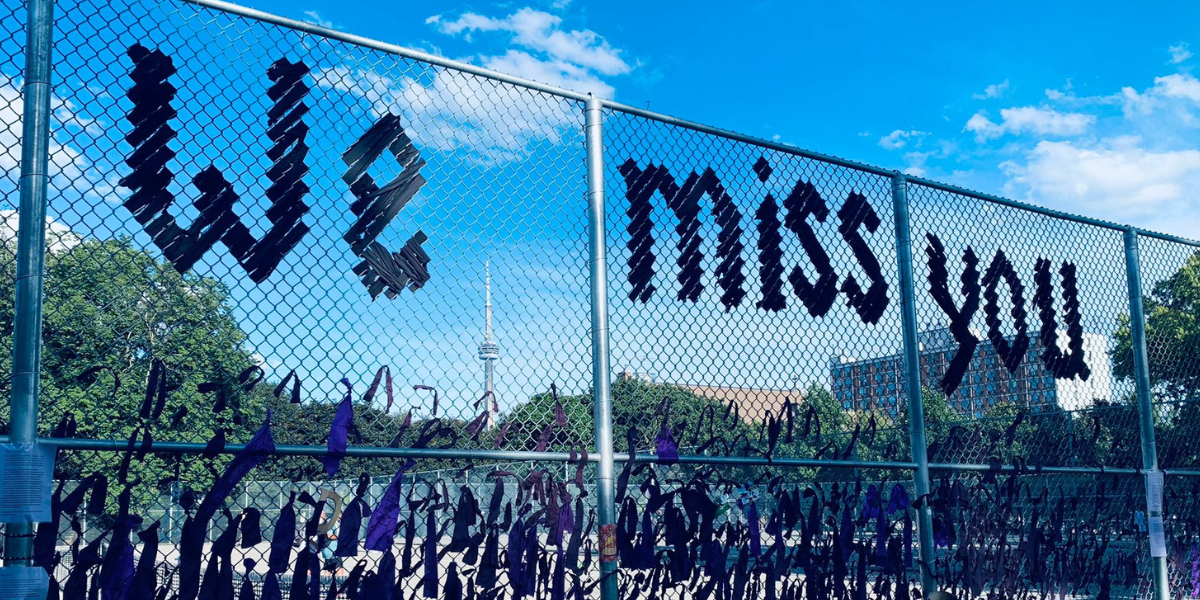
In Toronto, HAC is planning a series of community-led art installations and direct actions taking place over the day. We invite everyone to gather with us at “The Cube” at Scadding Court (707 Dundas St W) from 2pm onward on August 31. A procession to the vigil will depart at 6pm, following a winding route, illuminating dark alleyways and ending at the art installation at Trinity Bellwoods Park where the words “We miss you” were woven into the tennis court fence for last year’s event. The vigil will commence at 7:30pm, when all participants will be invited to then add to the installation with ribbons to memorialize lost ones. There will also be speakers and a grief tent.
The action builds from last year’s event, which focused on the looming closures of supervised consumption sites (SCS) required by Ontario’s Community Care and Recovery Act. The Act restricts the operation of harm reduction sites within 200 meters of a daycare or school, under the false belief that these sites attract violent criminals and encourage littering of used drug paraphernalia. In fact, these sites employ staff who clean up their neighbourhoods and users of the sites are usually extremely sensitive about exposing children to danger. There are also parents and children who use drugs, and these people are being pushed into hiding because their existence is seen as a danger to society in bills like this.
Using provincial funding as motivation, Ontario has ordered the opening of misleadingly named “Homeless and Addiction Recovery Treatment” (HART) hubs to replace SCSs. These hubs are ostensibly presented as “care” but have counter-productively eliminated access to basic harm reduction supplies and have instead mandated substance use ”treatment” in exchange for tenuous access to meagre resources. These heartless services are being forced on government funded health sites by the Doug Ford Ontario government in a tyrannical denial of the basic rights of site users. The bill is being challenged by The Neighbourhood Group, and a court has approved an injunction on the bill while we await their final decision. As we look toward IOAD 2025, HART hubs are now open in many of the closed SCSs.
The Ontario government’s drug-related policies exemplify the conservative and puritanical attitude of government policy makers who treat people who use drugs as outside of regular society, assuming that they are inherently criminal and not deserving of basic human rights or respect. The neoliberal, individualistic messaging from governments who claim to have housing to offer to unhoused folks perpetuates incorrect assumptions that people who are unhoused have made a choice to be that way. These issues intersect when drug users are expected to be abstinent from drugs to access housing, regardless of the health risks this presents and without addressing any needs that could be connected to substance use including mental health and trauma history, disability, and systemic barriers.
Community grassroots organizing, in contrast to HART hubs, focuses on providing resources that are required, immediately and without caveats, while affirming the agency and importance of people who use the services. In fact, organizations like HAC are adamant about the inclusion and leadership of people with lived experience who are directly impacted by the war on drugs. This marginalized population includes people in poverty, Indigenous people, queer and trans folks, women, children, immigrants, the working class, Black and racialized people, people with disabilities, and anyone who could be criminalized under laws like Bill 6 (which increases the criminalization of “public drug use” including in tents) and Bill 10 (which holds landlords criminally responsible for drug use by tenants, encouraging landlords to evict drug users). Self-advocacy matters to us at HAC because people seen as “victims” are actually the experts on these issues because of their lived experience and historical knowledge of the many related issues that are often overlooked by outsiders, even those with good intentions. We are United in Anger* against politicians, police and “health care” figures who orchestrate the organized abandonment of our community and we will never stop fighting because we keep each other safe.
In 2025, we are still fighting to keep supervised drug consumption sites open and against the criminalization of people who use drugs. Bill 6 was recently passed by Ontario’s legislature. as an attack on people who are houseless and are often assumed to be drug users and criminals. Being homeless is a failure of society, not individuals, and this Bill must be seen as yet another violation of the inalienable charter rights of valuable members of society.
We keep us safe, and harm reduction that meets people where they are at is the only way to save lives and reduce the negative impacts of a poisoned and criminalized drug supply. Please attend IOAD on August 31 and get involved in organizing in your neighbourhood! Check out hractoronto.net or @hac_toronto on Instagram.
* The slogan “united in anger” was used by ACTUP (The AIDS Coalition To Unleash Power) and we use it here in tribute to them and to acknowledge the inspiration and information we have taken from their struggle.
International Overdose (and Drug Toxicity) Awareness Day is taking place on Sunday, August 31. For more information and to find an event happening near you, please visit overdoseday.com.
To learn more about the Harm Reduction Advocacy Collective’s work, please visit hractoronto.net.
Author

Did you like this article? Help us produce more like it by donating $1, $2, or $5. Donate