
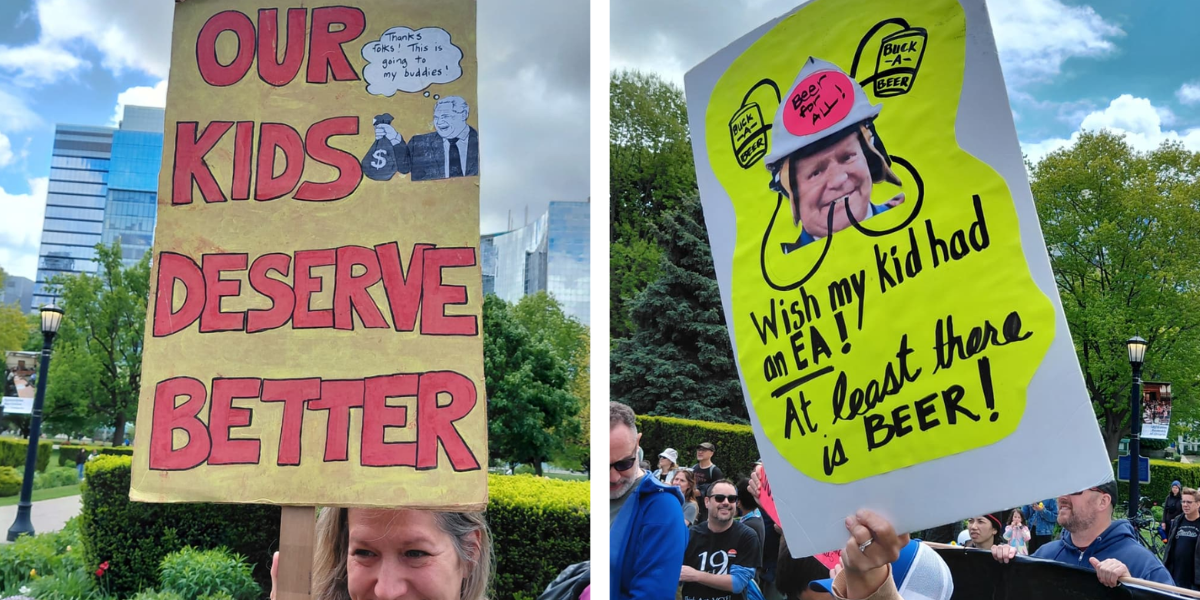
Peel Education Workers United (PEWU), a coalition of the 12 unions that represent more than 23,000 education workers in the Peel District School Board (PDSB), are denouncing the board’s decision to cut over 300 positions. The cuts would affect the 2026-2027 school year and are the biggest layoffs in the board’s history.
As budgets are forecasted for the following school year, staff are declared “excess to school” and “surplus to board/region” based on projected or forecasted need. Since the Ford government came to power in 2018, it has not been uncommon for teachers in their first few years to be excessed or surplused multiple times before they get enough seniority to stay in their positions. Uncertainty and change are common in a public education system chronically underfunded by Doug Ford Conservative’s government.
Calandra’s cuts
Last year, 64 elementary teachers were declared surplus to board/region, but all were hired back as retirements and other resignations opened up assignments for them to fill. What is uncommon this year is the size of the layoffs. With more than 300 teachers across elementary and secondary receiving surplus to board notices and more to come for Educational Assistants (EA) and Early Childhood Educators (ECEs) in the next few weeks the situation feels dire for educators and the students they serve.
It feels extra shocking as Education Minister Paul Calandra appointed himself temporary supervisor of the PDSB while proclaiming that he was doing so to stop the financial instability, save 60 teaching jobs, and protect students from staffing disruptions. The takeover of the board coincided with an end to a proposed mid-year re-organization in which 60 Central-Board-assigned teachers would be returned to classrooms and EAs would be shuffled to different schools. That plan was halted by collective action by PEWU and the Fund the Frontlines campaign, not by any benevolent action by the province. Calandra himself is now responsible for the 159 secondary and 172 elementary teachers being told that they will not have jobs next year.
Gift card funding is a sham
The announcement of the cuts came just days before the provincial government declared that it will be launching the Classroom Supplies Fund to provide elementary school homeroom teachers with direct access to $750 in funding each school year for classroom supplies via purchasing cards. The new fund will be launched as part of the province’s 2026 budget.
The new Classroom Supplies Fund will be included in Ontario’s 2026 budget, which is scheduled to be released on March 26. Ford and Education Minister Paul Calandra say the new funding is meant to ensure teachers have the tools they need in the classroom without paying out of their own pockets. The plan indicates that homeroom teachers will be able to use the funds to order supplies through a provincial website, with items delivered directly to schools.
The announcement was met with skepticism. Many educators have pointed out that the stipulations are vague With only “homeroom” teachers receiving the card, many are pointing out that many elementary teachers work in non-Homeroom teacher capacities and may, therefore, not be eligible to receive the funding. Others are, rightly, pointing out that this sounds a lot like other Ford-era scandals in which preferred business partners and supporters reap the benefits of lucrative contracts. Still others are suggesting that this is a way to “buy teachers off” right before bargaining with an offer that would be surely welcomed, but neglects to address the deep systemic problems within the province’s education system. Surely, common classroom items like pencils, paper, crayons, and facial tissue should be provided and funded by default by the very system that is now cynically offering teacher a gift card to purchase those items themselves
Even if the program were rolled out to every single teacher in the province (which the government has already stated that it won’t be), that would be an extra $63,000,000 dollars haphazardly “invested” in the education system. Divided evenly between Ontario’s roughly two million students that would be a measly $31.50 per student. Contrast that with the report last year from the Canadian Centre for Policy Alternatives which found that Ontario’s core education funding has dropped by $1,500 per student since 2018. The Ford government has overseen an education funding drop by $1,500 dollars per student (a total of $6.35 billion dollars across the entire public education system) and their answer is to give teachers a gift card that would inject less than $31.50 dollars per student. It is appalling and shameful.
PEWU will be insisting that that money could be better spent making sure the hundreds of teachers, EAs and ECEs receiving layoff notices will be in schools and supporting students come September. The board is blaming low enrollment, but enrollment is cyclical. Letting more than 300 dedicated educators walk away from the board or even the profession will hurt Peel in the long-term. What happens to Peel, a board under supervision, will be happening to others as Bill 33 has paved the way for the provincial government to take over boards and make financial decisions that will affect millions. “Peel is the canary in the education-funding coal mine,” said Aloysius Okafor, President of the Peel Elementary Occasional Teachers’ Local. “This government is choosing to gut classrooms as a first step. Teachers don’t want a $750 special charge card. They want adequate staffing to support their students.”
To fund the frontlines in the short term, the Board could use emergency reserve funds earmarked for special circumstances. What circumstance is more special than making sure student learning is not disrupted? The call to reinstate these employees is a fight for every education worker, student and parent across this province. Cuts like these will be felt most sharply by the most vulnerable students who access additional school supports, such as Special Education, Guidance, ESL and other front-line services.
“This is detrimental to students with special needs,” said Melody Hurtubise, President of OPSEU Local 2100, the union representing Educational Assistants and Early Childhood Educators in the PDSB. “By taking away special education supports, including contact rooms and specialized programming, this government will further harm Peel families already struggling with Ford’s defunding of health care, social services, and the autism wait list.”
All this is occuring while Doug Ford puts forward legislation to exempt him and his cabinet from Freedom of Information requests and ends funding for safe drug consumption sites.
Uniting to stop Ford’s attack on education
What is happening in Peel signals a broader warning about the direction of public education funding across Ontario. As so many education sector collective agreements are set to expire within the year (CUPE education workers, ETFO, OECTA, OSSTF and others) a coordinated approach to bargaining will be necessary to address the underfunding of education in the province.
By pushing for smaller class sizes and more frontline supports, education workers can reverse the cuts and get their jobs back. The unions have signalled that they are united. L’Association des enseignantes et des enseignants franco-ontariens (AEFO), Elementary Teachers’ Federation of Ontario (ETFO), Ontario English Catholic Teachers’ Association (OECTA), Ontario School Board Council of Unions (CUPE-OSBCU), and Ontario Secondary School Teachers’ Federation (OSSTF/FEESO) have called on the Ford government and Minister of Education Paul Calandra to start the bargaining process as soon as possible. Maintaining this united approach will be essential.
Author

Did you like this article? Help us produce more like it by donating $1, $2, or $5. Donate