
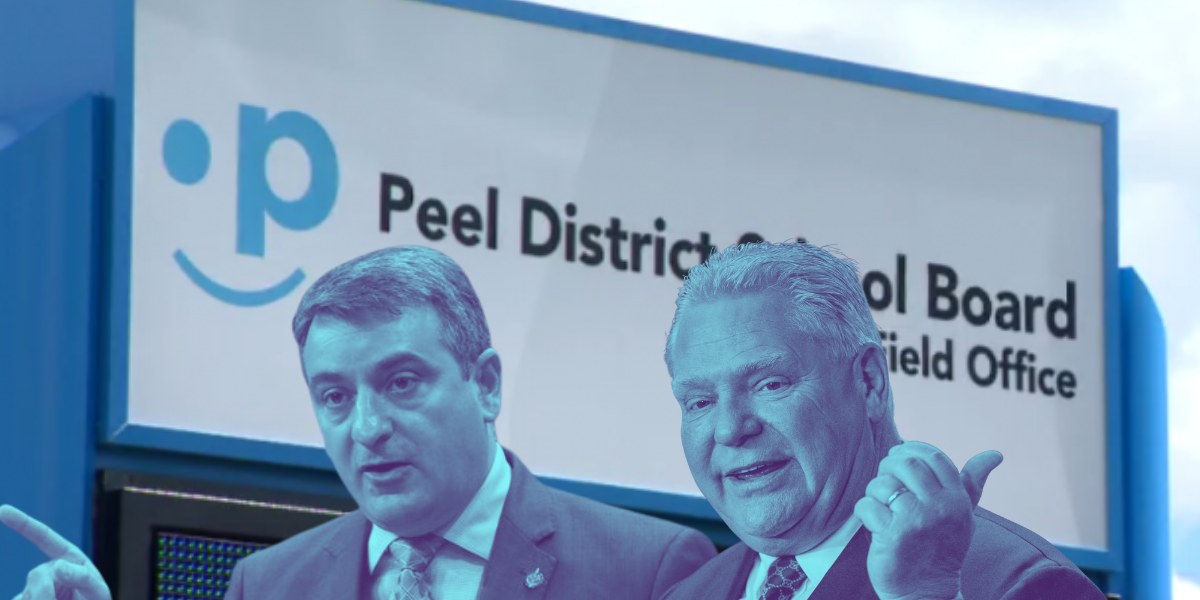
The Ford government announced on January 28 that it was moving to put two more Ontario school boards under its direct control. The Peel District School Board (PDSB) was taken over immediately and Education Minister, Paul Calandra put the York Catholic District School Board “on notice”, giving them two weeks to make the case against being put under supervision by the province.
Calandra began the spin immediately, insisting the move was to stop job losses at PDSB. In an announcement that Peel Elementary Teachers Local president Nadia Goode sent to members, she emphasized:
“The Ministry has suggested its decision is connected to the PDSB’s proposed mid-year reductions to front-line student supports and restructuring – changes education workers have collectively opposed over the past two weeks. That framing is disingenuous. These cuts were not inevitable. They were the direct result of years of provincial underfunding, as this government has stripped billions from public education through frozen funding formulas and a failure to keep pace with inflation. To now point to board-level austerity as justification for intervention ignores the Ministry’s own role in creating the crisis.”
Educators and parents in Peel united and won
The PDSB had announced at the beginning of 2026 that based on lower than expected student enrollment, they had to make significant cutbacks. That included laying off central board hired staff (such as literacy and math coaches and other specialized roles) and sending them back to their schools. This would displace the occasional teachers hired to do their usual jobs. In addition, they said this would require a mid-year reorganization of some classrooms and laying off centrally-hired Education Assistants and shuffling Education Assistants between schools.
These moves would have been terrible for students and schools, but Peel Education Workers United, a coalition of the 12 unions representing workers in the PDSB system came together to oppose the cuts. Faced with the combined opposition of education workers and parents, the PDSB quickly reversed most of their decisions. There would be no student reorganization and no EA shuffling. As Nadia Goode stated, “Because of sustained, organized pressure through our Fund the Frontlines campaign, and our collective action through Peel Education Workers United, those proposed cuts and reassignments have now been fully halted. Centrally assigned members will remain in their roles, and Occasional Teachers in full-year LTOs [long term occasional positions].”
So when Paul Calandra says, “The action I am taking at the PDSB will put an immediate halt to a disruptive mid-year upheaval in staffing that would have created uncertainty for parents, students and teachers alike,” he is not being genuine.
Calandra has already placed six other school boards under supervision, including Toronto Public, Toronto Catholic, Ottawa-Carleton, and Dufferin-Peel Catholic. Early in September, rumours began to circulate that Paul Calandra planned to collapse Ontario’s 72 school boards into just four: English Public, English Catholic, French Public and French Catholic. The moves to take over two more boards make that rumour seem even more plausible.
As we have seen from the Toronto District School Board and others, supervisors are eligible to bill up to $350,000 per year in salary. When they are sent in, trustees are sidelined and no longer paid.
Inadequate funding is the real problem
The education minister has argued he is able to make more “responsible” financial and governance decisions than local trustees. This obscures the fact that the those financial decisions by local boards have been sabotaged by inadequate funding from the province. The province has touted their education budget of $30.3 billion as a “record investment in education.”
However, a report last year from the Canadian Centre for Policy Alternatives found that Ontario’s core education funding has dropped by $1,500 per student since 2018. In individual schools, budgets are being slashed. The tech budget is down by 60 percent or more, and in some places they are barely able to afford photocopies and paper towel.
Critics have said it is a power grab by the province. Recently, Doug Ford’s government has spent $225 million in public funds to get Beer and Liquor into convenience stores. Doug Ford has moved to increase privatization in healthcare as well. He has not been shy about offering private solutions over public funding to fix problems in the public services. It is also the case that many contracts with education workers are set to expire this summer and some have speculated that the province wants to be in the driver’s seat in local bargaining, looking to claw back sick leave and other benefits.
Unity and collective action can defeat Ford’s attacks
Regardless, the key to countering Ford’s power grabs will be the same that reversed the initial cuts by the PDSB: unity and collective action. As Nadia Goode emphasized “This outcome [reversing the cuts] was not delivered by the Ministry; it was won by education workers. It reflects the strength of collective advocacy and solidarity across all 12 union affiliates representing 23,000 Peel education workers who refused to accept cuts to classrooms, student supports, and stability for students.”
Education workers’ contracts are set to expire at roughly the same time. Coordinating bargaining efforts so that all education workers standing together will be essential to stopping the Ford privatization and austerity agenda. An injury to one is an injury to all. United action such as that shown by the Peel Education Workers United will need to happen across the province with unions coming together for their collective good.
Learn more about what is happening in Peel at https://www.fundthefrontlines.ca/ and let’s keep that unity as we approach central and local bargaining.
Author

Did you like this article? Help us produce more like it by donating $1, $2, or $5. Donate