
Ontario’s post-secondary education has been in a prolonged crisis due to chronic underfunding from the government and mismanagement by college and university administrators It is not surprising that Ontario comes dead last in post-secondary funding per student compared to other provinces. Ontario also comes dead last in hospital funding and general program spending.
Colleges and universities have seen stagnant funding and tuition fees frozen since 2019, so the institutions have turned to international students as cash cows to keep their operations going and saw their surpluses grow despite funding falling. Satellite college programs began to pop up in Toronto to cater to international students who saw their fees double and triple to keep the machine running without public funds. With recent federal caps on immigration numbers, international student permits and graduate work permits, this lifeline is slowly disappearing. To be clear, the root cause of federal immigration caps is rising xenophobia and the offloading of government failures and corporate greed onto immigrants who were already paying a steep price. Any assertion that caps on international student permits is to protect them from exploitation is cover for widespread scapegoating of immigrants by all levels of government.
Layoffs, program closures, and growing demand
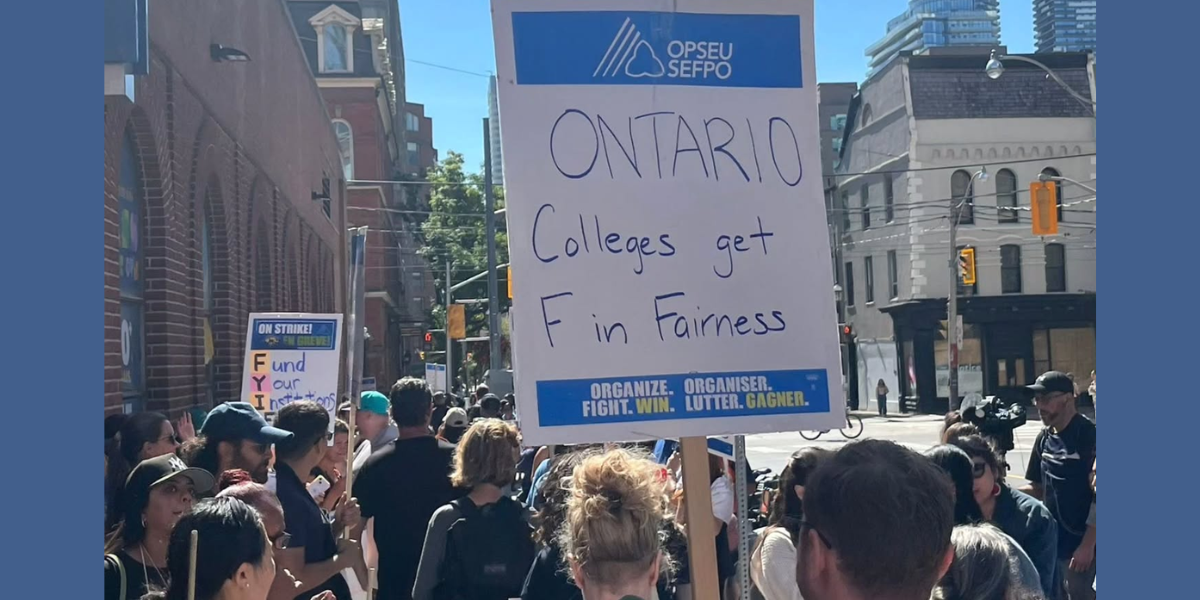
Colleges have started experiencing a devastating crisis in 2025 and are still seeing it worsen, with over 12,000 layoffs and over 600 program closures. The college model intended to offer local, affordable, and accessible education is disappearing as a result. Over 11,000 college support staff went on strike last fall to fight the cuts and demand a fair contract but are still facing an uncertain future for colleges and their livelihoods. This is troubling, as demand for college education will only increase in the coming years, as the college-age population is projected to increase by 20 percent. Recent polls show that more people see themselves in need of constant retraining to adapt to a volatile job market and threats from AI. In a province with crumbling public services, struggling post-secondary education, and high unemployment rates—particularly youth unemployment—this crisis is an existential disaster for Ontarians and the Ford government.
The financial, social and existential doom is also translating into public polls where support for the Progressive Conservatives and Doug Ford is softening. While the Ford government leads in voter intention and name recognition, they have abysmal favorability in actually governing and making the lives of Ontarians better. Almost half, 48 percent of those polled in January 2026 , say it is definitely time for a change in government in Ontario (up 6 points since October). In a February 2026 poll, the support for PCs is declining but Liberals are gaining ground even without an official leader of the party indicating people are desperate for an alternative. These results are also troubling for the ONDP as it continues to slip in polls. The key takeaway is that the government is feeling the crisis it has created and fueled for so long. While chronic underfunding and privatization of all facets of life has been a rampant feature under the Ford government, the areas hurting Ontarians the most in polls are healthcare, long waitlists for family doctors and beds and general affordability.
Tuition fees must go down, not up
In the midst of an affordability and unemployment crisis, the Ford government announced a revised post secondary education funding model this week which offers too little and too late but most notably increases tuition fees by 2 percent and brings in financial aid reforms. Under the new reform, 25 percent of a student’s funding can be non-repayable grants and 75 percent will be loans. This is a near reversal of the current system, where up to 85 percent can be grants and 15 percent loans. This has huge financial implications for students and their families as it will mean education will become increasingly unaffordable and will come with higher student debts. This model is a disaster not only because on principle tuition fees should go down and not up, but also because this model has been tested elsewhere including the UK where grants were eventually entirely replaced by loans, plunging students in a debt spiral.
The announcement of more funding for colleges and universities is framed as historic funding but the fine print clearly shows this is another policy that will make life more unaffordable for young people and those looking to retrain in the middle of an unemployment crisis. While the government wants us to be distracted by big figures like $6.4 billion over four years, but a six per cent increase to base operating funding as announced, it appears Ontario’s colleges and universities will still have the lowest funding in the country and won’t stabilize the sector. However, the tuition fee increase opens the gates for future governments to further increase tuition fees or change the funding formula making education wholly unaffordable. As public alternatives become attractive, the government is also propping up private training programs through the Skills Development Fund which has received over $2.5 billion to duplicate, in many cases low quality, private training. The fund has been mired in controversy and scandal as expected of any such unchecked transfer of public funds into private and corporate hands. This is the reason, as socialists, we oppose privatization—because not only is it enriching corporations, but it is expensive for all of us, lowers quality, and removes good jobs from our communities.
What does this mean for all of us?
Ford’s changes mean a college or university education will come with a greater price tag and more debt. The new changes to funding also means that the government can decide which programs are “in-demand”, important and funded, and which programs can be underfunded, like arts and sciences, as we have already seen. It also affirms that this government has no intention of meaningfully raising per-student funding, which directly translates into education quality and experience more than any other emergency funding it releases to win political favour.
For anyone who doesn’t see this affecting them right now, it does. Here is how: attacking public education and increasing costs affects us all, as it is directly linked to jobs and affordability. A college degree or training, for instance, halves youth unemployment, and when these economic lifelines are being threatened, we should all be ready to fight back for generations to come. A crumbling public education system means many prospective students will not have a post secondary education option in their own community. It also means that many more staff layoffs are coming in the sector, laying off tens of thousands of unionized workers, weakening the labour movement. We also know it does not stop at post-secondary education access and quality.
There is also an opportunity here as the polls indicate. We are seeing a political crisis brewing for the Ford government, and polling shows their growing unpopularity. As socialists and community members—many graduates of colleges and universities here—we need to organize pressure and support the workers at these institutions to mount a fightback and call for reversing these changes. The student movement in Ontario was able to fight back the student choice initiative in 2018 and made gains on many fronts. This crisis requires all of us to make these links for the wider province on how education, affordability, and our futures are interlinked—and we can’t and won’t let this happen.
Author

Did you like this article? Help us produce more like it by donating $1, $2, or $5. Donate