
In 2018, Doug Ford unveiled the slogan ‘Open for Business’ and plastered it across the province and on license plates. The fact that these were later scrapped at great cost to the taxpayer didn’t stop him from taking that slogan to its logical extreme as he successively and rapidly sold Ontario to his friends and the wealthy elites in exchange for political consent and more.
From the Greenbelt scandal to the billion-dollar booze boondoggle, from selling off Ontario Place to Bill 5, the removal of bike lanes, and repeated attacks on public sector workers—Ford’s government has sold off public land, services, jobs, and the environment to the highest bidder.
Despite this record, recent polls show Ford still enjoys strong approval ratings and would likely win another election if it were held today. Furthermore, the PCs are strengthening their position even further as Doug Ford’s brand continues to outperform all rivals, while the opposition parties struggle to gain traction.
Ford’s popularity vs. reality
Doug Ford is not on the side of workers and certainly does not offer any relief for the class. He has cultivated a “man of the people” image, posing as a champion of jobs and families at workplaces and diners, but under his leadership life has become objectively harder for Ontarians.
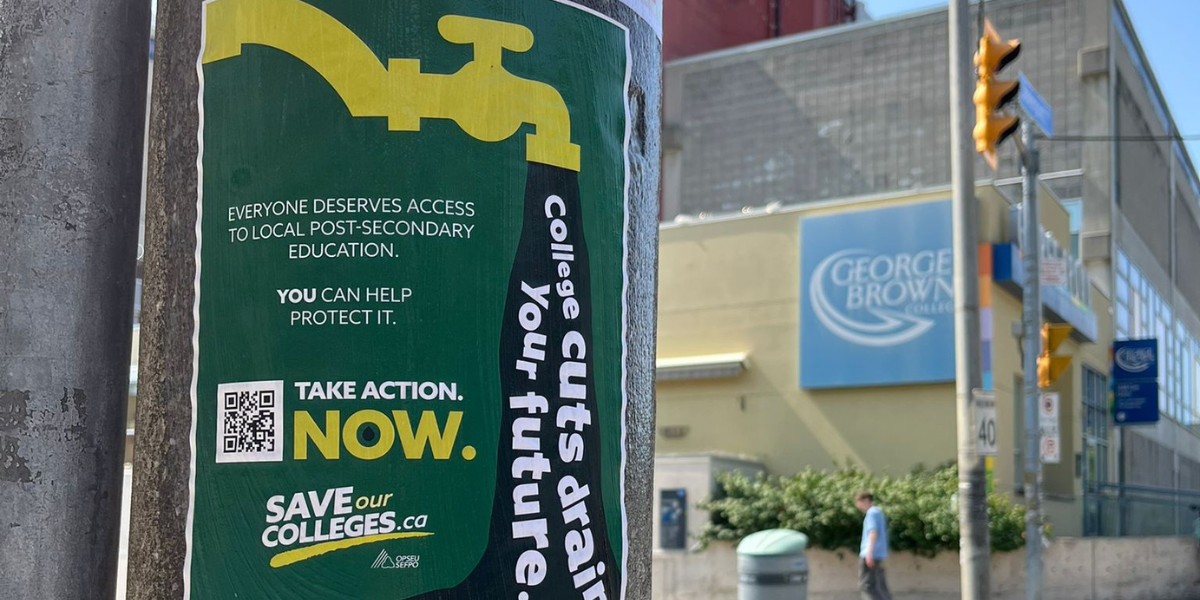
Ontario has some of the highest unemployment rates in the country, as well as some of the highest youth unemployment rates. As of June 2025, nearly one in four teenagers in Ontario’s labour force is now unemployed. The cost of living has skyrocketed with 59% of Canadians expecting conditions to worsen and just 10% expecting improvement, reinforcing the notion that financial strain is becoming a permanent feature of Canadian life. Public sector workers—many of them frontline workers in fields such as healthcare and education—saw their wages frozen between 2019 and 2022 under Bill 124, which was later ruled unconstitutional by the Ontario Superior Court. The Bill targeted workers who are mainly women and racialized, resulting in a dangerous underfunding and understaffing crisis across our hospitals, long-term care facilities, and children’s aid societies. The latest provincial budget shows that this is not an unintended consequence, but rather the very backbone of the province’s plan with most public sectors receiving funding (which has not kept up with inflation). Most recently, tens of thousands of college workers have been laid off, part of a calculated effort to privatize education and weaken unions.
Ford justifies these policies with fiscal conservatism and “responsible budgeting,” but this narrative is a smokescreen. His government has wasted billions of taxpayer dollars through political favoritism: selling public land to developers for example, or funneling funds into highways and boutique projects including a private spa on Ontario Place. These are not “hard choices in hard times.” These are decisions rooted in political self-interest, enriching his allies while Ontarians suffer from underfunded schools, hospitals, and communities as has been proven in many instances.
The attack on public sector workers
While our public hospitals, schools, colleges and universities are being gutted, we are also seeing a concerted attack on the workers that run them. We are already witnessing massive public sector layoffs at both provincial and federal levels, fueled by the false perception that these workers are wasteful. OPSEU’s “Worth Fighting For” campaign is revealing how the impacts of Bill 124 and understaffing of social and health services have pushed workers to a tipping point. These reductions in public services and staffing are presented as “essential cost-cutting,” but this narrative makes a mockery of the truth.
Public sector workers run the services that keep Ontario functioning. The public sector provides good, stable jobs with fair benefits, close equity gaps, and support communities. When they are attacked, all Ontarians lose: not only does it lower the floor for workers in the private sector, but it also affects the services we receive.
Privatization of public services decreases service quality and increases unnecessary bureaucracy. In 2014, the Auditor General revealed that the government could have saved $8 billion on 74 infrastructure projects if they were built and financed through public procurement. Public services not only save money but also offer decent union jobs with benefits and reduce the pay gap for Indigenous, Black and racialized workers compared to the private sector.
Changing the narrative
Ask yourself: is your life easier or harder than your parents and grandparents? And ask yourself also: what has changed? Are there more or fewer public services? Is there more or less privatization? Are there more or fewer restrictions on how much your landlord can change your rent? In almost every way, life is harder for Ontarians today. Services are being cut or privatized at an increasing rate, with the cost burden being shifted to individuals, and what services remain are increasingly squeezed and understaffed. The wealth of the very richest people in society has grown enormously while wages for workers have stagnated. Rent is higher than ever and rent control has been eliminated alongside paid sick days despite our collective experience of the pandemic. The answer is not more of the same, but a different system that delivers for workers.
Ford’s support may seem wide, deep, and uniform, but this does not mean Ontarians want this future. With voter turnout at 45.5% in 2025 (the second-lowest in Ontario’s history), only 19.5% of eligible voters cast a vote for Ford. As socialists, we do not chase polls; we change them. We don’t blame people for supporting Ford while demanding a better life. Instead, we offer a clear, alternative vision that includes an affordable life with high quality, accessible healthcare, education, housing and childcare, public spaces and programs that make life livable: a province that works for everyone, not just businesses and elites.
Contrary to what the Ford government wants us to believe, public services and public sector workers are our best defense against economic precarity—not privatization.
The role of unions and movements
The strongest vehicle for this vision is the union movement, particularly public sector unions, which are indispensable in protecting Ontario’s public sector. We’ve seen this in action before with the 2024 LCBO workers’ fight for keeping the LCBO public with decent jobs and the education workers’ strike in 2022. We need bigger movements to show that privatization harms all of us and that strong public services are the foundation of a fair society. As workers, we have the evidence and experience to win this argument.
Public services are a direct investment in communities and workers. Ford’s subsidies to corporations line private pockets before benefits ever reach workers. History shows privatization is a failure—services often cost more, quality declines, and workers pay the price.
Here in Ontario, there are many fights underway to defend public services and workers, from “Save Our Colleges” to “Worth Fighting For.” We must build these movements and make the alternative to Ford’s Ontario inevitable. We can start immediately by supporting the 22,000 college full-time support workers who could be on provincial strike starting September 11 to demand an end to the cuts of public education and a fair contract. Get involved here.
Author

Did you like this article? Help us produce more like it by donating $1, $2, or $5. Donate