
As fires ravage North West Ontario and Canada’s biggest city chokes under yellow skies and the worst air quality in the world,we are reminded of Doug Ford’s agenda for Ontario. In 2025, Ford’s Conservative government decreased the province’s budget for emergency forest firefighting from $177 million to $135 million, with $4 million cut from emergency preparedness. This is the same plan he has for healthcare and education, where investment has poured into private options and spending has not kept pace with inflation. His government is undemocratic, corrupt and the only way to stop it is with the collective mass action of Ontario’s working class. Mass collective action has the potential to cut against the divide and rule politics dominate right now.
How can we defeat Ford?
The opportunity to do that is right here and now. 255,000 education workers across the province have contracts expiring and begun collective bargaining with the province. That is an incredible potential force that can challenge Ford’s plan for Ontario and make the case for robust spending into the kind of public services that Ontario deserves.
A movement of united education workers can stand up to Ford and change the political terrain in the province, including for OPSEU public service workers who have been on strike for more than 8 weeks, holding out for more funding from the provincial government. In 2022, 55,000 education workers represented by CUPE’s took illegal strike action that shook the province.
CUPE members engaged in a systematic process of member-to-member organizing that produced a strike vote with 96.5 percent in favour and an 83 percent turnout. Activists in the community adopted worked to build solidarity in the run-up to the strike. Across the province, people were adopting local schools and covering the area with posters of support and purple ribbons to show their support for the education workers. Parents used pick up and drop off to sign up others to pledge their support. These initiatives, coupled with the union’s success in bargaining for the public good, produced a wave of support for education workers that swept the province.
So when the Ford government declared their strike action illegal with the emergency passage of Bill 28, CUPE workers had the confidence to go out anyway. They received solidarity from OPSEU, the largest public sector union in Ontario, who sent a letter to its 8,000 members in the education sector, encouraging them to walk off the job and join CUPE’s pickets. OPSEU’s move led to the closure of schools that initially tried to stay open despite the strike. This groundswell of support against an extremely harsh and repressive law, brought the whole labour movement into a near general strike, forcing Doug Ford to back down completely. This new political terrain led to swift and favourable settlements with the CUPE and the other education worker unions.
Education workers can defeat Ford
What do these lessons mean for us right now? First of all, they mean that Ford can be challenged outside of an election and united labour action can win. It means that if the education workers unions can work in solidarity, great things are possible for the workers, the education system and the province.
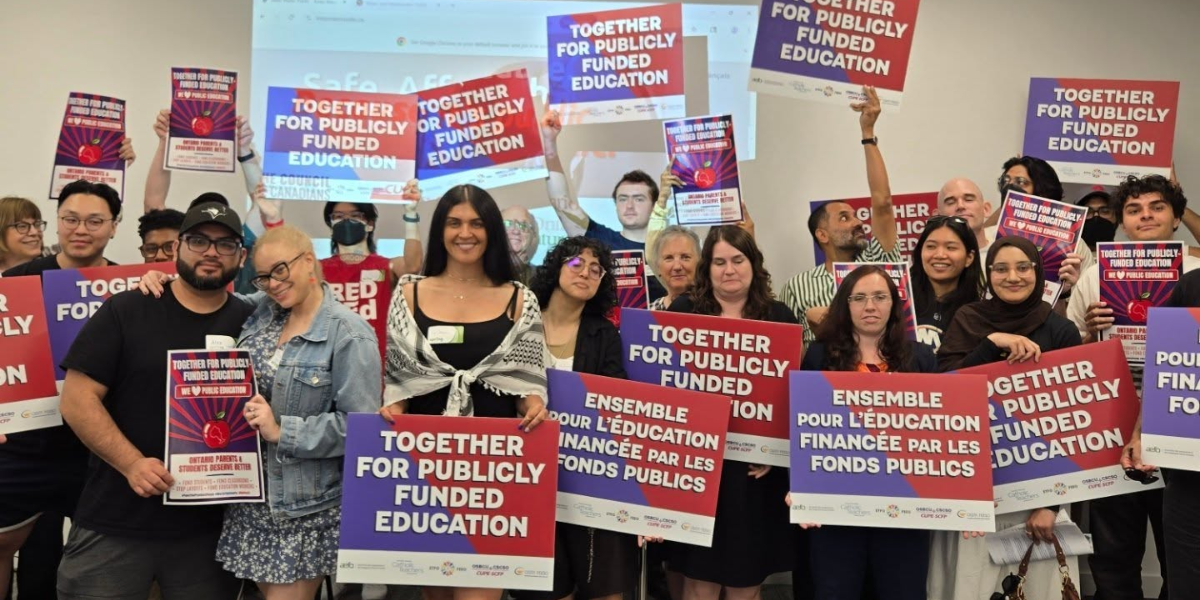
The unions have so far signalled that they are united. They have been holding joint press conferences, holding coordinated public outreach and distributing lawn signs that bear all of their symbols. L’Association des enseignantes et des enseignants franco-ontariens (AEFO), Elementary Teachers’ Federation of Ontario (ETFO), Ontario English Catholic Teachers’ Association (OECTA), Ontario School Board Council of Unions (CUPE-OSBCU), and Ontario Secondary School Teachers’ Federation (OSSTF/FEESO) have united around the demands of “smaller class sizes” and “adequate funding for special education needs.”
These get at the heart of the underfunding of education in the province and connect educator working conditions with student learning conditions. More adults in the building improves the quality of education. It is expensive, but there is no shortcut to a good education system. Ontario is a rich province and should invest in this crucial public service.
The fact is, educators in Ontario are being asked to do more with less. The 2026-2027 budget features a $56.2 million cut to the Classroom Staffing Fund. The fund supports the majority of in-classroom staffing costs and includes educators such as teachers, Early Childhood Educators, and Educational Assistants. Combined with the shameful 0.1% increase to Special Education funding, the cut to the Classroom Staffing Fund will put school boards in ever tougher situations as they try to meet student needs in their communities. These cuts are part of a broader pattern of underfunding by the province: since 2018, the Ontario government has cut $6.35 billion in education funding when adjusted for inflation and enrollment.
2022 showed us that community solidarity is important. For education workers to win they need to turn this into a political crisis for the Ford government. Ford is currently polling at his lowest numbers ever. His accumulated baggage of scandals, the weak economy, and crumbling public services are contributing to his sagging popularity. However, we’ve seen this before: despite fluctuating (and sometimes quite low) approval ratings, he has survived to win three majority governments. We need to solidify existing anti-Ford sentiment.
Education is where Ford is vulnerable
Education is a weak point for Ford and his government, and is a potential place where he can be defeated. Even Conservatives don’t think they’re doing a great job (for example, the recent editorial in the National Post decrying the province’s handling of Special Education) and parents are upset about the very well-publicized job cuts. There is a need and an opportunity to organize this sentiment.
It will be crucial for education workers and activists to use the summer months to build public awareness of their fight for better education. A successful strike against the Ford government will require community support; parents organized to care for children out of school, support picket lines, and pressure their MPPs for a quick settlement.
Author

Did you like this article? Help us produce more like it by donating $1, $2, or $5. Donate