
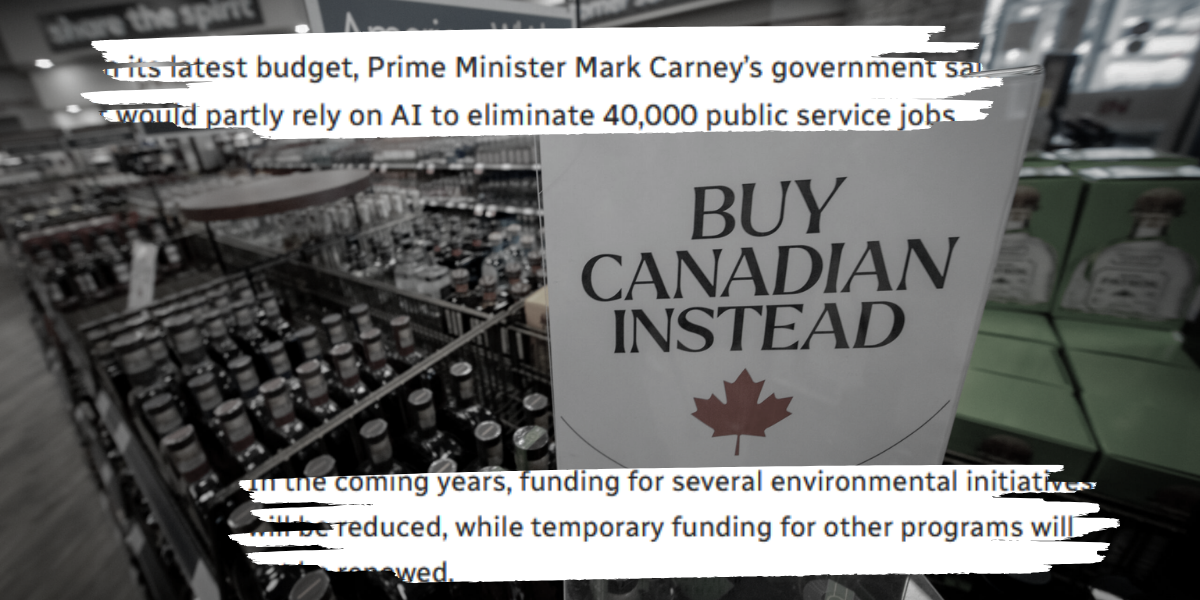
The outbreak of multiple regional wars, the global increase in military spending, and the fractious trade wars in response to Trump’s tariffs are all signs of an increasingly unstable global order. The recent fallout over Trump’s trade deal has whipped the country into a frenzy of “elbows up” nationalism, with many cheering on Carney as he openly draws up more plans to gut jobs, communities, and the planet. While there is a tendency to blame Donald Trump’s personality for plunging us into a deeply unstable global order, as socialists, we understand that Trump is merely a symptom of this instability, not its root cause.
The inability of the capitalist system to address fundamental and interlinked contradictions results in this instability: endlessly driving up profits while immiserating the workers whose exploitation enables such profits.
Why is global competition bad for workers?
The increase in military spending is a violent expression of this competition for resources, increased rates of profit, and domination. Likewise, the massive global AI race is retrenching state competition, fueling trade wars, and undermining efforts to combat climate change. The proliferation of trade wars and real wars speaks to the inability of the capitalist class to easily manage its affairs.
This competition has real consequences for the working class both at home and abroad. The cost of living has outstripped wage growth, social spending is being counterposed with military spending, states have abandoned commitments to address the climate catastrophe, and trade wars have opened the door to deregulation and renewed nationalism. This has led to an increased concentration of wealth by the capitalist class.
It is important to view the latest trade war between the US and Canada within this wider context of capitalist forces creating these crises at the expense of workers.
Trade wars, “Elbows Up” nationalism and its consequences
We cannot stand behind the Carney government, which has already attacked workers and social programs, to protect us from these new rounds of tariffs and economic hardship . We are also seeing the ripple effects of this federal picture provincially, with Doug Ford in Ontario riding the anti-Trump wave to see his deeply unpopular government climb in the polls. When Trump was elected in 2024, Ford celebrated his re-election; now, Ford is the loudest voice in defense of Lake Ontario while letting 4,500 social and community service workers hold a picket line for above-poverty wages for fourteen weeks in Ontario. This irony should not be lost on anyone. Empty political gestures from our governments will not save us from the reality they have set into motion through decades of decreased public spending across the board.
The “elbows up” nationalism logic resulting from the trade wars have necessitated that Canadian sovereignty vis-à-vis the US prevail at any cost, including accepting job losses, cutting public spending, and pumping public dollars into Canadian corporations for AI and military spending.
There is also a knee-jerk reaction of state retaliation cheered on by the ruling class which involves inflicting pain on Americans in the hopes it will punish Trump. Some sections of the left and policy think tanks have come out with plans that target US workers in Republican states through retaliatory tariffs. The targeted US states are home to some of the most impoverished communities.
American wages have already fallen to 43 per cent of national income, the lowest since the Great Depression. For every $1 the US economy produces, workers are getting less of it than at any point since 1929. Hurting workers in the US does not rescue us from our predatory corporate elites or Trump. There can be no path to justice or economic betterment for us here in Canada at the cost of the livelihoods of workers in the US or anywhere else.
Raising the demand for robust public spending
A recent poll was touted in a Globe and Mail opinion piece to demonstrate the extent to which average Canadians are willing to shoulder declining standards of living for national unity. The article concludes: “For a majority of Canadians, national pride appears anchored in genuine resolve to bear substantial personal costs defending our country against any and all who might come after us.” This political context gives the federal Liberal government the license to cut public spending and abandon climate commitments in exchange for military expansion, and move swiftly on proposals to curb the Charter-protected right to strike. While the Carney government has its sights on further tilting the balance of power toward major corporations and employers without much resistance, the things that are worth defending like our public healthcare, education and social safety net are facing imminent threat.
Booing American national anthems and consuming Chapman’s ice cream may feel like decisive ways to fight back against Trump’s threats, but they only show loyalty to capitalists within our own borders. As socialists, we know that the enemy is always at home, and they can only be confronted from where we are rooted.
One way of truly defending Canadian interests is by fighting for everyday workers and families who will be the first casualties of trade wars. Our economy and livelihoods will only be sustained through robust public spending that keeps up with inflation and population needs. We need to make a case for job creation and retention in the public sector, stronger worker protections and permanent Employment Insurance (EI) reform that removes barriers to access.
In reality, budget after budget, we have seen increased cuts to public sector jobs and programs that support workers, families, and the planet. As recently as November 2025, the federal government moved to reduce revenue through tax cuts, cut direct government program spending substantially, and increased military spending — from 2 per cent of GDP in 2025 to 5 percent in 2035. At a time when our economy is in recession, the government has chosen to stimulate the defense sector instead of rescuing every other sector in crisis, from healthcare to housing. We see similar austerity budgets being released across the provinces as well, solidifying a bleak economic future.
The forces fighting for workers are workers themselves; no one else is coming to save us. Our demands for better public spending are neither new nor unpopular. Poll after poll both nationally and in Ontario, public healthcare, the cost of living, and good jobs are the three most common demands and areas where people feel the most pain. While there is widespread support for the Carney government and its handling of the trade deal, a recent poll revealed that one-in-eight Canadian workers said they are “very” concerned about losing their job, with a further 25 per cent expressing some level of anxiety. The current tariff reality will cost the economy 0.4 per cent of GDP and as many as nearly 90,000 jobs according to experts. Therein lies the main contradiction between what our governments are willing to offer and what workers need and want.
The federal government has announced some modest supports to mitigate the tariff impacts including temporary EI reforms, but they fall short as the government fails to address some of the biggest gaps in Canada’s EI system. Lowering qualifying hours for part-time, part-year, seasonal and precarious workers, improving benefit rates, and extending benefit durations are all necessary for a robust EI system. These are the kinds of demands and spending that will support workers across all sectors in the face of job losses and unite the class to fight austerity at home. We should fight to ensure that any dollars being spent to counter tariffs are going to protect workers and our communities, and strengthen the industries that sustain Canada including the public sector.
The fights being waged by public sector unions and allies across the country are critical to winning our demands for direct investment in workers. The education workers’ fight in Ontario, backed by the force of a quarter of a million education workers and allies, is capable of mounting the kind of fightback that will defeat the chronic underinvestment in public services that is becoming the norm federally and provincially, while exposing the hypocrisy of the Ford government. We need all of us out there building this fight in our unions and outside of it, building the confidence of workers in our communities and workplaces to reject the logic of nationalism-fueled austerity that gives cover to the ruling class, and demand proper investment in good jobs, robust public services and strong social safety net for workers.
Author

Did you like this article? Help us produce more like it by donating $1, $2, or $5. Donate