
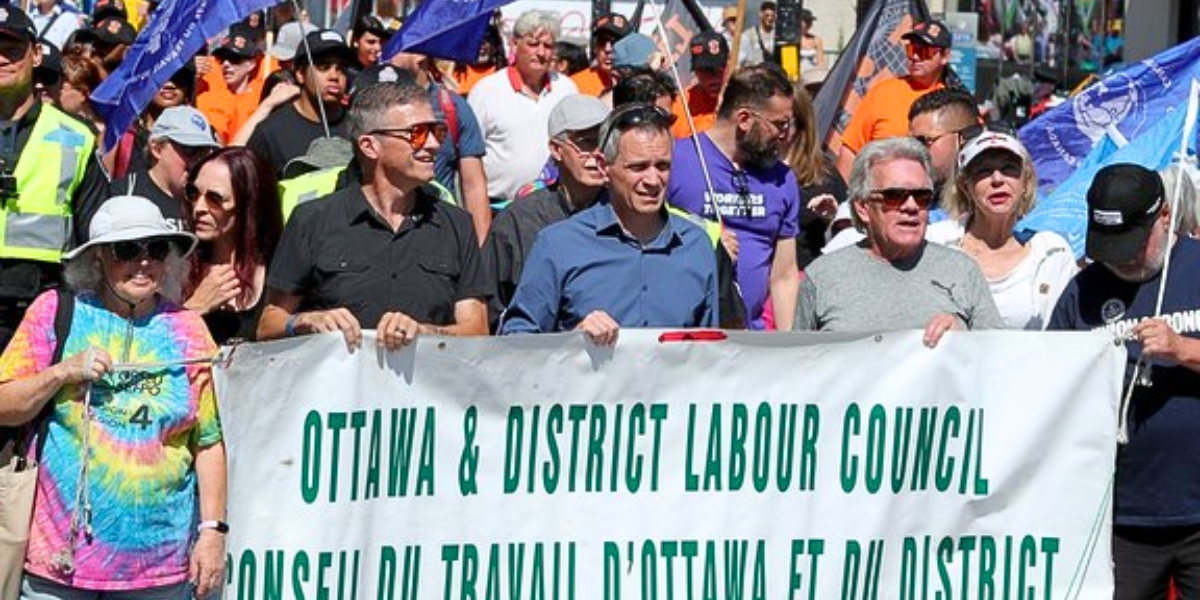
“We don’t have to watch things get worse, or wait for politicians to save us. Yes, we need champions in labour, and we must push them to deliver. That’s on us.” – Lizzie Houlding
Elections for Ottawa & District Labour Council (ODLC) are on Wednesday February 18th and Lizzie Houlding, Spring Member, is running for Vice President, alongside Susan Rab for President
Ottawa has one of the highest unionization rates in Canada with roughly 50 percent of workers organized into unions. With a high unionization rate, the Labour Council could be energized to realize big demands.
Lizzie has a passion for workers’ justice, on display in her years of organizing work. She has been active with the Justice for Workers campaign and served as the Ottawa organizing lead from 2020-2024. She is currently the Membership Engagement Rep at Horizon Ottawa, an organization working to advance public ownership of land and infrastructure in Ottawa. Within organized labour, Lizzie has served as a Steward Membership Engagement Lead in her union local since 2025. She is also on OPSEU’s Hospital Professional Division Executive as the Public Policy Lead.
Lizzie sat down with Spring to discuss her campaign and what it means to be a rank-and-file organizer running for leadership positions.
How did you first get involved with the Ottawa & District Labour Council?
Lizzie Houlding: I was brought in through a comrade in Spring, James Clark, who brought me into the “Enough is Enough” campaign. He asked if I could lead a rally for the campaign. The Ontario Federation of Labour was running rallies through the local labour councils, and I was brought in with Justice for Workers and got paired up with Sean McKenny and a few other community groups. Together through new relationships, we organized this big rally of 500 people. So that brought me into awareness of the Labour Council, and once I got more involved with my local I asked to be involved. I thought it was a great springboard for campaigns.
What does the process of running for the ODLC involve?
LH: In order to run for the ODLC you need to be an elected delegate of your local that pays dues to the ODLC. Each local gets up to seven delegates, and you have to attend at least six meetings. Meetings are once a month. My local has 1,500 members so we get seven delegates.
What is the hope for change with new leadership?
LH: The current leadership has been great at having strong relationships with OSPEU leadership. However, there needs to be more of a push for growing the Labour Council and growing rank-and-file membership engagement. There have been locals and unions that have been allowed to fall out of affiliation due to lack of payment. We want to bring people in and grow the council.
There’s a lot of potential there. We really need a space to coordinate campaigns and build solidarity. These councils also are great to prevent raiding and other noncooperative actions.
A lot of our major public service unions are not affiliated with ODLC. PSAC (Public Service Unions Alliance of Canada) is unaffiliated. CAPE (Canadian Association of Professional Employees) is not affiliated. PIPCS (Professional Institute of the Public Service of Canada) is not affiliated. They’ve even started their own regional councils.
What are some of the roadblocks for membership?
LH: Some central union bodies support the dues payments to regional councils, but many do not. That’s something we’re looking to help locals change in order to bring in more voices. It’s about 50 cents per member every month and you only get up to seven delegates, so the financial burden is huge for many unions. We’re looking to speak to those locals that aren’t affiliated and try to build bridges and find those gaps.
How do you balance rank-and-file goals with running for leadership?
LH: Building capacity with membership is one of the biggest goals of our campaign. Currently with how the Labour Council is run, it’s a lot of effort to bring people out to something that I know, at this time, won’t be a great use of my members’ time. It’s a balance of changing how leadership is running in order to facilitate a rank-and-file approach. It’s going to take a lot of capacity building to bring in more people.
What are some of your main platform goals?
LH: Firstly, as I’ve been speaking to: grow the Labour Council. Secondly, bring in the power of these massive locals we have in the region, and moreover, make sure we are connecting and bringing in the full force of the labour movement. A big place where I think the Labour Council can really make an impact is organizing—there are a lot of non-organized private sector unions. Lastly, connecting with grassroots campaigns, and rooting those in labour organizing.
How long is the term, and how can people outside the Ottawa area support you?
LH: It’s a two-year term. People paying attention to these races and being engaged does a lot.
Author

Did you like this article? Help us produce more like it by donating $1, $2, or $5. Donate