
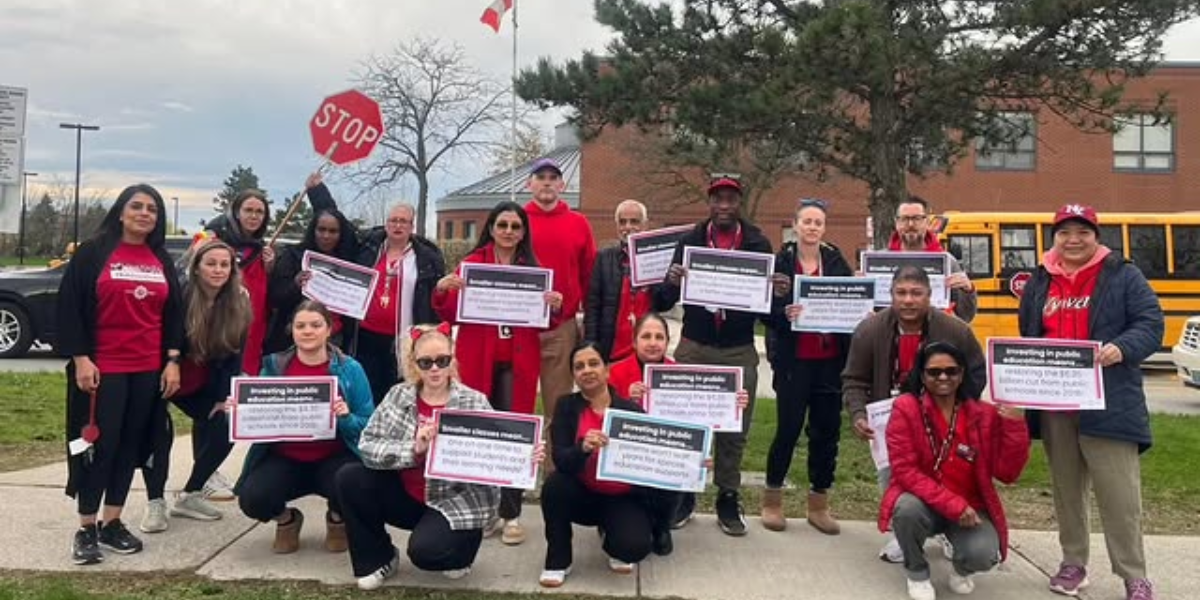
On April 29, education workers across Ontario participated in a province-wide day of action. What began as an effort by one teachers union to wear red and buttons turned into an action that involved over 250,000 union members across several unions.
April 29th as a test
The day of action brought together education workers from ETFO, AEFO, OECTA, OSSTF and OSBCU/CUPE and represented a lot more than just a red shirt. Key to the thought process of organizing the day was “how prepared are we to bargain with the Ford government?” The Ford government has taken over eight school boards at this point and is putting forward legislation aimed at sidelining the role of elected school trustees, forcing police back into schools and exercising more control over local school board decisions. The government has shown itself to be a likely hostile partner at the bargaining table.
The only way to counter that is through a united approach and ensuring union members are prepared for the fight to come. Organizing for the April 29 Day of Action involved systematic mapping and outreach to all members in all worksites. That meant a lot of one-on-one conversations, making the case for why their participation matters, discussing the political terrain that we are entering and ensuring members feel ready and willing to participate. There were plenty of teachers that scoffed at “another red shirt day” but seeing the participation in schools that reached or approached 100 percent participation and the flood of pictures posted to #OntEdUnited was heartening and a glimpse of the power that education workers hold when they stand together.
Ford government’s response
Did the Ford government change its tune after seeing this united display? Certainly not. But it did have an effect. The Minister of Education Paul Calandra released a video on his social media with a black and white picture of ETFO president David Mastin, rehashing a classic Ford talking point in which he tries to separate workers from the unions that represent them. In the video, Calandra chastizes unions for “putting teachers in the middle” and has a “real Ontario teacher” provide anonymous testimonial about how he felt so bad having to explain to his poor little students about why he was wearing a t-shirt. The replies were turned off, but predictably the quote tweets were filled with educators and supporters calling out the disingenuous attempt to villainize teachers for their unity.
As cynical as this is, it shows the government has learned from 2022 when they went hard against OSBCU/CUPE education workers. They know they need a strong counter-narrative. It is going to take a deeper, longer, and broader campaign for labour to win in the current climate compared to last time, for a host of reasons. For one, the economic environment is more challenging. There is higher unemployment, a poor labour market and the sense of solidarity and class outrage that came out of the COVID pandemic has dissipated.That being said, the Ford government’s popularity is extremely low, making them vulnerable in some respects.
Building unity
Considering this context, it is strategically important for educators to maintain this united approach in bargaining for the common good. Forefronting the fight for quality public education and public services will be essential. Public sympathy was high for the CUPE education workers in 2022 and they were able to defy anti-union legislation, unite the labour movement momentarily and change the terrain of bargaining for the entire sector. They can’t do it alone this time and pushing for smaller class sizes and more frontline supports could be rallying cries to unite all unions. Part of the process going forward is to convince our fellow union members that we actually can win smaller class sizes and more funding, but it will take a united and active membership to do it.
OSBCU/CUPE is organizing a province-wide day of action on June 6 with the focus being on connecting directly within communities – parents, caregiver and the public. The goal is to “Paint the Province Purple”, like in 2022. In your area there will be groups getting petitions signed at markets, knocking on doors, and tabling at community events. Other education workers should find ways to plug into these actions to continue to build worker unity and public support.
Author

Did you like this article? Help us produce more like it by donating $1, $2, or $5. Donate