
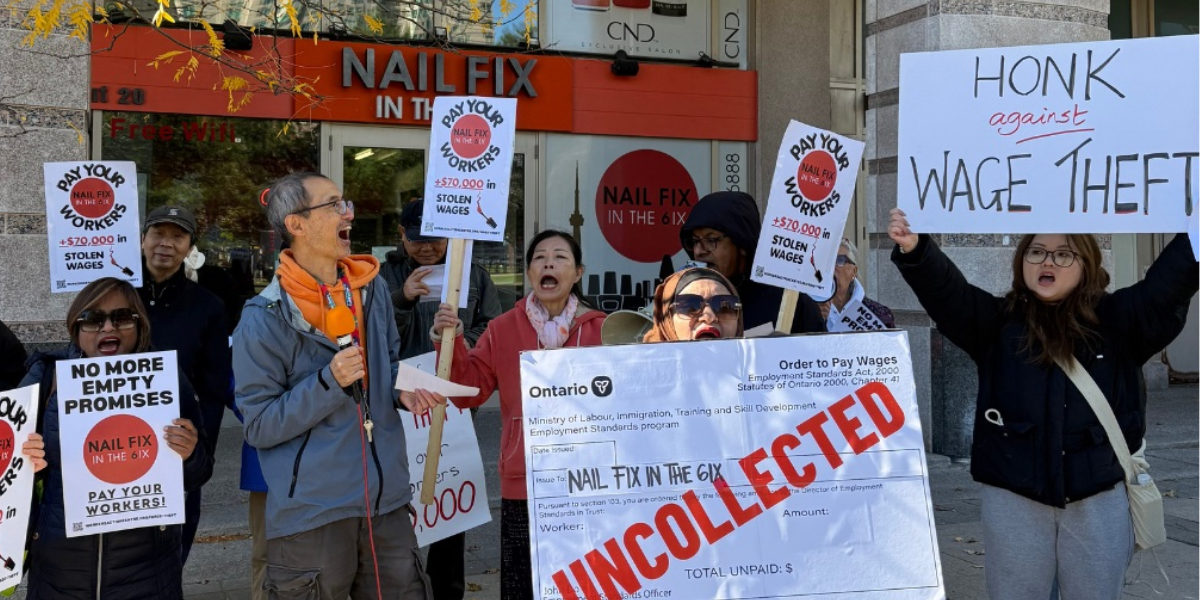
On Saturday, October 17, workers and their supporters gathered outside two different “Nail Fix in the 6ix” locations — one in Scarborough and the other in Leslieville.
The rally
Workers stood outside the Leslieville location with banners, picket signs, and a megaphone. They chanted slogans about wanting their money back, and wanting it back now. The Workers’ Action Centre (WAC) was there to support the workers at both locations, passing around literature explaining the situation as well as highlighting the broader wage theft crisis in Ontario. The workers were holding up a banner that read “HONK IF YOU THINK NAIL FIX IN THE 6IX SHOULD PAY WORKERS.”
According to the literature being passed by the WAC, 10 employees were owed a total of $70,000 in stolen wages — an amount of money which the Ministry of Labour ordered the employer to pay back in March 2026, and the deadline of which passed in April 2026. A single cent has yet to be paid.
One of the workers, owed $12,000, is Farah Yeo, the former Human Resources Administrator and Acting Manager. She started working there in January 2025, but the problems began later in the year.
How $70,000 was stolen
Yeo outlined how the employer, rather than stealing an entire paycheck all at once, would pay 20 percent to half of the paycheck, promising that the rest would come soon. The employees, faced with having to pay for rent, groceries, and more bills, saw themselves as forced to accept this raw deal, believing in good faith that the money would come. Every time that the deadline for the payment would come, the employer would delay it again. Slowly, the amount of wages stolen kept rising. The employer also discouraged the workers from looking for another job by telling them that “it’s a tough economy out there. At least here you’re getting some money.”
Yeo brought the problem to the Ministry of Labour in November 2025. After months of review, they issued the employers an order to pay her $12,000 in March 2026. After 30 days, the deadline passed without a cent being given to her. Then, Yeo brought the problem to the Ministry of Finance, who told her she had to wait 60 more days before she followed up.
Azmera Havtav, a nail technician and a coworker of Yeo’s, went through the same process. She was a newcomer to Canada when she began working at Nail Fix in the 6ix and had no idea what her rights were as a worker, let alone who to reach out to for help. One month into her job, they began to keep her wages from her. As a single mother, her goal was to work hard so she could support her daughter, but every delayed paycheck became what she deemed “a broken promise.” Once she told the employer that if she was not getting paid she would not be able to work, they asked her not to come in tomorrow. The next day, they told her they did not need her today. And the next, for three weeks.
According to Yeo, most of the workers at Nail Fix in the 6ix are immigrants. A lot of the workers there got to Nail Fix in the 6ix through employment agencies, like WoodGreen. The workers believe that the employer is purposely targeting immigrants from employment centres because they will not know their rights as well as citizens would. A Canadian citizen even tried to work there, but became appalled at the request for a $1,200 certificate and declined the job offer.
This is another way that the employer managed to wrest money from their workers — by claiming that they needed to go through a nail technician course amounting to around $1,200 even when the workers were already experienced and trained in the necessary skills for the job. This certificate was provided by the employer, meaning that they were asking their employees to pay them over a thousand dollars just to get hired. The justification was that there is a particularly “Canadian” way to do clients’ nails, although the workers interviewed claimed to have learned nothing new during the training. After going through the training, which some workers had to save up for, they were given a measly piece of paper with their names scribbled, not printed, on the certificate, alongside the business’ name.
Now, some of the workers are still looking for new jobs. Some others have had to take on different jobs. Many are still dealing with back pain and physical strain from the job while waiting for the Ministry of Labour to take action. They are struggling financially at the same time as they are struggling with depression.
Reflecting on the experience, Yeo said:
“A good employer, as a small business in the middle of a tough economy, could have let us go. Instead, they paid us 20 percent or 30 percent or sometimes even nothing. Now some of us are owed $12,000 because we had good faith and stayed, believing the payment was going to come. When we started to stay home, they started to blame us for the business not making any money because we weren’t coming in to work. They wanted free labour for as long as they could get it. They even hired more people and did the same to them.”
Part of a larger crisis of wage theft
A previous article by Spring Magazine is a more in-depth review of the wage theft crisis in Ontario, as reported on by the WAC. 60 percent of workers surveyed reported to have had wages stolen from them, while 28 percent reported to have been paid less than minimum wage. The report highlights the rampant problem of wage theft in Ontario.
In 2024-25, the Ministry of Labour only initiated 12 prosecutions of the kind that are most likely to deter violations of the Employment Standards Act. That number is 85 percent smaller than the amount of prosecutions of the same kind in 2017-18. Since the Doug Ford government was elected in 2018, low level fines for ESA violations are also down. The Ministry of Labour has also stopped inspecting workplaces as often as it used to.
According to the WAC report, “Between 2013 and 2023, the MoL referred $102.4 million worth of confirmed wage theft violations to the Ministry of Finance (MoF) for collections. The MoF was successful in collecting less than one-quarter (22 percent) of that amount. Meaning workers with successful wage theft claims are still owed a staggering $79.9 million dollars in stolen wages.”
The case of the Nail Fix in the 6ix, although it has elicited shock from many onlookers, is a drop in the bucket of a wider crisis that is being inadequately addressed. The Ministry of Labour, for a variety of reasons, is not keeping up with the amount of theft occurring at the hands of employers. This is why it is important for the community to stand in solidarity with victims of this type of exploitation.
How to help the Nail Fix in the 6ix workers
- Phone the owners to let them know their business will not be attended until they have paid their workers
- Spread the word across your social circles and community
- Stand with the workers
Learn more about wage theft at the Workers’ Action Centre website.
Author

Did you like this article? Help us produce more like it by donating $1, $2, or $5. Donate