
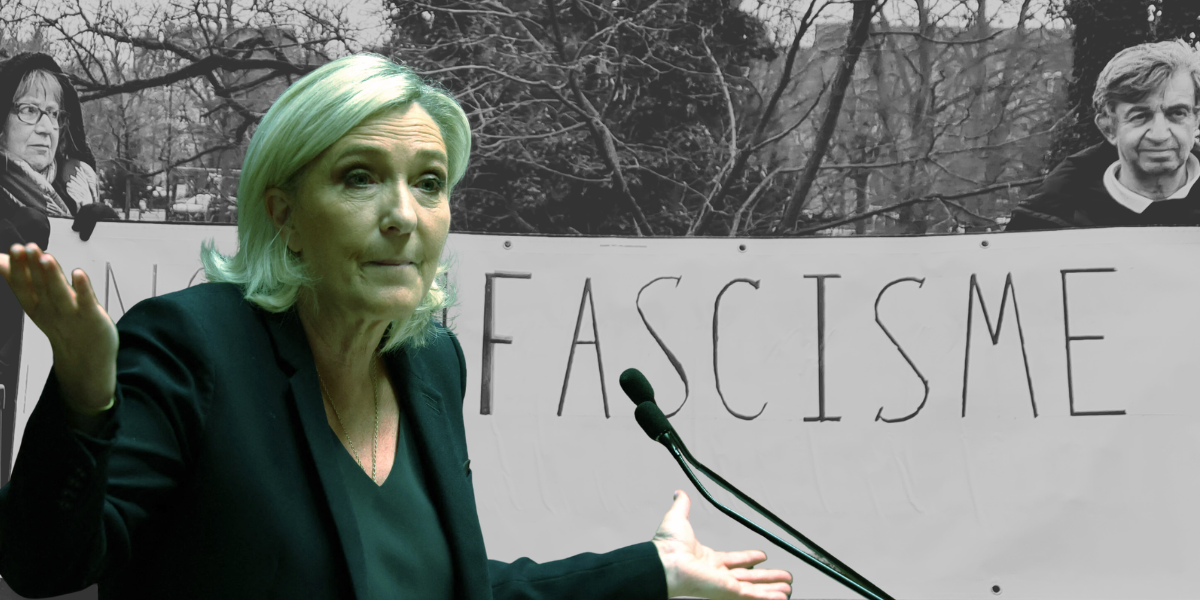
The upcoming French presidential election next May carries weight far beyond France’s borders. A victory for fascist candidate Marine Le Pen—in a major world economy—would embolden far-right movements globally while dealing a terrible blow to French workers, particularly women, LGBT+ people, and Muslims. Conversely, a win for the radical left candidate Jean-Luc Mélenchon, of the France Insoumise (“France in Revolt”) would offer an important boost to anti-capitalists everywhere.
In France itself, this election will be anything but business as usual. A recent poll revealed that 71 percent of French voters want the new president to bring about “real social and political change”. This Q and A article aims to explain the key dynamics at work, as well as the strengths and weaknesses of antifascist activity in France today.
Will the French have a fascist president next May?
Nobody can know the answer to this question right now, but the danger is very real. Far-right candidate Marine Le Pen of the Rassemblement national (National Rally) is the favourite in the polls, with around 33 percent of voting intentions for the first round. No other candidate polls above 20 percent. She has particularly gained ground in recent years among women voters and among public sector workers, traditionally populations where the left is strong. A quarter of those public sector workers who say they feel close to a political party cite the Rassemblement National as that party.
Worse, polls at present show her winning in the second-round run-off against any other candidate, whether right, centre-left or radical left.
The first round will take place on April 18, 2027, with the two leading candidates going on to the run-off on May 2. In 2022, Macron won the second round by 18.8 million votes, to Marine Le Pen’s 13.3 million. Importantly, 13 million registered voters stayed home that day, 3 million spoiled their ballots, and another 4 million citizens were not even on the electoral roll. In the first round, radical left candidate Jean-Luc Mélenchon of the France Insoumise secured 7.7 million votes—just 400,000 short of beating Le Pen to the second round.
Unsurprisingly, fatalism is rife in France faced with this historic danger. But Le Pen’s high polling numbers are no reason to despair. The France Insoumise has already started a huge campaign to push back against the far right—and this has worked in the past. Ahead of the 2024 parliamentary elections, thirty consecutive opinion polls predicted the National Rally (RN) would become the largest party in the National Assembly, with several forecasting an absolute majority. Instead, the most dynamic campaign for fifty years, both by parties and by trade unions and associations of all kinds, along with the alliance of all left-wing parties into the Nouveau Front Populaire (“New Popular Front”), led to a real victory: the far right came in third in number of seats, behind the NFP in first place and Macron’s coalition in second.
Who are the other candidates? How do the elections work?
The political situation, and the list of candidates, is extremely fluid. For the moment, the rest of the left, outside the France Insoumise, is fractured. The Socialist Party, which received only 600 000 votes at the 2022 presidential elections, is a muddle of jockeying wannabes. Five of them will take part in a lacklustre primary mid-October.
The Communist Party has decided to stand their own candidate again, Fabien Roussel, with a “class struggle but anti-woke” profile. The Green leader Marine Tondelier has also announced she is standing. Left-wing loose canon, François Ruffin, is already campaigning too.
Some of these will give up and support a stronger candidate (sometimes after negotiations concerning the programme or support in subsequent legislative elections). Others will have to give up because they cannot clear the hurdle which the electoral system imposes before a hopeful can get onto the first-round ballot: each candidate must get 500 declarations of support from a pool of 42 000 elected officials (mayors, Members of Parliament and regional councillors mostly). This time round, given the large number of hopefuls, some may not get the 500 endorsements.
The constitution does not allow Macron to stand for a third term, so on the traditional right and in the Macronite neoliberal centre, several candidates have emerged – at least five of them. Most are polling quite weakly right now, and some will fold in the coming months.
Where does the Rassemblement National come from and what does it defend today?
The Rassemblement National was founded in 1972, under the name Front National, by a collection of figures from the far right: Nazi collaborators, former SS members, sympathisers of far-right terrorist groups, opponents of decolonisation, Holocaust deniers and Catholic traditionalists. They adopted as their emblem the tricolour flame used by Mussolini supporters in Italy. More than fifty years later, that flame remains the RN’s logo.
Marine Le Pen has worked hard to convince millions of voters that the old Front National has been transformed. She expelled her father, Jean-Marie Le Pen, who continued to make openly antisemitic remarks, and she sought to distance the party from the small neo-Nazi groups that once inhabited its orbit.
But beneath the makeover, central elements of fascist politics remain, including ethnic nationalism. The RN proposes banning Muslim headscarves in public spaces, restricting access to social housing and social benefits on the basis of French nationality, abolishing birthright citizenship, barring dual nationals from certain senior public positions, and denying medical treatment to undocumented migrants. It invokes France’s Christian heritage while presenting the radical left as somehow ‘anti-French’. The town councils controlled by the RN regularly slash social service budgets and try to hamper the activities of trade unions, human rights, women’s or LGBT groups. The new RN mayor of Carpentras, in the South of France, for example, cut all funding for family planning organizations.
And the fascist core cannot be hidden. RN members and candidates are regularly exposed making openly racist or extremist statements. Last year, a police officer and RN activist was filmed comparing Black people to monkeys and using racist slurs. RN vice-president David Rachline was sacked last year after being photographed with two well-known Nazi sympathizers. In 2024, an RN candidate was forced into the spotlight after posting a selfie wearing a cap bearing a swastika, supposedly ‘for a laugh’. There are several more recent examples.
In September, the RN announced that, if elected, it would fine Muslim women for wearing headscarves in the street, a measure plainly at odds with the UN Declaration of Human Rights. The reaction on the left was immediate and furious. And rightly so. But we must remember that Le Pen knows such an idea is unpopular. The aim of the announcement is to reassure the Nazi core of her organization, who are worried by the official moderate stances of the RN on other questions. Such an announcement also pushes those circles who openly support the RN but are not hardcore racists to take one more step towards becoming such.
If elected, Le Pen promises a “constitutional referendum”, aimed at putting racism at the heart of the constitution by abolishing birthright citizenship and imposing “national preference” in many areas of the welfare state.
However, one cannot really understand the RN simply by looking at its programme. Fascist leaders are not known for being honest about their project! Le Pen’s medium-term aim is to smash unions and all resistance organizations, once she can get more of the big capitalists to feel it is worth the risk, and once she has a violent street movement that will do the dirty work.
What is the RN specifically promising the capitalists?
Fascism always eventually depends on support from top capitalists. The RN is working hard to reassure the rich that their priority is cutting taxes for the wealthy and for businesses, and following neoliberal orthodoxy by strictly limiting budget deficits. They say they will drastically reduce the social security payments that employers must make. Party president Jordan Bardella was trumpeting late September the classic Thatcherite dogma “France is living beyond its means”, and he has often proclaimed himself “pro-business”.
The party also promises to take an axe to environmental regulations. Their response to the 2026 heatwave has been to loudly defend the “common sense” solution of encouraging the installation of air conditioning. And of course, they are known for their hard-line anti-union stance, which holds considerable appeal to capitalists in a difficult world market. The main bosses’ organization, the MEDEF, invited RN president Jordan Bardella to a lavish business lunch a few months back. Capitalists are preparing in case the RN comes to office, and in case, later, fascism might suit their interests better than liberal democracy.
What factors are running in favour of a victory for Le Pen next May?
The profound discrediting of all the governmental parties that have implemented austerity programmes over the past 25 years has produced a sharp political polarisation, with only the far right and the radical left significantly increasing their influence. The Macronist project of pursuing right-wing policies through ministers and MPs originating from both the traditional right and the Socialist Party has now definitively run out of steam. Le Pen can appear to many as a radical option not yet attempted, and she can appeal to very widespread Islamophobia and other prejudices.
The constant adoption of far-right policies and talking points by Macron’s government is of course a huge boost to the National Rally. The kid gloves generally worn by mainstream journalists when interviewing RN figures help legitimize the far right: talk shows seem to be filled with fast-talking, sharply dressed, and well-educated fascist spokespeople—both men and women. And far-right influence and networks are getting stronger. Billionaire Vincent Bolloré has systematically built a far-right echo chamber in France, weaponizing outlets like the news channel CNews, newspaper Le Journal du Dimanche or top radio station Europe 1 to push hard-right narratives further into the national conversation. In September 2026 leading public radio station France Inter hired a prominent far right journalist, Charles Sapin, from a hard-right magazine, Valeurs Actuelles, (which has been convicted several times of inciting racial hatred) and gave him a regular political comment spot. The excuse was to reflect a diversity of opinion! A protest strike was organized by journalists, while Macron’s Minister of Culture publicly defended the extremist. The strike was solid, and successful, and Sapin was thrown out, a victory that sheds important light on what can be done against the far right.
What factors could derail Le Pen’s project?
One crucial factor is the antifascist mobilization which I will describe below. Otherwise, internal friction between rising RN star Jordan Bardella and party matriarch Marine Le Pen might trip them up occasionally.
A more significant challenge is the RN’s inability to address some of the political issues most vital to the public. Following a summer marked by historic wildfires—the worst in over 70 years—and unprecedented heatwaves, the RN has no real policies to deal with the problem. Marine Le Pen has vehemently opposed wind power, while party spokespeople have repeatedly downplayed the gravity of climate change.
Also, tremendously important is what happens in the immediate class struggle between now and next May. Macron’s minority government will be trying to push through an austerity budget this autumn. Fifty billion euros in cuts are being demanded by Prime Minister Sébastien Lecornu. Last year he eventually managed to pass a budget, because Socialist Party MPs refused to vote for a motion of censure that would have toppled the government. With presidential elections looming, it is likely that this organization will be less keen to do a deal with Macron. Revolts by groups of workers under pressure in fishing and in farming have already begun, and mass strikes in the public sector are planned for October 2026. Macron may find himself with a mass revolt like the one to defend pensions three years back, which could have led to a full-scale general strike if national union leaders had not been so keen to put on the brakes.
When class struggle is on the rise, it is easier to persuade workers that the problem is not the immigrant, but the banker. And Le Pen’s liars stumble when there are militant social movements. The RN can never loudly oppose violent police repression, since their base in the police force is huge. The RN can never demand a sharp rise in the minimum wage, since it relies on the support of small employers and is assiduously courting big business.
How has Macron’s presidency paved the way for the far right?
As Jean-Luc Mélenchon rightly points out, Macron and Le Pen represent “more of a duet than a duel.” Macron’s governments have adopted large chunks of RN ideas and policies, while appointing figures with openly reactionary views to ministerial positions. Current Prime Minister Sébastien Lecornu even held a secret dinner with Marine Le Pen last year, and the administration subsequently pressured French banks—which had initially refused to lend money to the far right—into granting them major campaign loans.
Macron’s former interior minister and presidential wannabe, Bruno Retailleau has demanded, among other horrors, that the definition of France as “a Judaeo-Christian country” should be enshrined in the constitution. His higher education minister Frédérique Vidal launched a moral panic and official enquiry on the invented danger of “islamo-leftism” taking over French universities. In 2023, the government declared a ban on the wearing of North African tunics (“Abayas”) in high schools (despite the fact that they are not religious garments). And arch-Macronist Marlène Schiappa supported a campaign to ban Muslim women who wear full-body swimsuits from using municipal swimming pools, suggesting that Islamic fundamentalist infiltration was at work.
In 2024, Macron clamped down on immigration, introducing more citizenship testing and language requirements, and making it harder for workers to renew temporary permits. All these measures do not primarily have a practical aim, but simply want to point the finger at immigrants and Muslims, in order to please far-right voters.
Macron has vastly increased powers for the police (despite a series of murders by racist police). This year, he is pushing through a law that institutes a “presumption of self-defence” for police officers. This would mean victims of police shootings would need to prove that the officers were not acting in self-defence! No other country in Europe has such a law.
All this has been accompanied by other authoritarian clampdowns, of a type which had not been seen for a very long time. Antifascist organizations like the Young Guard and antiracist networks like the Collective Against Islamophobia in France have been banned. This authoritarian march can only smooth the road to fascism – already it has led to convert to RN politics, Eric Ciotti, saying the France Insoumise should be banned.
Finally, there have been concerted efforts from Retailleau and other ministers of Macron to portray the radical left, not the far right, as a threat to democracy. “LFI is a party of collaborators with the enemies of France” insisted Retailleau. Earlier he had declared “The Rassemblement National is part of the arc of republican organizations, which the France Insoumise is not”
What are antifascists doing, and will it be enough?
There are three pillars of antifascist activity needed in the present situation where the far right have very high electoral support, massive media presence and many rich supporters but have an extremely weak local party structure. Firstly, there is the building of a radical left alternative to respond to the anti-austerity anger of the population. Secondly, there is the mass education campaign, in order to pull apart the piles of lies told by the fascists, (since the established media tend to treat them so kindly). And finally, there is the need for mobilization on the streets and outside all far right events, which should aim at making it impossible for the RN to build a mass party with roots in every town. The first two pillars are encouragingly robust, the third is dangerously underdeveloped.
Campaigning for a genuine radical left alternative, through La France Insoumise, is already in full swing, giving people a clear, positive reason to vote against the far right. With 67 percent of French people reporting they are worse off than they used to be, both poverty and public anger are rapidly rising. For the next seven months it will be far from politics as usual. Over 100 000 people have joined local LFI Action Groups. Spectacular numbers of new activists, particularly under 30s, are already mobilizing and the campaign will be extremely exciting. The door-to-door campaigns in working class areas to encourage people to register to vote are in full swing (four million French citizens are not registered, mostly among the poorer population). In September, two of Mélenchon’s speeches, each over an hour long, got 250 000 views each on YouTube within a week.
LFI leaflets and meetings obviously highlight fascist lies. But many who are either not convinced of Mélenchon’s politics, or who belong to organizations which prefer not to endorse a particular political party, will nevertheless be running mass campaigns against the ideas of Le Pen and the fascists. The experience of trade unions under far-right governments in Hungary and Italy, and the attacks by RN town councils in France, are pushing French trade unions to take sides. In 2024, specific calls against the far-right were launched by university presidents, by researchers, by Catholic and protestant charities, by elite athletes and football players, by theatre managers and music venues, by artists and cinema directors, even by organizations of classical musicians. This mobilization is likely to be broader and deeper in 2027.
The third and (mostly) missing element is systematic mass mobilization to stop Le Pen from campaigning and from building her party. Most of the left is not convinced that this is the way forward. There are nevertheless frequently demonstrations and rallies against the RN. Here are a few recent examples: Last April in Brest several hundred people attended an antifascist mass meeting. In May in Avignon, a mobilization stopped a far-right demonstration, and in Macôn another rally opposed the RN’s regional conference. This year, antifascist rallies have also occurred in Nancy, Mont de Marsan, Dijon, Niort, Bayonne, Grenoble, Beziers and Saint-Nazaire. Far-right politicians have faced pickets and rallies when going to book-signings in various towns. And in September 2025, an antifascist demonstration in Paris protested against fascist attacks on left-wing bookshops.
These actions are, however, almost always of hundreds rather than thousands, and are local affairs. A far higher priority should be given to them. In late October 2026, the Rassemblement National will have its conference in Orléans. There will be a counter-demonstration, but the main left organizations have not (yet) called for a national mobilization. Pressure by systematic counterdemonstration helped lead to a split in the Front National in the late 1990s, and such things could happen again, given the political will.
If the worst happened and Marine Le Pen was elected, what would this mean for France?
Despite dozens of examples every year of physical attacks by small groups of Nazis, the RN still lacks the mass, violent street movement which characterized classic fascism and is necessary for a fascist regime. If Le Pen became president, French workers would not immediately be living under a fascist regime, even though this is Le Pen’s eventual aim. In Italy, fascist leader Giorgia Meloni has been Prime Minister at the head of a coalition government for four years. Although anti-union measures have been taken, opposition parties and trade unions remain highly active. In October 2025, in response to Gaza, hundreds of thousands of Italian workers went on strike, while demonstrations brought more than a million people onto the streets. In December 2025, similar numbers mobilized to oppose Meloni’s budget, which cut healthcare and pensions while directing far more money to the military.
Four years after Mussolini’s takeover in 1922, independent trade unionism was banned and the right to strike effectively abolished. Hitler did this within four months of becoming chancellor in 1933. So although Meloni aims, more or less secretly, at a fascist regime, this has not been established in Italy.
A Le Pen victory would be worse than Meloni’s. The French president possesses far more constitutional power than the Italian Prime Minister. She might well attempt, through referendums, to institute vicious racist reforms. In addition, one would expect—much like a more coherent version of Trump—that she would show little respect for the constitution or for political tradition. Anti-immigrant pogroms like those seen in Minneapolis would be on the agenda, as would dreadful anti-trans measures and much much more. Above all, Le Pen would be keen to show big capital that she can be trusted to fight in their interests against workers’ resistance of all kinds. She would also use state power to help build the street-fighting movement she needs to eventually transition to a fascist regime.
The election of Le Pen would certainly not mean the end of the struggle. But it would be a major, historic setback. We have seven months to stop this nightmare from coming true.
Author
Did you like this article? Help us produce more like it by donating $1, $2, or $5. Donate