
It’s that time of year again, when the leaves turn bright red (and yellow and orange) in colour. But this isn’t what makes October red.
For socialists, it’s an event that happened 108 years ago—the October Revolution—when millions of workers across the Russian empire rose up for “Land, Bread, and Peace” and set in motion one of the most radical experiments in democracy in human history.
The impact of the revolution shaped the entire 20th century, despite its deterioration by the end of the 1920s, and continues to be felt in movements and struggles today. Its early years are rich in lessons about the ability of ordinary workers to take control of the world around them, and to re-organize society in order to meet the needs of all of humanity.
These are the lessons that hundreds of participants will be discussing, among many other topics, at this year’s Red October conference, the annual flagship event of the Spring Socialist Network.
Red October begins this Friday, October 24 at the Toronto Metropolitan University Student Centre in downtown Toronto, and continues all weekend.
War, genocide, climate catastrophe
Like last year’s conference, Red October is taking place amidst a series of deepening crises: war, genocide, climate catastrophe, the rise of the far right, the return of austerity, unchecked spending on arms and militarism, a weakening global economy, a worsening affordability crisis—the list goes on and on.
The conference is also happening against the backdrop of a crisis in the trade union movement and social democracy, and urgent debates over strategy and tactics across all our movements.
With all this in mind, Red October aims to be a space where activists can come together, share our experiences and learn from each other, and draw on the rich history of working-class resistance from all over the world and every period of struggle.
But it’s not just about talking: Red October aims to be a conference of socialist ideas in action. What we discuss and generalize must come from movements and struggles, and likewise must build and strengthen them.
Strategy
Since its inception in 2023, Red October has had three goals: 1) to connect with, contribute to, and learn from the best revolutionary socialist traditions, from the Russian Revolution to the present day; 2) to create a platform for leading activists to share their insights and experiences; and 3) to develop our own collective sense of revolutionary politics, on a wide range of issues.
These goals inform our opening panel on Friday evening: a strategy discussion called “Getting organized for a better world.”
So much of our time, especially in moments of crisis, is spent running from struggle to struggle without the opportunity to step back, survey the political landscape, and consider the longer-term strategies that are meant to achieve our shared goals. This meeting aims to create such an opportunity.
Four speakers, with deep roots in their communities, workplaces, and a range of movements, will join a strategy discussion that asks: What are the biggest barriers or fault lines facing our movements? And what kind of strategic focus do we need in the months and years ahead?
- Nas Yadollahi is the president of CUPE 79, which represents 30,000 Toronto city workers, and led a tough round of bargaining in 2024 that saw members win unprecedented gains, including record wage hikes for the lowest-paid workers.
- Nigel Barriffe is the vice-president of the Elementary Teachers of Toronto, the largest ETFO local in Ontario, and community organizer and activist who fights for quality public education and good green jobs.
- Chiara Padovani is a social worker and the founder of the York South-Weston Tenant Union, which unites renters against landlord profiteering in Toronto and recently won its 16-month-long rent strike.
- Deena Newaz is a member of the Spring Socialist Network, a regular contributor to Spring Magazine, and an activist in the labour, social justice, and Palestine solidarity movements.
After their opening remarks, the speakers will engage each other in conversation and then respond to questions and contributions from the audience.
Courses & talks
On Saturday, October 25, the conference will host 24 talks, organized in four blocks and across six courses.
The first course is called “Socialism & liberation” and includes four talks:
- Black, Feminist, Queer, Marxist: What was the Combahee River Collective?
- José Carlos Mariátegui: Latin American Marxism & Indigenous liberation
- Trans liberation: What are the roots of transphobia?
- Kanehsatà:ke (Oka), Ipperwash, Gustafsen Lake: Land Back lessons from the 1990s
The second course is called “What is revolutionary socialism?” and includes four talks:
- The United Front: How to build a mass movement
- Russia 1917: The Theory of Permanent Revolution
- From above or from below? The two souls of socialism
- From Claudia Jones to Hossam El-Hamalawy: What is revolutionary journalism?
The third one is called “Workers’ power” and includes four talks:
- On-to-Ottawa Trek 1935: Unemployed workers fight back
- Soviets, shoras, cordones: The revolutionary history of workers’ councils
- Black workers versus South African Apartheid: Lessons for Palestine
- Education workers & Ontario’s almost general strike: The role of socialists
The fourth one is called “Understanding capitalism” and includes four talks:
- Exploitation: Where does profit come from?
- Capitalist crisis: What is the Tendency of the Rate of Profit to Fall?
- Artificial Intelligence: What is the value of human labour?
- Resisting the new militarism: What is the permanent arms economy?
The fifth one is called “How do we get to socialism?” and includes four talks:
- Can we vote our way to socialism?
- The Waffle movement and the NDP: Lessons for socialists
- Capitalism & class consciousness: How do ideas change?
- What would a future socialist society look like?
The sixth one is called “Strategy & tactics” and includes four talks:
- How do we win climate justice? Why we need the working class
- Don’t attack Iraq! How we stopped Canada from joining the war
- The case for Universality: From child care to health care
- Palestine solidarity: What was the Pride Coalition for Free Speech?
Throughout these courses, the talks also cover the following themes: Anti-war, Black liberation, Climate justice, Indigenous sovereignty, Palestine solidarity, and Queer liberation.
Spring members will deliver all the talks, followed by a period of discussion and debate among participants. The full program is available here.
Strike solidarity
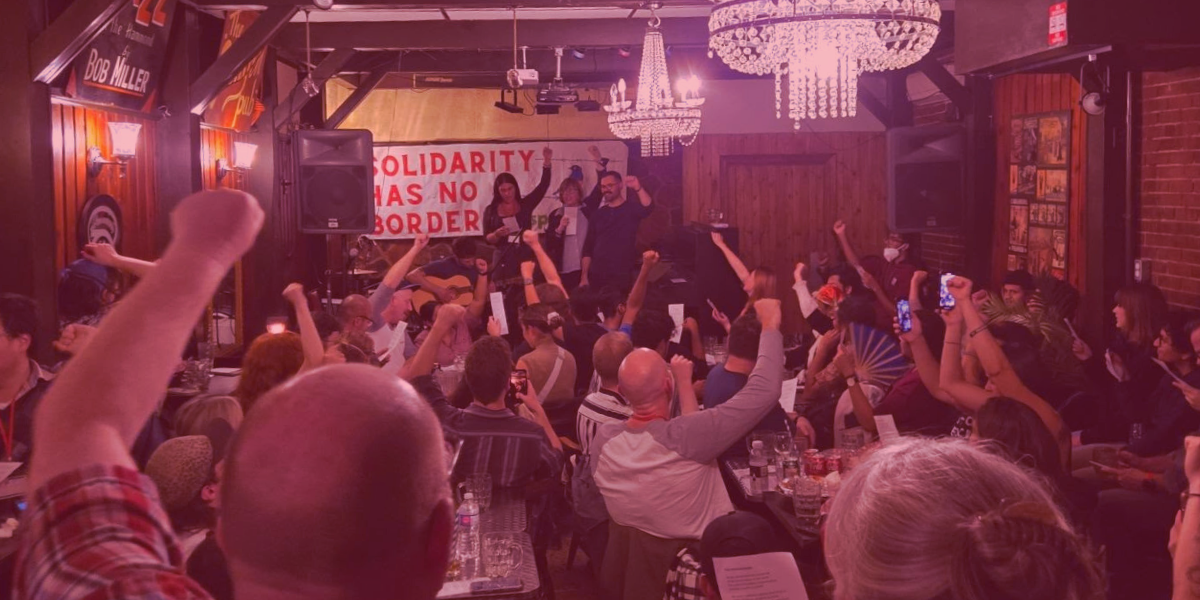
The Saturday program concludes with Red October’s “Nuit rouge,” a cabaret-style social featuring spoken word, musical performances, and a short closing rally. The event takes place at Pauper’s Pub, 539 Bloor Street West (map), and will be a chance to reflect on the day, relax, and enjoy each other’s company.
On Sunday morning, Red October will host its usual Labour Caucus, with a strategy discussion among trade union and decent work activists called: “How do we build a rank-and-file power?”
Following the Caucus, the conference will conclude with Spring’s latest instalment of its “Strike Solidarity School,” which aims to build and share organizing skills in three workshop-based discussions: Visiting a picket line; Building community support; and Covering the strike.
Socialist ideas in action
There aren’t a lot of opportunities on the left for hundreds of activists to assemble in one space over three days—to share our experiences, compare notes, generalize lessons, and equip ourselves with the most effective ideas and practices from past and current struggles. But Red October is one of them, and we want to make this year’s conference the biggest one yet.
Last year, over 400 people participated over the course of the weekend. This year, more than 350 tickets have been sold in advance, and we expect a rush of sales in the next three days.
Whether you attend one session, one course, or the whole conference, we look forward to meeting you, hearing about the things you do and care about, and finding ways to build and organize together.
Our current political moment is not the first time working people have faced multiple crises that threaten the future of humanity and the planet. But we can take inspiration from what workers did 108 years ago, and from countless other turning points in history, to fight back and win a better world.
We owe it to all those who fought before us, and to future generations, to continue and deepen that fight today. Don’t miss Red October—we have a world to win.
See you this weekend!
Author

Did you like this article? Help us produce more like it by donating $1, $2, or $5. Donate