
Contains spoilers.
As a fan of animation and Daniel Chong’s “We Bare Bears,” I was so delighted when I saw the first teaser for Hoppers and so beyond impressed when I finally watched the film.
Mabel Tanaka (voiced by Piper Curda), a staunch environmentalist and lover of animals, is up against Jerry Generazzo (voiced by Jon Hamm), the very popular mayor of Beaverton whose plans to build a highway would destroy a glade that Mabel and her late grandmother took care of for years.
With a clear environmentalist intention, talking animals, absurdist comedy, and a protagonist who has no friends and a dead relative whose dreams they hope to carry forward, it truly felt like a classic Pixar film.
However, scepticism of the film’s environmentalist and activist message has seeped into popular discourse, especially pertaining to how they resolve the central conflict.
Instead of stopping the highway, it is rerouted. Instead of outing the mayor for intentionally disrupting a habitat in order to build his highway, audiences must suspend their disbelief enough to believe a politician could see the harms of their actions and change (albeit minorly) their position on an issue they financially benefit from.
While one might expect the conclusion of the film to be a hard-fought victory against the mayor, the film reroutes and changes its antagonist to be one of the animals impacted by the mayor’s plans, leaving Jerry and Mabel left to team up and save the town.
While the conclusion to that plot point might feel damning, the true lessons in the film are about the harms of disingenuous organizing, and the importance of building community connections.
When Mabel first learns that beavers are a keystone species, she sets out to lure one back to the glade in order to bring the animals back and prevent the construction, ultimately leading to her use an experimental technology (mind-uploading robot animal body, think Avatar) to turn herself into a beaver, and sets out to recruit other beavers to the glade.
The animal kingdoms here are not new to the glade, they’ve had their own systems of governance and ways of handling the crisis caused by the loss of land. Even though the land is rightfully theirs, they adapt in any way they can. Mabel struggles to understand this, and after already infiltrating an indigenous community by pretending to be one of them, she further demands that the animals respond to the crisis the way she would like.
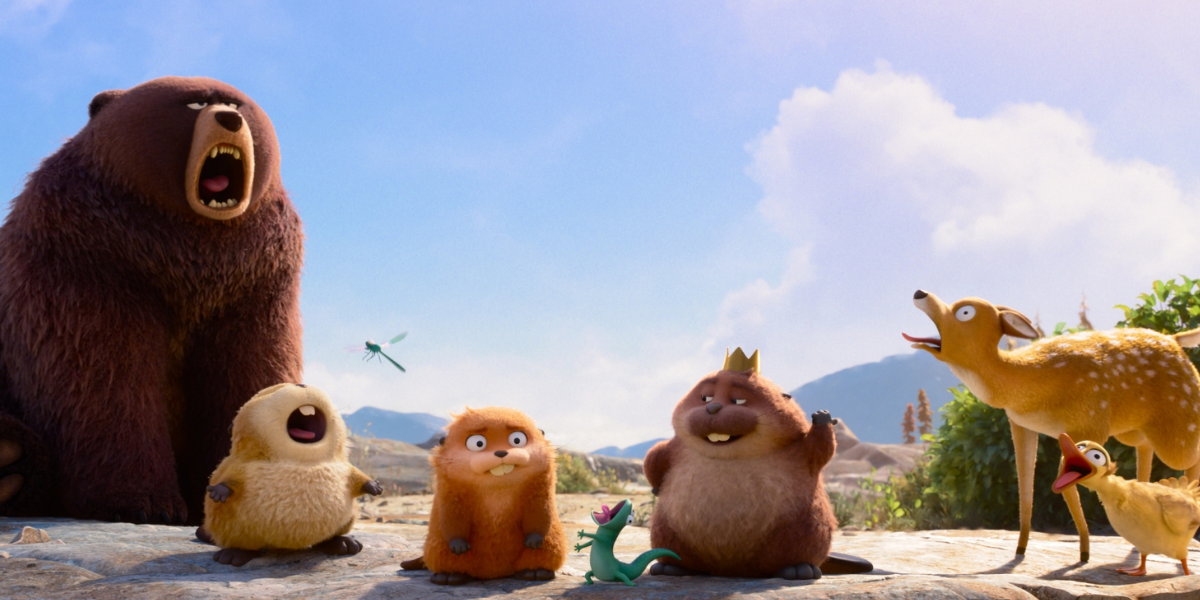
Even when she is able to solve the mystery of why the animals left and helps them restore the glade, she does so under false pretenses through which she gains the trust of the leader, the mammal king, George, becoming his paw (right hand/royal advisor).
When Jerry doubles down on destroying the glade for his political project, Mabel uses the trust she has gained to persuade George into calling a meeting of the animal council, a meeting that she agrees to let George take the lead on.
Unsatisfied with his approach to the conversation, Mabel speaks down at the other community leaders (monarchs of the various animal kingdoms), using her own hatred of Jerry to fuel the fear and anger of the animal community.
When the queen of the insect kingdom decides that the solution to this problem will be to “squish the human king,” i.e. to kill Jerry, Mabel still insists that her own approach to the problem is better. This insistence and subsequent backlash leads to Mabel and George being chased out of the superlodge and instigating even more extreme monarchs of the animal kingdom to seek revenge on humankind.
As activists, as organizers, it can be abundantly clear that action needs to be taken, and fast. But regardless of the urgency needed to make change, manipulating your way into communities to get them to join your cause will harm more than just your relationship with them: it will harm the cause you’re fighting for.
It’s easy to identify a problem and connect with it and simultaneously see that the problem is impacting others. But infiltrating that community and forcing them to respond to the crisis your way can only damage trust.
Marginalized communities can easily find themselves victim to this kind of organizing which sees marginalized communities not as partners to be respected, but as tools to use to achieve political aims. By denying them agency to respond to information and situations in their own way, organizers damage the relationships they have with these communities, simultaneously making them more skeptical of the goals of their organizing.
One could argue that Mabel’s actions were imperative to stopping further destruction to the natural habitats, but who does she hurt in the process? She damages the relationship the mammal king has with the rest of the animal council and kingdom. She hurts the relationship the researchers behind the hopping technology have with their school. She even almost gets George killed. If any such environmental crisis were to occur again, who would trust Mabel to handle the resolution?
The focus of the movie relies on Mabel recognizing the destructiveness of her organizing. Her love of the glade is certainly pure, but could it really be said that she loves the animals that inhabit it if she is willing to put them at such risk? Like Jerry, she takes steps to subvert the agency of the animals to achieve her own aims.
What causes Mabel to act as her arch-nemesis does? The isolation of caring about the glade on her own.
“Because I’m so tired of feeling this way. Like everything is broken and I can’t even fix this one little thing. Like I can’t make a difference — I am so tired of having to do this alone. Why… Why doesn’t anyone else care?”
These feelings are foundational to many activists, organizers, and just generally people. Caring so much about something in isolation can blind people to their actions, but in recognizing and voicing those feelings, only then can we find true community to take action with, as Mabel does.
Truly respecting and working with marginalized communities takes a lot of work, and even with earnest intent we may sometimes be blinded by our own feelings and make mistakes. But what matters most is coming back to the foundational trust needed in organizing.
Like George says, “Trust is like a dam: it’s gonna leak sometimes. We just gotta patch it up!”
Author

Did you like this article? Help us produce more like it by donating $1, $2, or $5. Donate