
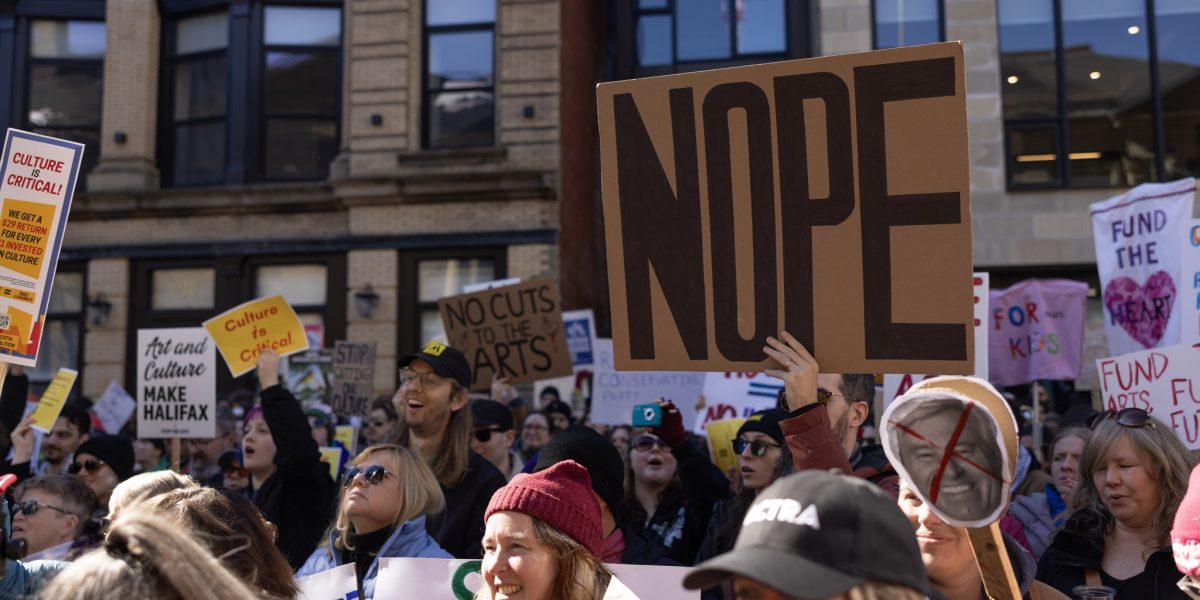
In this year’s provincial budget, Nova Scotia Premier Tim Houston announced $304.9 million in budget cuts to arts and cultural programs including supports for Indigenous communities, African Nova Scotian community programs, museums, environmental conservation efforts, disability supports, public education, and more. The full list was reported on by the Halifax Examiner.
Following an intense backlash, being booed off the stage at the Black Cultural Centre of Nova Scotia’s Heritage Gala, and dodging protestors outside Province House, Houston reversed a small portion of these cuts two weeks later. Approximately $53.6 million in funding will be restored.
“Nova Scotians have spoken clearly. Many people told us that they were worried about certain parts of the budget,” he said. Since then, many residents have continued to raise concerns about the over $250 million cuts that remain.
From March 23-26, an unprecedented number of concerned residents spoke at the legislature during a public hearing on the Financial Measures Act. On March 24, the PC government attempted to push the bill through before all voices were heard. When the vote was about to begin, a crowd of constituents in the gallery sang out in protest, reminding the government “It’s ok to change your mind.” Following the disruption, the speaker of the house delayed the final vote to March 25 and restricted members of the public from sitting in the gallery as the vote passed.
A manufactured crisis
Many residents are accusing the provincial government of “manufacturing austerity” by cutting revenues like HST and bridge tolls and creating a major deficit in order to justify cutting essential public services. The PC government has also prioritized funding to the oil and gas sector and mining, and increased military spending. Premier Houston has suggested this funding is different – it is to grow our economy.
Yet, working class residents do not stand to gain from increased revenues to oil and gas companies. In Nova Scotia, most of these companies are subsidiaries of larger companies in Alberta or even Texas. Houston was also sure to grant funding for the already well-funded SailGP race sponsored by Rolex and a buffet of other corporations. These choices raise the question of whose interests the Premier is focused on.
Public education in disarray
The cuts hit public education particularly hard. The $6.8 million in cuts to the Department of Education and Early Childhood Development includes the complete defunding of programs that put artists and writers in schools, the Africentric Summer Scholar Program, Student Advisory Councils, Outdoor Learning Spaces and more.
Houston’s cuts to public education come at a time when student enrollment is rapidly growing. Schools are overcrowded and violence is on the rise. Auditor General Kim Adair raised concern that the number of violent incidents reported by school staff has increased 60 percent since 2017. Over 27,000 incidents of violence were reported in public schools in 2022-23, not including those that go unreported, as these acts of violence are becoming increasingly normalized. Lockdowns have become commonplace in elementary, middle and high schools.
This is a natural consequence of under-resourced and underfunded schools, in which many otherwise committed teachers feel no other option but to quit the profession altogether.
The provincial government has responded by reducing the requirements for certifying new teachers. This may seem like welcome news for prospective teachers who are struggling to pay for their courses, and university programs need to be more affordable in order to represent a wider cross-section of the population. But these changes do not deal with the underlying issues.
New teachers are still not being supported and resourced enough to stay in the profession. Training is for the most part limited to unpaid internships facilitated by teachers who are working overtime without extra pay to support new teachers. This is not a sustainable model for retaining staff both new and old.
Teachers have few resources to address the underlying issues causing violence. Nova Scotia Teachers Union (NSTU) President Peter Day has said some teachers wear Kevlar sleeves to protect themselves from students who bite or stab. Other teachers are not sure how to solve this problem without increased police presence in schools.
Children and youth rightfully anxious about their future
Our children are inheriting a world with an uncertain future. It is no wonder so many of our children are feeling anxious. Bombing for oil and empire is becoming increasingly normalized. Our summers are characterized by forest fires and camping bans. Middle and high school students are walking out en masse for climate justice because they are concerned they might not even have a future if this continues.
Children deserve a future where care is prioritized above profit, where violence is not glorified and the air is breathable.
For many students, public schools are where they go to feel safe. Creative expression through arts and writing, as limited as it is, has helped many students work through conflict. For example, having local, African Nova Scotian and Black authors like Andre Fenton and Habiba Diallo come into classrooms gives students the opportunity to see how people respond to harmful systems of racism or violence with creativity and art. When these writers come to schools, it not only breaks up the monotony of the day. They leave lasting impressions on new generations of writers and give hope in an increasingly volatile cultural landscape. For many students, these experiences are the highlight of their school year.
By eliminating the funding for these types of programs, Houston is tugging on this loose thread that could unravel a social fabric. This budget’s acceleration of resource extraction and military spending send the message that they have given up on our children’s future.
What next?
As teachers and parents, we know we can’t give up this fight. The NS Arts Coalition, an adhoc advocacy group formed to oppose the budget cuts, is calling on everyone to join them at Province House on March 27 to make their voices heard before the budget is finalized. There is still time for MLAs to make the right decision. The majority PC government will likely try to push forward the vote before then. Regardless, Nova Scotians are showing strength in numbers and communities are becoming more interconnected to support their neighbours, as the overlap between different causes becomes more apparent. This is just the beginning.
Author

Did you like this article? Help us produce more like it by donating $1, $2, or $5. Donate