
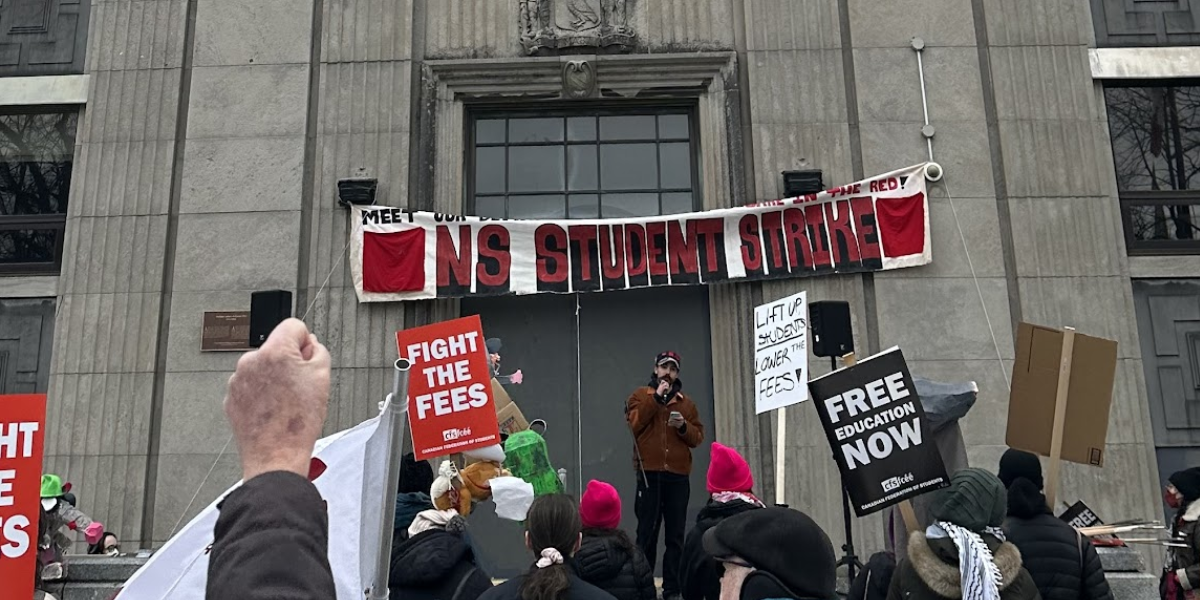
Students at multiple universities in Nova Scotia have voted in favour of a province-wide student strike set to take place March 16 to 21. The decision marks one of the most significant student mobilizations in the province in decades.
At NSCAD University, students voted 89 percent in favour of the strike. At Saint Mary’s University, a referendum saw 82 percent of participating students support the action, with 1,447 ballots cast in favour. At Dalhousie University and the University of King’s College, strike motions also passed through student union meetings. 64 percent of Dalhousie students and 51 percent of King’s students voted in favour. Acadia University students voted overwhelmingly as well, approving the strike with 93 percent support.
Taken together, these votes represent a rare moment of coordination across multiple campuses. During the strike week, students plan to collectively refuse to attend classes or submit assignments while organizing demonstrations, marches, and political education events.
Students organizing the strike have laid out four central demands. The first is an immediate 20 percent reduction in tuition fees for all students. The second is the standardization of tuition rates by ending differential tuition fees that charge international and out-of-province students dramatically higher costs. The third demand calls for universities to divest from companies involved in fossil fuels, weapons manufacturing, human rights violations, and corporations implicated in genocide or violations of Indigenous sovereignty. The fourth demand calls for increased public funding for post secondary education and the reversal of provincial cuts that threaten the accessibility and quality of universities.
For many students, the strike reflects growing frustration with the direction of higher education in Nova Scotia and with decisions about universities being made without meaningful participation from those who study and work in them.
Universities under pressure
The strike comes amid growing controversy over the provincial government’s decision to commission a major review of Nova Scotia’s universities.
The review, conducted through the Maritime Provinces Higher Education Commission, has been contracted to the United States consulting firm Huron Consulting Group. The firm is known for recommending aggressive restructuring at universities in the United States, including layoffs, program closures, and deep cuts to academic departments.
Students and faculty have raised alarm about the review. Critics point to both Huron’s record and the lack of democratic consultation in the process. For many, the situation reflects a broader trend in higher education. Universities are increasingly shaped by corporate consultants and government austerity rather than by the students and workers who make them function. Universities are public institutions built through the labour of students, faculty, and staff. Yet decisions about their future are often made behind closed doors.
This strike is partly a response to that reality.
Universities drawn into fossil fuel expansion
Concerns about the direction of higher education deepened in 2025 after reporting revealed new details about a provincial natural gas program administered through Dalhousie University. The Nova Scotia government has committed roughly $30 million to a program run through Dalhousie to study and facilitate onshore natural gas development in the province.
According to reporting by CBC News, much of the funding allocated to the program will be used to provide incentives to companies interested in drilling exploratory wells rather than purely academic research. Environmental scientists and students have criticized the program, arguing that it contradicts Dalhousie’s public commitments to climate leadership.
For many students involved in the strike movement, the controversy illustrates a broader problem. Universities are increasingly serving the priorities of governments and corporations rather than the public good. Students also point to the ethical responsibility universities hold through their investment portfolios.
Speaking at a Halifax rally launching the strike week, NSCAD Student Union president Ziggy Kirch argued that universities cannot justify maintaining investments in destructive industries. “If education is our future, it cannot come at the cost of human rights, ecosystems, water and life,” said Kirch. They also emphasized that the strike was the product of long term organizing. “This did not happen overnight,” they told the crowd. “It has been months and years of work.”
Gaza and the divestment movement
The demand for divestment is also connected to the global movement for Palestinian liberation. Student organizers argue that universities should not profit from companies linked to war crimes or violations of international law.
Joanna Ghiz, a Saint Mary’s University student and Nova Scotia Student Strike representative, told rally participants that divestment had been central to the strike movement from the beginning. “When students across so called Nova Scotia began organizing the student strike, the demand for divestment was always at the heart of this movement,” Ghiz said. “It is the bare minimum for our universities to stop using our tuition dollars to invest in genocide, crimes against humanity, climate destruction and infringement of Indigenous sovereignty.”
Ghiz described the strike as part of a broader wave of global student organizing. “Students across the province have been waiting and are ready to stand up against the escalating injustices in our province and across the world,” she said.
Climate crisis raises the stakes
The debate about universities is also unfolding during a worsening global climate emergency. Scientists warn that human driven climate change is intensifying extreme weather events like heat waves, droughts, floods, and wildfires. Canada has already begun experiencing the consequences. The 2023 wildfire season was the most destructive on record in Canada, with thousands of fires burning across the country.
Nova Scotia experienced the crisis directly. In May 2023 a massive wildfire in the Hammonds Plains and Upper Tantallon area forced more than sixteen thousand residents to evacuate their homes. Entire neighbourhoods were threatened and homes were destroyed. Families were displaced and communities across Halifax spent weeks living with smoke filled air and uncertainty as the forests around them burned.
For many students the connection is difficult to ignore. While communities across Nova Scotia are still recovering from devastating wildfires, public institutions are being mobilized to support fossil fuel expansion through programs like the natural gas initiative at Dalhousie. Students organizing the strike argue that universities should be helping lead the transition away from fossil fuels rather than facilitating new extraction projects that deepen the climate crisis.
Labour movement support
The strike has also received support from the labour movement. Nicole Turple, Vice President representing young workers with the Nova Scotia Federation of Labour, told rally participants that the struggles of workers and students are deeply connected. “Students are workers and workers are students,” Turple said. “Our movements go hand in hand.”
Turple argued that decades of government underfunding have pushed universities to rely more heavily on student fees. “The failure of our provincial and federal governments to adequately fund our universities and colleges has led to skyrocketing fees and the exploitation of international students through differential tuition,” she said. “The fight for truly universal education won’t be easy, but workers are with you every step of the way.”
Debate among students
The decision to strike has generated debate on campuses. At a recent Special General Meeting of the Dalhousie Student Union, students discussed whether a strike was the right tactic. Supporters argued that student strikes have historically been one of the most powerful tools students have to defend public education.
Alva Wilson, a student speaking in favour of the strike, told the meeting: “When we go on strike, we are taking risk onto ourselves because we believe in a cause that is more important than a single grade. Strikes are an expression of bravery. They are an expression that we are not willing to lie down and do nothing about what is wrong with the world.”
Other speakers emphasized that the problems facing universities stem from decades of declining public funding. “Funding for education has been on the decline for years, and now we’re really starting to feel it collapsing on itself,” one student told the meeting. “Programs are being cut and campus workers are getting laid off in the hundreds.”
Some students expressed concern about the impact of missing classes. Phoenix Bradley, a third year stage design and technical theatre student, warned that missing instruction could have serious consequences in programs that rely on hands on training. “For a lot of us, if we don’t show up, that’s not a lesser future. It’s no future,” Bradley said.
A moment of possibility
Student strikes have played an important role in struggles over education in Canada. In Québec, mass student strikes forced governments to abandon tuition hikes and defend public funding for universities. Even shorter strikes can demonstrate the collective power of students and force politicians to respond. The strike votes held across Nova Scotia suggest that many students believe the time has come to use that power.
The strike planned for March 16 to 21 will test whether students across the province can act together in defence of public education. If they succeed, it could mark the beginning of a broader movement for democratic control over universities. Universities should not belong to consulting firms, corporate partners, or politicians. They should belong to the students and workers who make them possible.
Author

Did you like this article? Help us produce more like it by donating $1, $2, or $5. Donate