
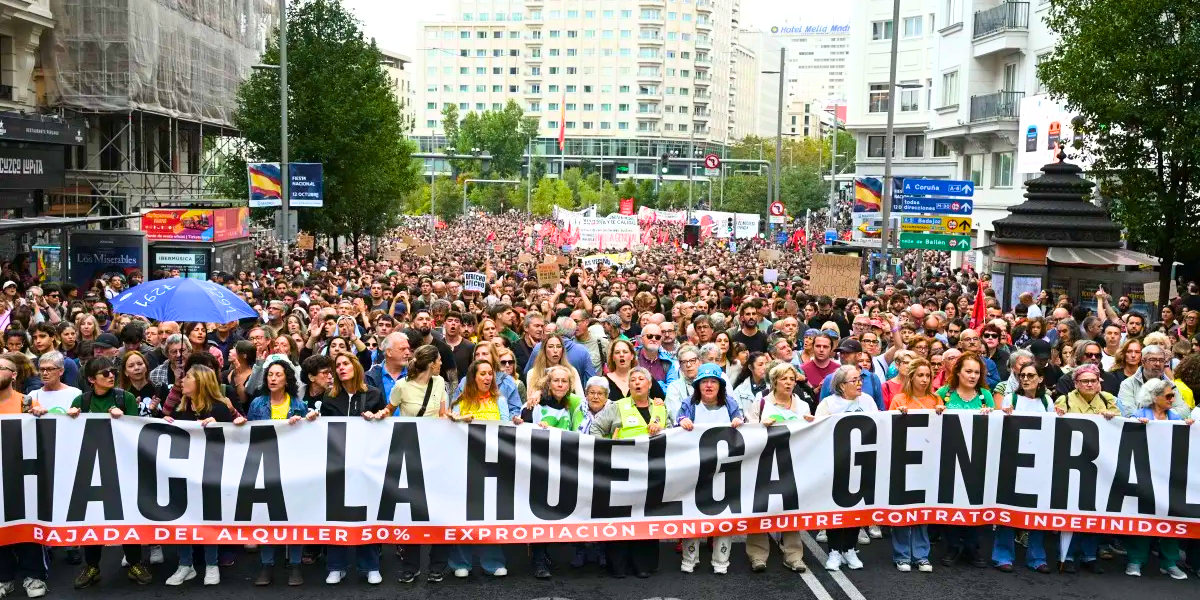
Hundreds of thousands of people have taken to the streets of Spain to fight back against intolerable increases in housing prices. One precipitating event was the eviction of 87-year old María del Carmen Abascal (aka Maricarmen), who had lived in her house for many decades. Maricarmen’s eviction, and the violent nature by which police carried it out, prompted thousands to hit the streets in solidarity with her. When she died just after the eviction, rage boiled into the streets even more strongly. As a result, the major unions have called for a general strike on November 11, and Prime Minister Sanchez has called an early election. This shows how linking the struggles against the different calamities of capitalism can create political crises.
Spring’s Valerie Lannon spoke with Luis, a young anthropologist living in Madrid, to get a perspective from someone participating in the street demonstrations.
Spring: Can you tell us a little bit about the Madrid demonstrations?
Luis: The main issue is the housing crisis. House prices have increased so much that it’s impossible for the people to live in the same house as before, to pay the rent, or to buy a house. To be honest, it’s hard to know how many people have taken part in the demonstrations because, at the end, it (the estimate) is a political tool, that the government says there are less people than what the (tenants’) union says. But I would say more than 100,000 people for sure.
Depending on the day of the week, the makeup of the demonstration changes. For example, last Saturday morning, you’ll see flags and a lot of people. It’s not only the people from unions and the tenants’ groups — of course they were there, but in time, most people were there, like me, because we believe in those things (the aims of the tenant movement).
Spring: Why do you think so many people have turned out?
Luis: We’re tired of living this way. Madrid has become a city where everyone wants to live. A lot of people have come from around the world, there are more things to do, more events. But the quality of life has been reduced. We have to pay more and more to live in the same house where we used to live, and the house hasn’t changed. It’s like, “Why are we paying more if we have the same thing that we had in the past?” So I feel like that’s the main problem. We’re wasting too much money on housing and we can’t do other things.
Spring: What is the main goal of the demonstrations?
Luis: The main goal is to control the housing prices. I’m not sure what it will take to win because the crisis is deeper than all these uncontrolled housing prices. I feel like, at the end, more and more people are living in Spain and I can say we have to build more and more houses, but also figure out how to stop the speculation in housing to figure out who’s living in the houses and why (e.g. short-term tourist rentals). I think that’s difficult.
If we support capitalism and the market, nobody’s protected because, as has been shown here, an old woman can be expelled from her house (Maricarmen) just because the market doesn’t take into account other things, like she’s been living all her life there. I mean, if this can happen to an old woman, then what happens to young people who are just starting to live in a new house and the market’s housing prices go up and up? I don’t know how you, and the next generations, are going to survive in the cities.
Author

Did you like this article? Help us produce more like it by donating $1, $2, or $5. Donate