
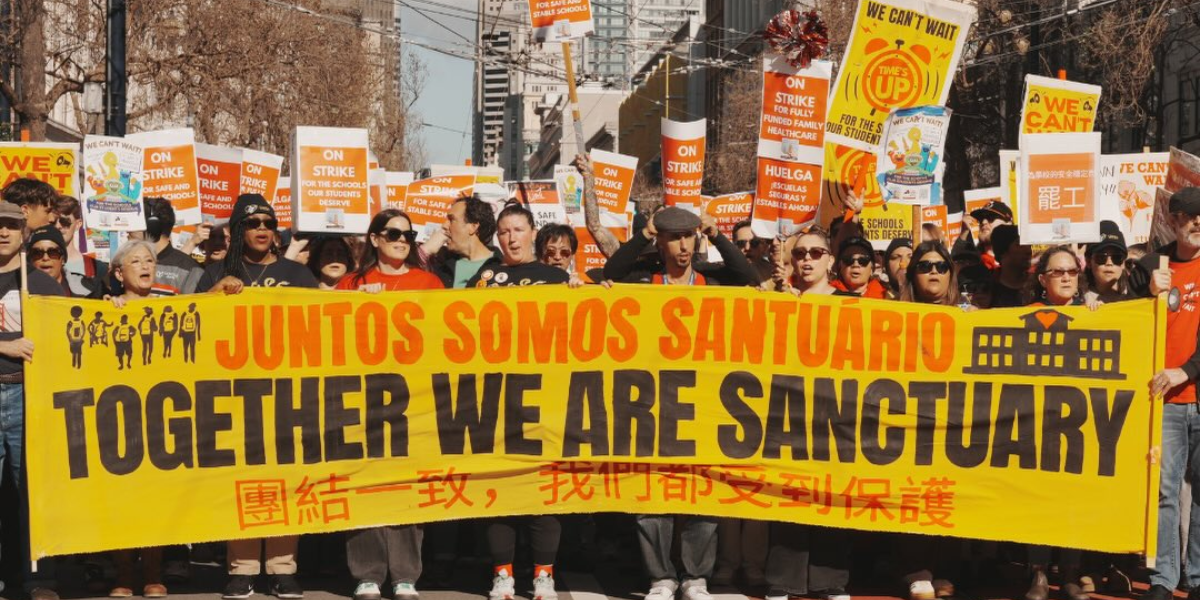
On February 13, the United Educators of San Francisco (UESF) bargaining team announced major victories on key contract demands. The strike by 6,000 public schoolteachers was the first teachers strike in the city in nearly 50 years. For four days the strike closed all 120 of the district’s schools. Teachers hit the picket lines demanding better wages, improved family health benefits and more support for students with special needs.
This part of the story will sound very familiar to Ontario educators: San Francisco Unified School District (SFUSD) is under supervision by the state of California because of a long-standing financial crisis. The union asked for a 9 percent raise over two years, which would mean an additional $92 million per year for the district. SFUSD rejected the idea saying it faces a $100 million deficit. The union emphasized that the money could come from reserve funds that could be directed back to classrooms and school sites. A report by a neutral fact-finding panel recommended a compromise of 6 percent over two years and largely sided with the arguments of financial constraint by the district.
But, after the dust cleared on the four day strike, the tentative agreement secured fully-funded healthcare for employees and their families, pay raises of 8.5 percent for paraeducators (what might be called EAs in Canada) and 5 percent for teachers. Resource Support Programs will have caseload reductions and fewer barriers for additional support. The communities the schools serve also won support in the tentative collective agreement, including sanctuary city language that will create greater protection for immigrant students and their families and a continuation of the innovative School Stayover program which temporarily houses students experiencing homelessness.
How was it done?
While the agreement goes to membership for a vote, educators and their supporters are celebrating. How did the union go on strike for the first time in nearly 50 years and win against a state-supervised district that was crying financial hardship? Hopefully, more details of the city-wide mobilization will come out in the weeks to follow, but it is clear that picket lines at schools in every community became a focal point of the struggle. Parents, students and other members of the community joined the highly visible lines in what came to be viewed as a fight for the city’s future. The teachers posed the questions: will the city belong to billionaires or should the people who care for the city’s kids be able to afford to live and have health care? Will our schools be a sanctuary from ICE terror and shelter for our most vulnerable students or will it be survival for only the privileged few?
The educators’ cause was aided by the participation of students. Including a delegation of high school students who interrupted bargaining with a message Superintendent Maria Su in support of the union’s demands. Supporters and educators also flooded the city with signs. Thousands of small business and residential windows proclaimed loudly “we demand the schools all our students deserve.”
There were also city-wide marches to gather support, at parks and civic squares and one that even marched to Superintendent Su’s home, protesters chanting “ “Listen up Maria Su/You need us, we don’t need you/If there’s no money tell us why/your salary is too damn high!” All this support and action didn’t come out of nowhere, the union had been preparing to strike for the last two years, even organizing practice pickets to ensure members were prepared for the moment.
Bargaining the public good
The movement of educators in San Francisco is the first in a series of potential teacher strikes across the state of California, as Los Angeles, San Diego, Oakland and elsewhere are all facing potential confrontations with their districts.
It also demonstrates a template for educators elsewhere on how to win. Bargain with the public good in mind; educators and community together for the common good. Make solidarity easy, visible and accessible to supporters. It should be easy to show support and spread that solidarity around. Finally, EAs are essential to education, teachers can’t leave EAs behind in their bargaining and vice versa. Education workers united can win.
Photo by Andreas Amador.
Author

Did you like this article? Help us produce more like it by donating $1, $2, or $5. Donate