
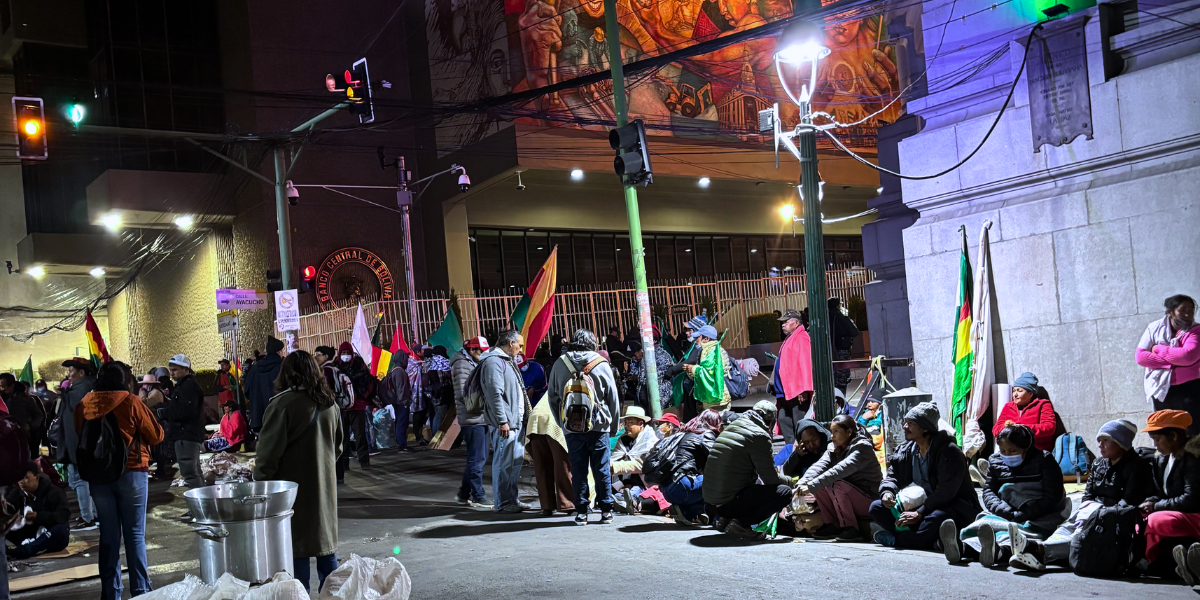
Austerity and neoliberalism have pushed workers across Bolivia into an indefinite general strike, with miners, teachers, and transport workers, alongside social movement groups (primarily Indigenous), blockading La Paz and other major cities for over five weeks, grinding the cities to a halt. Road blockades, led by millions of mostly Indigenous peasants and labour unions directed by rank-and-file militancy, are still going strong despite severe government and military repression. In the face of escalating violence from the state, demonstrators are clear: “fusil, metralla, el pueblo no se calla” (rifle, machine gun, the people will not be silenced).
As has happened countless times before, striking workers and people protesting in the streets are portrayed as criminals, gang members, and thugs, while the government is cast as the defender of democracy. Unsurprisingly, the United States has expressed clear support for the government and its actions to suppress the demonstrations.
Over five weeks of mass protests, road blockades, and strikes in Bolivia demonstrate to the left and beyond that workers will not quietly accept austerity and destitution imposed in the interests of the ruling class.
While the protests and road blockades have been cleared by the military after a state of emergency was declared last week, unmet demands from the masses suggest that organized discontent is not going anywhere without real change.
A fight against austerity and neoliberalism
Rodrigo Paz Pereira, or Paz, elected just six months ago as the U.S.-backed and centre-right candidate, came to power on the promise of “Capitalism for all.” Since coming to power, high inflation, spending cuts, privatization of resources and land, and most recently, cuts to fuel subsidies have been met with protests and strike action culminating in the ongoing general strike and blockading of La Paz and other cities. Protesters are demanding a 20 percent pay rise as a response to collapsing living standards, an end to austerity measures, and the resignation of President Paz. Other demands include a halt to the privatization of natural resources and land and rejection of IMF loans and structural adjustment which have spelled disaster for other nations in the region.
In December 2025, Paz issued the Supreme Decree 5503. Its first measure was to eliminate fuel subsidies, doubling fuel prices, followed by other measures that directly attacked the lives of working class Bolivians while paving the way for foreign exploitation of land and resources.
These austerity measures culminated in a wave of opposition, with the Bolivian Workers’ Central (COB), the country’s largest trade union federation, calling a series of mass actions against the measures. COB is also joined by the Unified Syndical Confederation of Peasant Workers of Bolivia (CSUTCB), which organizes peasants by region and acts as rural trade unions (sindicatos agrarios). The COB follows a similar organizational structure and leadership system to CSUTCB, in which leaders meet with regional elected members through assemblies, and the rank and file play a key role in determining strategy and tactics. The coordinated alignment of trade unions, social movements, and rural groups grew into a broader movement, eventually reaching half a million people in the streets.
The result of this kind of grassroots and rank-and-file militancy is reflected in the ability to hold these mass demonstrations and blockades for as long as the people have, despite severe crackdowns and attempts by external forces to destabilize the movement. Many of the leaders of major unions involved in the mass strikes have been arrested, with their whereabouts unknown. The fight evolved to include the release of all those detained as one of the key demands alongside renewed calls for Paz’s resignation.
The global ruling class united to support Paz
As socialists and internationalists, we must recognize this as a significant working-class and Indigenous fightback against not just austerity and centre-right policies, but against neoliberalism, U.S. imperialism, and an attack on life itself. It is instructive to see the response from mainstream media and other state leaders who have come out in support of Paz and his actions to suppress the demonstrations. Trump and Washington have fiercely maintained their support for Paz and the selling off of state assets, as well as the attacks on indigenous people and workers on the street, much like how they have normalized the same methods elsewhere.
Heads of state in Argentina, Ecuador, Peru, Costa Rica, El Salvador, Chile, and even Brazil have come out to condemn the blockades and have called for democracy and dialogue. Unlike many other nations in South America, Colombia’s President Gustavo Petro has voiced his support for the rights of demonstrators to protest and fight for dignity. Colombia’s support for the demonstrations has been met with hostility from Paz and the state, leading to the expulsion of the Colombian ambassador to Bolivia.
The irony is not lost on anyone paying attention: workers, peasants, and Indigenous communities taking to the streets in millions to demand the right to live with dignity and have a say in how their lives are governed are portrayed as undemocratic and dangerous, while ruling-class austerity policies that impoverish the masses are treated as responsible governance.
What is at stake for all of us?
While the mainstream media has largely ignored the struggle of Bolivian workers and peasants resisting austerity and imperialism at great personal cost, it is up to socialists and the international working class to highlight what is possible when collective anger is organized through mass mobilization.
The working class in Bolivia is fighting back and holding the line. We should stand in solidarity with their struggle and draw lessons from it in our own fight against austerity at home.
Author

Did you like this article? Help us produce more like it by donating $1, $2, or $5. Donate