
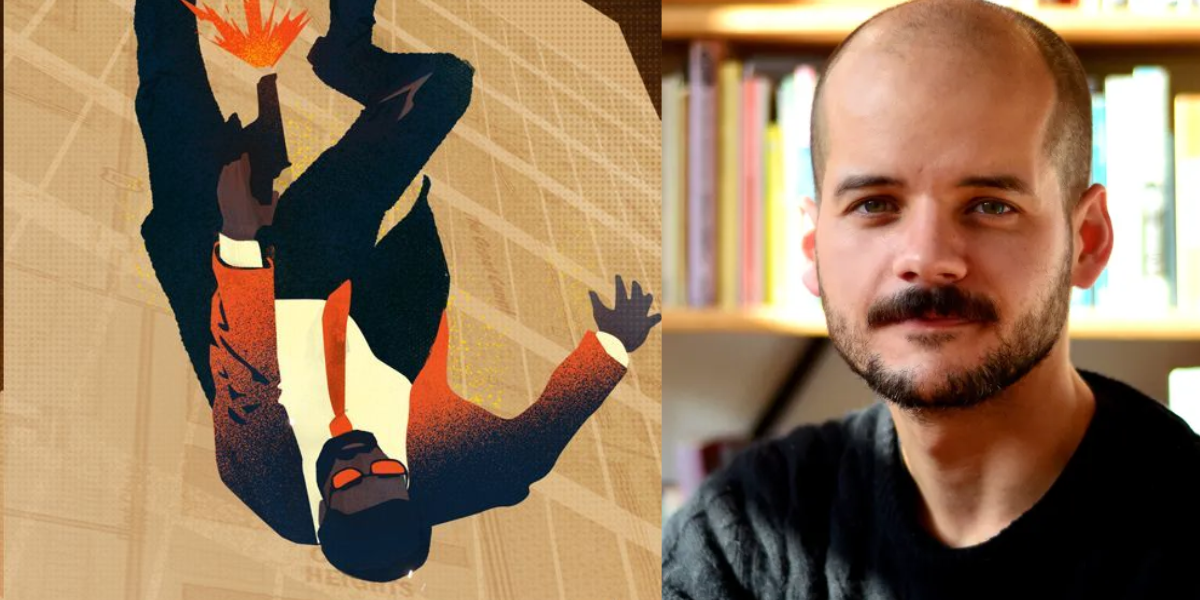
A revolutionary setting for a revolutionary game
Ten years ago, John Harper’s Blades in the Dark set a new precedent for tabletop role-playing games with a fresh system that emphasizes politics, puts story over simulation, and places agency in the hands of players. Now, ten years on, game designer Tim Denee returns to Harper’s Victorian-Gothic city of Duskvol and takes it somewhere unexpected: the swinging 1960s.
Blades ’68 moves the setting forward by a hundred years, swapping apocalypse for dystopia, gothic for groovy. Gone are touchstones like Dracula, Peaky Blinders, and Crimson Peak; now the vibe is Disco Elysium, Brave New World and — if players dare — Austin Powers: International Man of Mystery. (Says Denee, “This is the forbidden touchstone.”)
Blades ’68 has blown past all crowdfunding expectations, raising nearly half a million dollars on a thirty thousand dollar goal. The eagerly awaited sequel ships in August 2026.
Spring spoke with Tim Denee remotely from Wellington, Aotearoa. The following interview has been edited for clarity and length.
Blades in the Dark is a Victorian pastiche; the obvious choice for a sequel might be something like WWI. So why jump ahead to the late ‘60s? Why do stories from that period feel urgent right now?
TD: Well, the unexpectedness is part of the point of the project; it gives it an energy and vibrancy. But the ‘60s are the formation of the modern world as we know it, in terms of advertising, corporations, civil rights movements, the sexual revolution; the world as we know it is formed in the ‘60s. But everything’s still new and small, so everything’s more approachable than it would be if we set the game in, say, the ‘90s, when everything’s had the chance to grow. In the 60’s everything’s still small, so it’s easier to get your hands around.
Duskvol is — to put it lightly — a highly political place. How do real-world politics inform the world of ’68?
TD: Blades in the Dark has a lot of politics, and a big part of that is about friction — giving your players something to push against. John Harper put a lot of his own politics into the original Blades, and I wanted to keep that through line; so class struggle is still a core part of that friction. In the original Blades, Duskvol is full of these unions struggling for better conditions. In ’68, we see a lot of these same groups and struggles, but now they also have to deal with spy agencies, mass surveillance, and international corporations’ meddling. I also wanted to gesture at the soft power aspect of that. There’s this idea in the game about living in the “Age of Consensus”. The game’s interested in this cosy, comfortable, middle-class consensus that emerges [after World War 2]. And there’s a more cartoonish Big Brother vision of social control you see in some of the media we’re referencing, but that cartoonish version is less interesting and relatable to me than the complacent, middle-class version which we’re sort of living with.
It’s a rare game of, say, Delta Green in which you help a faction called “The Congress of Unions” trigger a general strike — but these sorts of political activities are a core part of gameplay in the Blades franchise. Why are politics so much more front-and-centre in tabletop role-playing games today than they were in games you and I might have grown up playing?
TD: It must be the independence, indyness of these games that’s driving it. With older mass-market games, you’re still living in the world of old-school publishing; you need to handle print and distribution yourself, so you still need a big upfront investment, and maybe you don’t want to take as big of a swing when you’ve got that much on the line. Today with Itch.io and Backerkit and other crowdfunding sites, most games are made by just one person. And so the creator can take bigger swings and be much more personal with the kinds of stories that they want to tell.
In a time of rising fascism, it seems like tabletop games — Blades and Lancer both come to mind — are meeting the moment better than a lot of other media. Why might that be?
TD: It’s the independence and freedom we just talked about, for sure, but also the size of the hobby. Put simply, there’s not a ton of money to be made. People still call it a “hobby,” not an “industry.” So that means people are in it for the love of the game. There’s no point selling out because there’s nothing to sell out to. And so you make art the way you want to in a way you couldn’t, say, if you were working with a large corporation.
Are there any insights to be found here for artists working in other fields?
TD: RPGs in particular are a medium where you’re able to self-produce — of course this all relies on third party platforms, and you know, Patreon has its own problems. But overall it’s a really good model.
In the process of researching and designing ’68, what have you learned about the struggle for social change?
TD: I was surprised by how very broad and how endless it is. The endlessness is scary, but the broadness is inspiring. There’s this Hunter S. Thompson quote about 1968 as the “high water mark” of social movements and solidarity, and everything was sort of downhill from there. So that’s also part of why we chose ’68. In my own research, I was looking at social movements that emerged in the ‘60s and ‘70s: civil rights and women’s rights movements, movements for international solidarity, political movements among Puerto Ricans and Asian Americans. Here in Aotearoa I was thinking about the Māori protest movement that gained momentum in the early ‘70s, leading up to the establishment of the Waitangi Tribunal. So for some movements it was the high water mark, but for others it was just the beginning.
In your own games is ’68 the high water mark?
TD: Usually the start of something better. I hope the start of something better! The game provides a lot of problems and not a lot of answers, but you can rely on the players to come up with solutions. There’s always a certain amount of… explosiveness in those solutions, since it’s a tabletop game, but that’s part of the fun.
It seems like the game is on your side when you set out to do that, too. The mechanics of the game really want to empower you to change the world.
TD: Yes; no matter how big the problem is, you can just set out a clock and start working slowly toward it. Which is sort of like real life, I guess.
Bonus question: Will the revolution happen in Aotearoa, and when?
TD: I hope so! There are a lot of social movements: the Tino Rangatiratanga movement for example — a lot of reasons to be hopeful. But also it’s a country where a big part of the economy is farming, and there’s a very strong conservative streak that comes along with that. There’s a famous tweet by the poet Hera Lindsay Bird that goes, “godDAMN, this stupid milk-loving piece of shit dumbass mean spirited sale at Briscoes racist sexist 40% off deck furniture piss country.” And that pretty much does describe the place a lot of the time. But I think there’s a lot of reason for hope. Check in again in 5 years and see how it’s going!
Blades ’68 can be pre-ordered through Rain City Games in Vancouver, B.C., and Ratti Incantati in Oshawa, Ont.
Author

Did you like this article? Help us produce more like it by donating $1, $2, or $5. Donate