
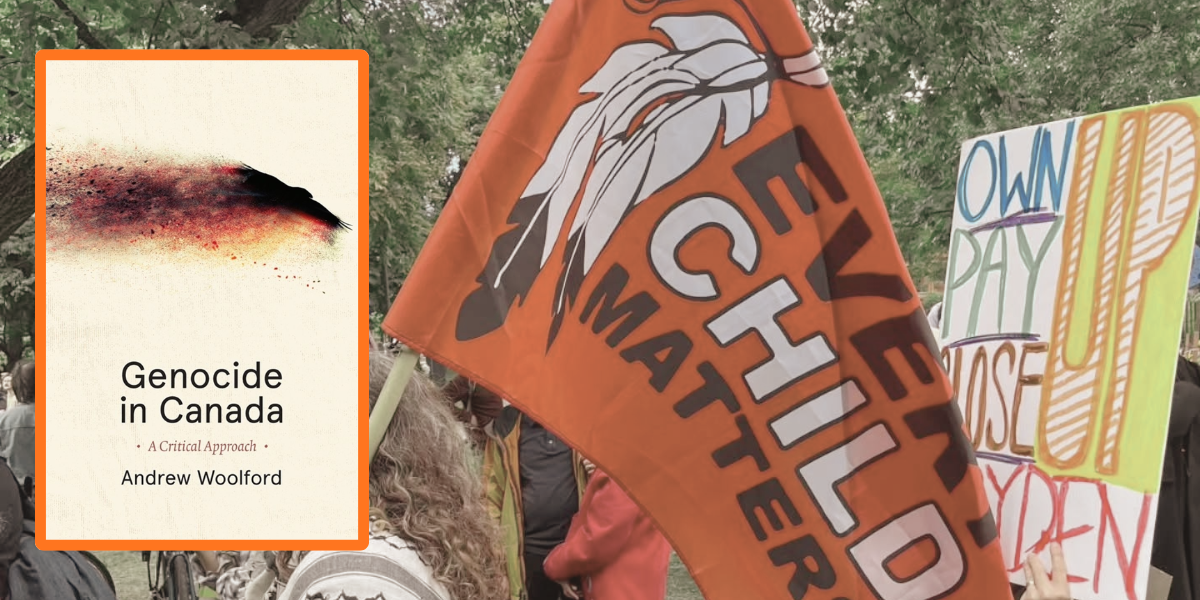
Review: Genocide in Canada: A Critical Approach by Andrew Woolford (Fernwood Publishing, 2026).
The term ‘genocide’ often invokes strong imagery in the minds of those who come across it . Images of gas chambers, crematoriums, mutilated bodies, and mass graves are conjured. The term was coined by Polish-Jewish lawyer Ralph Lemkin in the early 1940s as the brutality of the Holocaust was coming to light. The Nazi regime systematically killed millions of Jews, Poles, socialists, Romanis, and homosexuals in extermination camps. While the term genocide refers to the mass killing of individuals, what makes it distinct from other forms of mass slaughter is that there is an intent to eliminate a group and those belonging to it. In 1948, the United Nations passed the Genocide Convention, which outlined the legal definition of genocide to consist of any of the following actions committed with the intention of eliminating a specific racial, ethnic, national, or religious group:
- (a) Killing members of the group;
- (b) Causing serious bodily or mental harm to members of the group;
- (c) Deliberately inflicting on the group conditions of life calculated to bring about its physical destruction in whole or in part;
- (d) Imposing measures intended to prevent births within the group;
- (e) Forcibly transferring children of the group to another group
Despite the United Nations’ efforts in standardizing a legal definition of genocide to keep actors accountable for atrocities, many critics maintain that the legal definition of genocide may be too limiting in its scope and excludes attempts to eliminate racial, national, ethnic, and religious groups that did not take the same approach of industrialized slaughter as seen during the Holocaust or perhaps even mass chaos and violence in the streets as seen in Rwanda. Instead, genocide can also consist of the death of language, the separation of children from their families and culture, and the forcible takeover of land and natural resources. This process can be seen in Canada’s history with its Indigenous population. A history of displacement, forced assimilation, and abuse.
Genocide in Canada
In Andrew Woolford’s monograph Genocide in Canada: A Critical Approach, Woolford analyzes the Canadian government, settler society, and the Catholic, Presbyterian, Methodist, and Anglican churches’ attempts to eliminate the culture, stewardship, and language of Canada’s Indigenous population to establish a settler colonial state. Through the process of residential schools, private ownership of land and natural resources, and the reserve system, the Canadian government aimed to assimilate Indigenous peoples into the dominant and supposedly superior European culture. Woolford pushes for a broader definition of genocide that is not bound by legal criteria but is instead a sociological and cultural approach that considers the death of the group to go beyond outright slaughter.
Woolford makes a case for genocide taking place in Canada against Indigenous peoples by examining the necessity of eliminating Indigenous culture and land stewardship as an essential element of the settler colonial project in Canada. Woolford is informed by the perspectives of Indigenous peoples and how they would classify their history and experiences. He also looks at how the Canadian state explicitly targeted and aimed to destroy Indigenous Peoples as a “group.” Despite the atrocities that Woolford examines, he also considers the resilience and defiance Indigenous peoples have demonstrated in the face of violence and adversity.
Settling by displacement
Woolford links the elimination of Indigenous ways of life and to the settler colonial project of building the Canadian state. Woolford defines genocide to be “a set of coordinated and purposeful actions designed to severely interrupt the ongoing negotiation of group life through destruction of meaningful social and natural relationships, which are crucial to forming and reforming persisting collective identities.”
Woolford argues that the distinction between genocide and cultural genocide is mute as the term itself should also encapsulates the destruction of culture that defines a group and not only through means of murder and sterilization. This destruction of culture and livelihood is an essential aspect of the establishment of a settler colonial society. The goal for the emerging settler colonial state is not simply the extraction of resources, but to institute a new relation to property ownership conducive to capitalism. The ownership and control over land for the settler-colonial project was key. This requires for the legal and political understandings of Indigenous peoples and their claim over and stewardship of the land to be destroyed. Alongside the conquest of land and resources, Euro-Canadian society also interpreted Indigenous culture, language, and connection to family as a threat to what was perceived as the superior culture and religion.
The Residential School system as genocide
With the aim to displace and replace Indigenous populations, the stewardship of land, and the dominant culture, the Canadian state developed a network of institutions such as the Indian Residential school system, the reserve system, to address what was understood as the “Indian problem.” Through these institutions Indigenous groups were isolated, separated from their families, forced to abandon their native tongue, and were even often physically, sexually, and emotionally abused.
Woolford pays special close attention to the Residential school system, and how these boarding schools operated to eradicate Indigenous culture and group identity while children were still young and vulnerable. Woolford discusses the stories and deep traumas experienced by Indigenous peoples at the hands of the residential school system, run and operated by the Church and the Department of Indian Affairs. These schools separated children from their family (often by force), placed them in boarding schools where they were forced to only speak English, made them do difficult chores with little resources such as scrubbing the floor with small brushes, and taught them their beliefs were evil, inferior and anti-Christian. They were taught that they would suffer in hell if they did not abandon their culture and way of life, which in turn resulted in strains in the children’s relationships with their family and community members as well as resulted in emotional trauma as the sense of omni-present surveillance would continue to haunt survivors of the Residential school system.
Agency over the past
Through testimonies from survivors and by connecting these stories with Lemkin’s goal of using genocide studies as a way to create a more pluralist and inclusive world, Woolford demonstrates how the forceful assimilation and physical displacement of Indigenous populations is form of perpetrating genocide through the destruction of group identity. Some genocide scholars and far-right activists deny this experience as a form of deliberate malevolence towards the Indigenous peoples, as it does not replicate the same industrial level killings of the Holocaust. This has resulted resulting in actors, including representation of Canada at the United Nations, to advocate for the exclusion of cultural genocide to be considered as a part of the legal definition of genocide. Limiting the definition is about absolving the Canadian state of its crimes against its Indigenous peoples.
To counter this exclusion of Indigenous voices in the construction of the legal definition of genocide Woolford dedicates a chapter of his book to a discussing with Indigenous elders and survivors of the Residential school system about how they would classify their experience. David Courchene, an Elder of the Anishinaabe nation, told Woolford that their is no word in his language that accurately describes the violence that was inflicted onto his people, the word that resonates instead with their experience is the English term “genocide.”
Indigenous peoples noticed that clear-cut logging, oil extraction on their lands, pitiful health services, and the disregard of treaty rights as a form of attack on their group identity and way of life. Woolford’s analysis rightfully centres victims and survivors in the process of sociologically and legally defining their experiences in order to seek justice and prevent future atrocities.
Expanding our scope of genocidal institutions in Canada
Despite Woolford’s in depth analysis of how the Residential School system acted as an institution of genocide against Indigenous peoples, this institution did not exist in isolation but a part of a broader network of institutions that had the aim of addressing the ‘Indian problem.’
The Residential School system stands as an example of how Canada sought to destroy aspects of Indigenous culture, however Woolford makes the point of how the stewardship of the land and use of its resources being taken from Indigenous populations, and the responsibility being places in the hands of the European settler society is also an essential aspect of how genocide was used to establish settler colonial society. Though Woolford does not examine this process in as much depth. A discussion of direct conquest, treaties, and the origins and operation of the reserve system would reinforce his argument argument to broaden our understanding of genocide.
Woolford’s focus on the cultural aspects of genocide also results in overlooking examples of genocide that does in fact correlate with the UNGC definition of genocide including the forced sterilization of Indigenous women that took place in racially segregated hospitals. In fact, the very institution of racially segregated hospitals and tuberculosis sanatoriums that would emerge in the 20th century, acted similarly to the Residential school system in the way that it isolated members from their community and prepped patients to not return home to their traditional ways of life but to relocate in urban centres and adjust to a capitalist and Christian way of life. Woolford is taking on a large question in examining the a set of what he describes as “coordinated and purposeful actions designed to severely interrupt the ongoing negotiation of group life,” and it would have reinforced his argument to examine a larger network of these institutions and how they perpetrated genocide rather than focusing solely on how the Residential School System as a stand alone example of forced assimilation, violence, and genocide.
Reconciliation and the ongoing fight against genocide
Woolford’s aim in expanding the definition of genocide and extending this definition to include Canada’s violent actions against Indigenous peoples is essential in an era where far-right activists commit to denying the severity of the atrocities that took place against Indigenous communities. To honour survivors and to also fight against the ongoing violence against Indigenous groups such as the epidemic of Missing and Murdered Indigenous women, we must hold our institutions accountable, using the terms and definitions that resonate the most with
said survivors. This critical approach to genocide is not only essential in retroactively addressing past abuses and tragedies but also to fight against violence that is ongoing today such as the genocide that is currently unfolding in Gaza. Woolford reminds his readers that the destruction of identity, culture, and community can be just as effective and eliminating groups as does physical violence and slaughter.
Author

Did you like this article? Help us produce more like it by donating $1, $2, or $5. Donate