
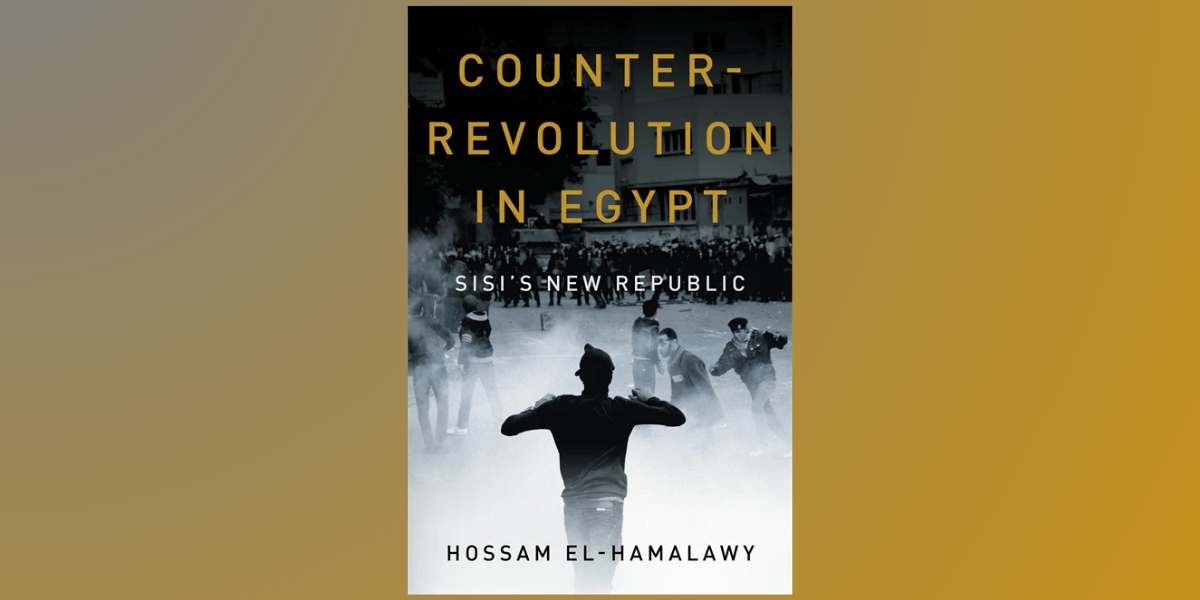
Counter-revolution in Egypt: Sisi’s New Republic by Hossam el-Hamalawy (Verso, 2026).
“Engels elucidates the concept of the ‘power’ which is called the state…What does this power mainly consist of? It consists of special bodies of armed men having prisons, etc., at their command.” – Lenin, The State and Revolution
Even after living in extremely repressive Tsarist Russia, Lenin might have been shocked had he lived to see Egypt under its current dictator, Abdel-Fattah el-Sisi, better known as Sisi. Counter-revolution in Egypt: Sisi’s New Republic spells out the endless ways the Egyptian state controls and overpowers its people, starting with the coup in 2013 and including examples as late as 2025.
The Egyptian author, Hossam el-Hamalawy, is a familiar name to Spring readers, since we aspire to follow his lead in using revolutionary journalism as a key tool for revolutionary organizing. His personal involvement as a journalist and revolutionary socialist in the events leading up to the 2011 revolution, and the state’s persecution of him afterwards, make him singularly qualified to write this book.
The Arab Spring
Egypt is no stranger to coups or repressive governments. The overthrow of the monarchy happened in 1952 by way of a military coup and takeover by Gamal Abdel Nasser. His hand-picked successor, Anwar el-Sadat, took power in 1970, and, after his assassination in 1981, was succeeded by Hosni Mubarak. But the Egyptian working class is no stranger to resistance either. After decades of facing government corruption, police repression and economic failures, workers, along with students and others in their millions across the country, stepped up their protests. These reached their peak in the uprising of January 25, 2011, inspired, in part by the overthrow of the neighbouring dictator in Tunisia, in what became known as the Arab Spring.
Mubarak was forced to step down, and the government was taken over by the Supreme Council of the Armed Forces. Elections were called in June 2012, won by Mohamed Morsi, the candidate of the Muslim Brotherhood. But in June 2013, another military coup took place, which put Sisi in power.
El-Hamalawy describes how, during all this time, with the occasional rhetorical concessions regarding state power, the government continued to repress the population, killing and imprisoning tens of thousands of people. But Sisi has proven to be unique in his exercise of violence and authority.
The New Republic
Previous governments had attempted to be “coup-proof” by not letting any single part of the vast array of “bodies of armed men” – the police, the military, the intelligence services – be in control. But Sisi centralized all these forces (the “fragmented apparatus” as el-Hamalawy describes it) under his command. While there would be a division of labour of sorts, Sisi controls the levers, hence, “the new republic.” Our fallen Spring comrade, Sarah Hegazi, when speaking to Sudanese and other activists in 2019, warned about the dangers of complacency once dictators are overthrown. In the case of Egypt she noted, “There are mini-Mubaraks everywhere.”
As el-Hamalawy notes, “Sisi sought to unify the repressive apparatus for the first time since 1952, to respond to the new dominant perceived threat of popular unrest.” This book details the many unbelievable ways that Sisi’s power is exercised as “a perfect military camp”.
El-Hamalawy describes not only the extreme levels of state violence against perceived threats, but also the militarization of all aspects of society: the economy or “military capitalism” (more rife than ever with state favouritism); the state bureaucracy; the courts; the diplomatic services; all forms of media; the education system; the entertainment industry; cultural spaces (e.g. museums, theatres); and religious institutions.
In addition, Sisi has trampled gender rights, and the rights of religious minorities, and extended state surveillance of the population to the new parameters now available through evolving technologies. The number of public spaces has been reduced, in order to decrease the possibility of another experience like the huge occupation of Tahrir Square during the revolutionary period.
Role of the west
El-Hamalawy’s book is peppered with references to the West’s involvement in propping up the Sisi regime, through extensive sales of military and surveillance hardware. Countries such as the US and Germany are particularly singled out. One of several examples is how Sisi uses the state’s Administrative Control Authority (ACA) to purge government bureaucracy and private capital. “Starting in 2015, the ACA and the FBI ‘have increased cooperation’ according to the US Embassy in Cairo. ACA officers are sent to the FBI’s National Academy in Quantico for training.”
The whole topic of Western support for Sisi could be a book in itself, and it would be wonderful to see one that included research on the role of the Canadian government.
What next?
Unfortunately, Sisi is not unique in militarizing a whole country. Countries like Indonesia, the Philippines, Iran and countless others perform from the same playbook. And the enormous increase in military spending among NATO countries and other powers is a huge cause for concern.
In Egypt, while Sisi has “delivered” on repression, his measures are not one hundred percent successful, either economically or ideologically. We are beginning to see rivalries among the “bodies of armed men.” And small cracks in the state edifice are evident in sporadic protests and strikes and the popular mood over Palestine. While the objective conditions that led to the 2011 revolution are in place, the subjective factor – a mass movement of opposition – is not, due to its decimation at the hands of Sisi’s government.
But as el-Hamalawy concludes: “Sisi’s extraordinary intervention to annul the first-round results in nineteen constituencies (in the November 2025 vote) was not a show of strength but a sign of fear: fear that the very apparatus he fused into a single command structure is beginning to pull against itself. The unity has not collapsed, but its cracks are now visible to anyone willing to look. And cracks in authoritarian security coalitions rarely stay small.”
Author

Did you like this article? Help us produce more like it by donating $1, $2, or $5. Donate