
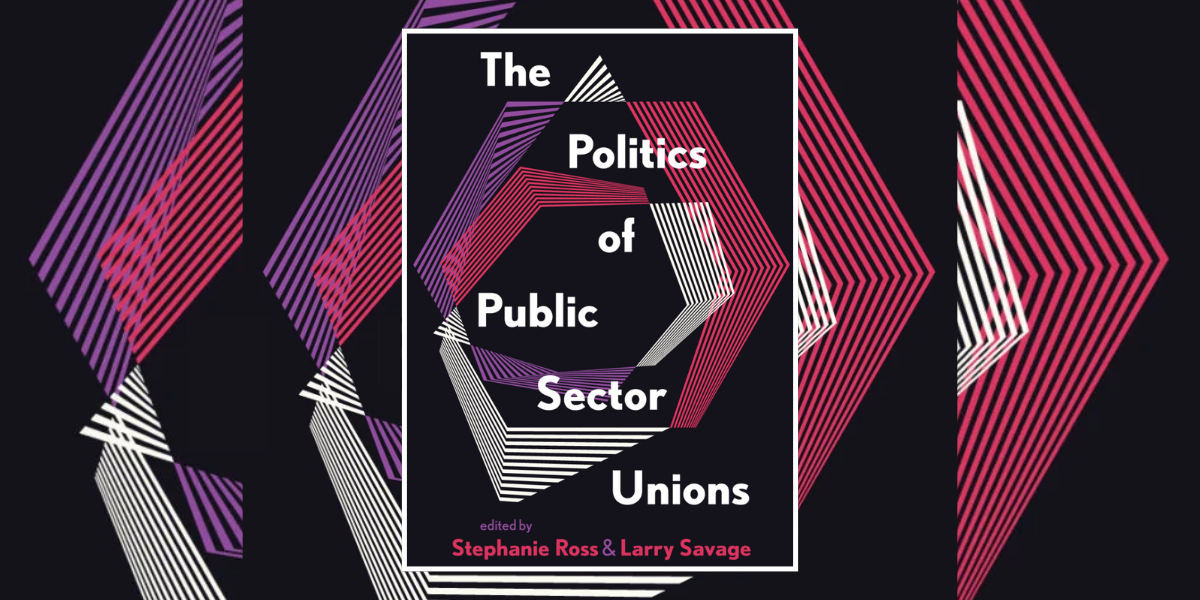
The Politics of Public Sector Unions, edited by Stephanie Ross and Larry Savage (Fernwood Publishing, December 2026)
Stephanie Ross and Larry Savage’s book The Politics of Public Sector Unions is a timely intervention in the Canadian labour movement, exposing the challenge of fighting successive austerity governments and growing attacks on public services while navigating uneven class consciousness within public sector unions. At a time when the average Canadian worker is a woman in the public sector rather than a factory worker, it behooves all workers and organized labour to soberly analyze how power operates in this sector, what levers are available to public sector unions and how they relate to electoralism and the capitalist state. This forthcoming book delves into the world of public sector unions in Canada, their evolution and the ongoing challenges of bargaining with a capitalist state. Through case studies and interviews, the book complicates simple formulas about how unionized workers can win material gains from the employer, when the employer is the state with its own set of tools.
Public sector unions in the neoliberal era
The collection of essays sets out two objectives: to address the unique role of public-sector workers and unions and to examine the various options available to public sector unions to build union power and confront the capitalist state. The book is at its strongest when delivering on the first objective, while the authors struggle to formulate a clear path forward to effectively confront the capitalist state, raise class consciousness and create a political crisis to win against neoliberal forces. The reasons for this are less a fault of the book and more a reflection of the political challenges facing public sector unions, for which there is no one-size-fits-all solution. The book challenges the idea that increased worker militancy and strike action alone are sufficient to win gains in the public sector. The varying nature of class consciousness, a largely feminized workforce where care work is underpaid, austerity programs and the inability of public sector workers to interrupt capitalists profits all contribute to complicate the simple formulation of worker militancy and union gains. Nevertheless, building working-class consciousness and rank-and-file militancy remains essential to compel employers and governments to give up ground.
The book successfully contextualizes why, as trade unionists and socialists, we need to analyze power in public sector unions and the path to building it if we want to confront the state and make meaningful gains for workers. The book foregrounds that, until the 1960s, private sector unionists dominated the labour movement while public sector unions lacked organized structures and representation. However, in 2025, one out of every five Canadian workers was employed in the broader public sector and, of those, 77.5 percent were members of unions. Public sector work stoppages as a share of the total number of strikes and lockouts in Canada have increased over time, making public sector unions a key source of strike activity. However, as opposed to private sector unions, when workers in the public sector go on strike, they do not undermine capitalist profits; instead, the public goes without critical services while the employer and the government save on wages. Diving deeper into these dynamics alone make the book compelling for workers and elected leaders in the public sector.
The essential role of united fronts and coalitions to win
We have seen these dynamics at play recently in some of the largest and longest public-sector strikes in Canadian history, in sectors in which most of the work is delivered by women—often racialized women—as seen in the 2022 Canadian Union of Public Employees (CUPE) education workers’ strike in Ontario; the major BC General Employees’ Union (BCGEU) public service strike in 2025; the Alberta teachers’ strike; and, just this year, the community service and childcare workers’ strikes in Ontario and Nova Scotia. While the 2022 education workers’ strike in Ontario brought the Conservative Ford government to its knees, almost bringing the province to a general strike, we have seen less favourable outcomes in other cases. The reasons for this range from the devaluation of care work delivered by women (since they are often expected to perform it for free) to low levels of organized community support and the inability of bargaining units to disrupt and shut down their workplaces to create the kind of crisis that forces the government to act. One of the central questions in the book that stays with readers is: how can high union density coexist with persistently poor working conditions in the sector?
The book takes us through various case studies to show how the answer is rooted in the structural fragmentation of the sector, relentless privatization, the persistent undervaluation of feminized and racialized care work, tendencies toward business unionism and other factors that are not easily countered through localized bargaining alone. Issues of inequity, racism and privatization must be fought alongside narrow union demands. This necessitates broader coalitions, united fronts and a long-term plan to bring structural changes from an organized membership that cannot be rolled back by the government of the day.
While no single formula is offered in the book, the different essays and examples of struggles across sectors in the Canadian state present formulations of how public sector unions can win when they successfully create a political crisis rather than just targeting the employer. The 2022 education workers’ struggle demonstrated firsthand to me and others the crucial role of organized solidarity from parents, community and other unions (both private and public) in uniting against the government’s austerity agenda. However, without an accurate calculation of power and lessons from past struggles, labour disruption alone in the public sector faces insurmountable challenges that can demoralize workers while leaving the root causes of austerity, gender inequity and racism untouched.
Navigating union professionalization and electoral pulls
While each of the 12 chapters deserve their own discussion, the two key themes that provide the basis for much debate at the moment are how public sector unions relate to electoralism and the challenges of organizing a highly professionalized workforce along class lines. Public sector unions and their members have a great deal at stake in election outcomes at all levels of government, as elected governments eventually become their employers. However, the book draws on evidence from Ontario to British Columbia to Nova Scotia to demonstrate how the pro-labour NDP governments have often acted as managers of the capitalist state rather than champions of workers, enforcing similar austerity measures and legislative interference to clamp down on union militancy. The book offers evidence of how unconditional support for social democratic parties have faltered as a strategy without independent worker militancy capable of pressuring the government of the day for long-term structural changes that cannot easily be rolled back.
Finally, the historical origins of many public sector unions as professional associations and the challenges of building class consciousness in a highly professionalized workforce stands out as an important discussion. Professional unions, many of whom refrain calling themselves unions altogether, tend to avoid confrontation at the bargaining table and opt for conciliation with the employer on the basis of loyalty to their employer and the profession. The chapter also points to the reluctance of professional unions to forge alliances with the broader labour movement as class privilege and status drive their approach, and they see a united front approach as diluting their identity and professional autonomy. However, as the federal and provincial governments continue to escalate their attacks on public servants, including professionalized workforces, these strategies may not be sufficient to fight back and gain protection against the state.
The book is an excellent exploration of the structural limitations of organizing narrowly within public sector unions without broadening the fight to include the public. The individual chapters open up new fronts to consider, and the editors ultimately centre the role of class consciousness and rank-and-file militancy in transforming conditions for all workers. The book is rich in examples from our collective history of struggle, and some chapters include interviews with union leaders and staff. Additional rank-and-file member interviews and perspectives would have added another important dimension to the discussion as well. The chapters in the book provide much needed insights to public sector unions involved in campaigns that struggle to deliver intended outcomes despite taking the right steps, as well as to those who gloss over the inherent contradictions altogether.
The book will be available in stores and online in December 2026.
Author

Did you like this article? Help us produce more like it by donating $1, $2, or $5. Donate