
I remember the first time I learned about Abu Ghraib in detail and being stunned at what a lacklustre aftermath took place. I felt a similar kind of stunned thereafter whenever I heard there was going to be another American film about soldiers and the Iraq war. And another, and another. Beyond the bleakness of these films conveying anti-war messaging with a side of American-propaganda, thinking about the tragedy of the Iraq war continuously brings back that same stunned, upsetting feeling.
For a film that doesn’t mention where in the middle east it is taking place, Once Upon a Time in the Middle East presents the most grounded story about the Iraq war and subsequent American occupation I’ve ever seen in my life, and I doubt there will be another film like it.
A cook’s wartime story
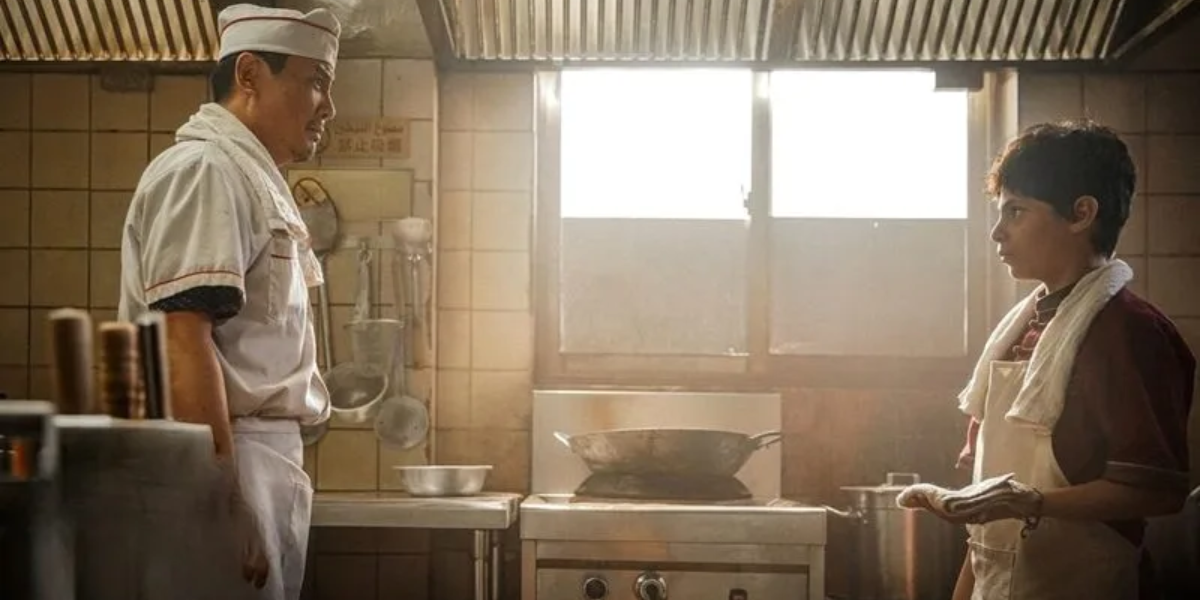
Presented largely as a flashback retelling across 20 years after the events of the non-specified war and subsequent American occupation, the film strays far from the typical insights into what motivates soldiers or extremists. Instead, it focuses on the wartime opportunism of chef Xu Su (Shen Teng).
A once-failed restaurant owner seeking a way to quickly pay off his debts, Xu takes a job as a chef at a Chinese restaurant in the middle east, leaving his young daughter and mother behind in China. Soon after achieving stability working in a new land, American airstrikes decimate the region Xu works in, leaving him as one of the only chefs in the city.
What starts as the restaurant owner offering him a raise to stay despite the increased risk, begins a slippery slope of opportunism that leads him closer and closer to the truth – war spares no one. Whether it is soldiers abusing their power, children orphaned from war, or a Chinese restaurateur trying to get by, a similar sadness follows them all.
Spanning language across Arabic, Mandarin and English, the film follows that bleak truth while showcasing another more simple, more heartwarming message: everybody wants to enjoy a good meal. Expertly shot, with gorgeous colouring and dazzling cooking technique on display, Xu’s meals bring the heart of the film to light.
His cooking brings a sense of peace to diners, defying many of the stresses that exist beyond the dining tables. Xu’s restaurant brings him closer to the people of the region; everyone from poor orphans of war to angsty American soldiers is able to put aside the manufactured environment of destruction and feel, even for a brief moment, at peace.
The influence of American propaganda
The film treats American occupation with a sense of disgust. Soldiers are presented as rash, manipulative, and immature. They are quick to pick fights with children, and quicker to use whatever superiority they have against people who have much, much less, like extorting a man for his daughter’s cancer medications. Still, there remains a holistic portrayal of some of the soldiers, in that they have been imbued with fear. Though it doesn’t offer them much pity, the film gives that fear an origin that is familiar to many living in North America now: innate American propaganda that every middle eastern child is a terrorist.
This perspective isn’t played for laughs, but it comes across quite ludicrous early in the film. The only children displayed are war orphans with very little to lose, who suddenly take a deep appreciation for cooking and serving at the restaurant. When Xu takes Saif, an initially bratty but quiet arab child, in as his apprentice, the appreciation Saif feels grows into a passion for cooking.
The film frequently portrays children as innocent to the violence that surrounds them, but concurrently shows how they are made victims of aggression by their environment. Inevitably, even for children like Saif passionate about a life outside of war, this victimization leads to bitterness, and there is a clear display of how the cycle of violence has no winners.
Media portraying the Iraq war, metaphorically or otherwise, have long had a chokehold on Americans – American eyes, fears, and the consequences on the American psyche. But as time has shown, what the US funds has ripple effects on how the rest of the world views itself. With Once Upon a Time in the Middle East, a Chinese perspective of Iraq highlights the impact of a monstrous war across language barriers, and the lasting consequences of American actions have their own unique flavour.
Author

Did you like this article? Help us produce more like it by donating $1, $2, or $5. Donate