
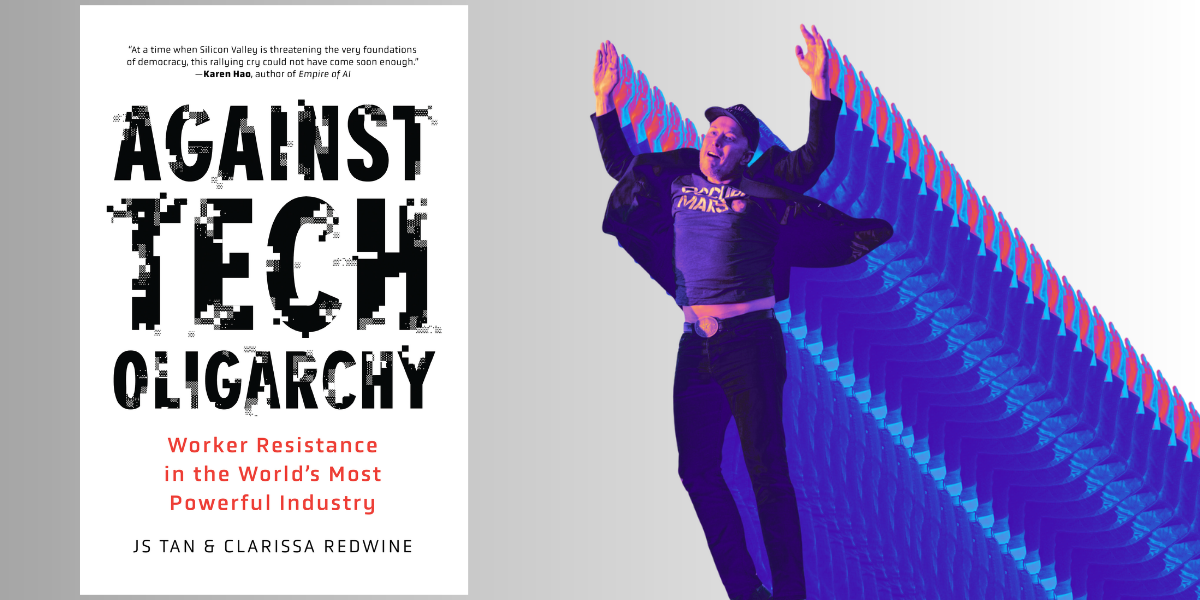
Against Tech Oligarchy: Worker Resistance in the World’s Most Powerful Industry by JS Tan & Clarissa Redwine (Haymarket Books, 2026)
A firsthand account of worker organizing in an almost “union-proof” sector, Against Tech Oligarchy: Worker Resistance in the World’s Most Powerful Industry is a call to arms for labor activists to develop new strategies to take on the richest companies in history.
A timely perspective directly from tech workers
Written by former tech workers Clarissa Redwine and JS Tan, Against Tech Oligarchy arrives at a time where multiple authors are pulling back the curtain on the industry’s bit-rot. Gil Durán’s The Nerd Reich documents the techno-fascist ideology held by industry leaders, Naomi Klein and Astra Taylor have just chronicled how AI evangelists are hastening global catastrophe by trying to give birth to a “Digital God,” and Cory Doctorow has coined the phrase “Reverse Centaur” to illustrate how AI has been far less of a boon to production than expected — something that even its most ardent supporters are now realizing.
Having won the first tech worker union at Kickstarter in 2020, Redwine and Tan’s perspective on the rise of a techno-billionaire class feels intimate, refreshing, and — in spite of the book’s ending — hopeful. The book truly believes in the democratizing and liberating power of tech, but only if it puts people and workers first. If there really is a progressive version of tech (something that may seem uncharacteristic of the current Luddite-left), ATO shows how a human-centric future is still within reach–though it won’t be brought about by the bosses. While holding the heads of world’s richest and most powerful companies to account seems like an insurmountable task, readers should see this book as a sign that there are still people in tech who do not share the same values as our would-be overlords.
Uncovering anti-worker industry roots
Starting off, the book dispels the myth that Silicon Valley’s hard swing to the right happened over the past 15 years, and up until then had been a beacon of liberalism in the San Francisco Bay. Looking at how the industry developed, it doesn’t take much to see how pro-capital and anti-worker values had been there from the start.
In the early days of a burgeoning tech industry, the “California Ideology” reigned supreme: a novel blend of freewheeling countercultural leftovers from the 60s and the neoliberal, libertarian dreams of the 80s. In effect, this meant the tech sector was both “pro-freedom” and “anti-union.”
At the time, the lack of worker representation wasn’t much of a concern for tech workers. Big employee benefits, company stock options, and relaxed offices with ping-pong tables were all offered up in place of actual bargaining power. If anyone found themselves unsatisfied, they could easily move from one startup to the next, giving companies an incentive to keep their employees happy. Along with this, the “creative” nature of tech work produced a culture where the work meant something more than just a paycheque: it was a mission to change the world. With companies hiring workers who expressed a deep and personal commitment to “building the future,” it made them relatively easy to exploit — something which did not go unnoticed by their bosses. In writing about what made a startup successful, PayPal founder Peter Thiel declared that “The Best Startups Work a Lot Like Cults.”
Tasking itself with “building of the future,” tech companies of the 80s and 90s saw themselves as Davids taking on Goliaths — disrupting the stuffy world order and allowing for new ways of commerce, culture, and communication to take shape. When the internet made its shift from Web 1.0 to 2.0 after the Millennium — that is, moving from disconnected websites to the current platform economy — companies like Facebook and Myspace began to dominate the web. Then, in the aftermath of the 2008 financial crisis, plummeting interest rates caused a tidal wave of free money to flood into the Valley.
With every venture capitalist looking for their “Unicorn” investment, it allowed these companies to scale rapidly, and attract millions of users into their “walled gardens.” High off the injections of VC money, companies like Facebook, Google, and Amazon found that it was much easier to simply buy out any competitor that could cut into their market share. With companies gobbling each other up left and right, it appeared that the only way that the Davids could survive was by becoming Goliath. Scale became a necessity.
Oligarchs in underdogs’ clothing
This did nothing to change the industry’s self-image as the scrappy underdog, even as its role in the global economy continued to expand. With the rapid growth that occurred during the Obama presidency (an administration with multiple ties to Google), many companies prided themselves on having a public image that was left-leaning, or at the very least “liberal.” In the summer of 2011, the Arab Spring protests — many of which had been organized on Facebook — helped give the industry a reputation of being a powerful force of international democracy.
It would take the actions of whistleblowers like Edward Snowden or Christopher Wylie (Cambridge Analytica) to reveal how these were the same companies that had been building America’s surveillance state and had been allowing far-right political operatives to microtarget users, inundating them with fake news and conspiracy theories. Along with Brexit, Trump’s shocking election victory in 2016 meant that tech’s (particularly Facebook’s) political impact could no longer be ignored. From here, public sentiment towards the industry took a very decisive turn and by 2018, writers at both Buzzfeed and the Financial Times would announce that the “Techlash” was finally here.
ATO’s first-hand perspective
This is a story that many of us know all too well, but what has remained absent has been the perspective of those working for these companies. These were engineers, data analysts, and programmers who were horrified at how the tools they spent years building were now wreaking havoc across the globe; they were just as concerned as the rest of the public about how their bosses were choosing to wield them. In tech, they saw the promise of a better world and realized that in order to deliver on it, it would have to be up to them.
Against Tech Oligarchy tells the story of its authors’ own experiences within the tech worker movement, but it also covers how the tactics of the movement have been forced to evolve. During Trump’s first term, it was common for workers to leverage public pressure through walkouts or open letters, as Google employees did in 2018 when Gizmodo published the details of the company’s dealings with the Pentagon.
Pressure campaigns were the weapon of choice for companies that valued their brand’s reputation, but as their revenue models shifted away from outperforming competitors to locking users in and extracting as much value from them as possible, “brand crises” became much easier to weather. With the industry becoming too big for the public to opt out of, labour activists would have to pursue a new strategy. Some — including the authors — decided it was time to form a union.
Organizing in a “union-proof” industry
This proved to be particularly difficult due to the unique aspects of working in tech. Unlike factory work, platforms are automated extensively, meaning that a programmer withholding their labour won’t have the same impact on a company’s bottom line as a spot-welder walking off the factory floor. It can also be done remotely, requiring employees to use a company’s internal messaging channel — something that’s become the norm in the post-COVID workplace. With a majority of workplace communication happening under the watch of management, who’ve been equipped with a whole other set of tools to surveil their employees, traditional methods are becoming incompatible with organizing a digital workforce.
This, of course, is by design. As the industry’s long, cybernetic tentacles have crept their way into all other sectors of work (“all jobs are tech jobs now”), it has given companies the ability to re-create the same working conditions of those who work in tech. With a workforce that is increasingly atomized, surveilled, and made to be disposable, workers face an uphill battle in the challenge of reclaiming their labour power. Here, ATO makes the call for unions to build upon the traditional methods of organizing in order to better address the needs of the non-traditional worker. Tech has spent years innovating, and it’s time unions did too.
Uplifting worker power over executive power in tech
Built on a labour-first perspective, Redwine and Tan’s book is a standout amongst other works on the topic, particularly because of how they’ve provided readers with an authentic, human perspective. While Gil Durán or Shoshanna Zuboff examine Silicon Valley from a birds-eye-view, ATO blends wider forms of analysis with its authors’ own lived experience, creating a kind of intimacy that feels surprisingly rare in critiques of an industry that’s enmeshed itself so deeply into our lives. Along with Sarah Wynn Williams’ Careless People (a memoir of her time as Facebook’s Director of Global Policy), stories detailing how the human cost of the tech industry is borne by those who work within it, are vital reading for those who seek to create an alternative.
In ATO, readers can be reminded of how not all of those who have chosen to work in tech are the same kind of bratty sociopaths that Elon Musk used to staff the Department of Government Efficiency (i.e. “Big Balls”). Those who own the platforms that we use to connect with each other every day may be angling for a future where their power is absolute, but this isn’t always a vision they share with their workers. Though it’s easy to imagine that all of Silicon Valley is ideologically aligned, ATO helps us remember that the tech oligarchs are not same as the people who work beneath them. Despite the many challenges they face, the tech worker movement still might be the just the ones who can finally take them all down.
Author

Did you like this article? Help us produce more like it by donating $1, $2, or $5. Donate