
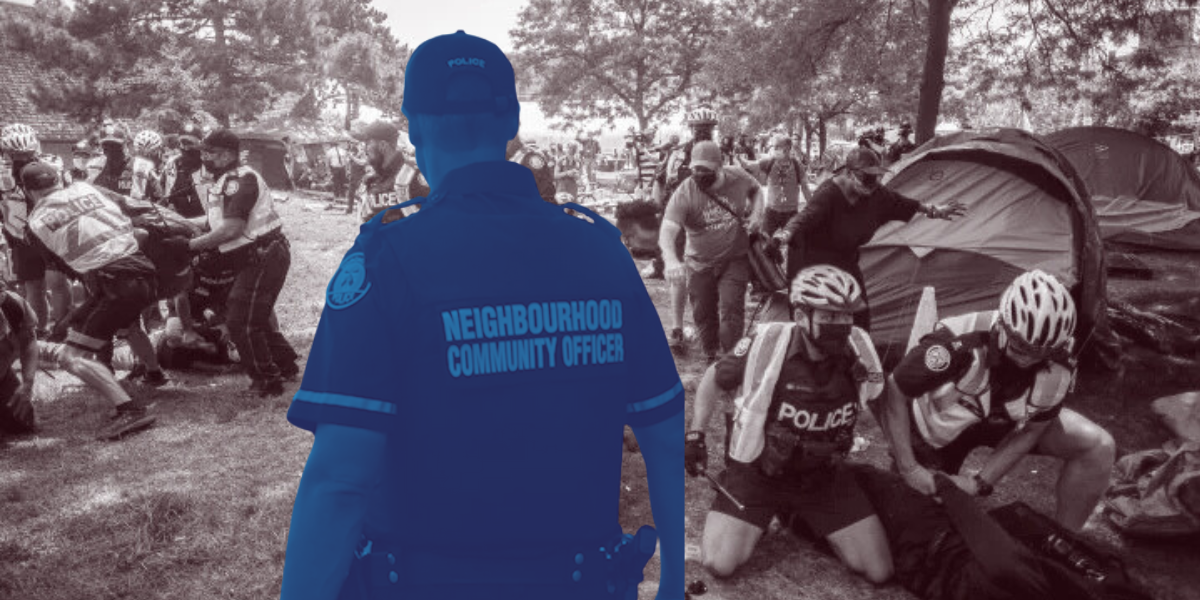
On November 26th, with a direct endorsement from Mayor Olivia Chow, the Toronto Police Service (TPS) announced that neighbourhood community officers will soon be deployed into four new areas of Toronto: Dufferin Grove, Banbury-Don Mills/Victoria Village, Wexford-Maryvale and Etobicoke City Centre. The message was also accompanied by the plan for four officers to soon be patrolling the TTC subway to enforce “seven-day-a-week dedicated coverage” on Line 1, the busiest subway in the city. According to Toronto police, this is a reaction to the rising levels of violence and crime occurring in the selected areas. This is contrary to their own recent data which displays declines in almost every major crime category in Toronto in 2025.
For TPS, neighbourhood community officers are different from regular officers in that they “work hand in hand with the people we serve, solving problems together and addressing issues before they become a crisis.” A recent Instagram post showcases community officers interacting with children, laughing with people at community meetings. Chow herself purported that community officers “get to know people over time and build trust. When that happens, crime goes down and people feel safer.” Such an idealistic view encompasses what is referred to in the language of copaganda as “community policing.”
But what exactly is community policing, and how should socialists and abolitionists confront it?
“Community policing” is oppression by another title
In August of last year, I wrote an article that analyzed the underlying motives of the implementation of Project Magnify, an initiative that also expanded neighbourhood officers in specific sections of the city. My argument boiled down to the fact that police take advantage of violence resulting from the intentional disinvestment in racialized and poor communities in order to re-entrench their legitimacy in racialized neighborhoods. Disinvestment turns into “crime,” and “crime” is used to justify policing. The purpose of police is to reproduce the unequal racial and class relations required for capitalism to function, and dealing with crime through policing (as opposed to well-studied alternatives like stronger social programs, welfare, and housing) is an excuse to let police run rampant in racialized communities.
TPS, however, cannot simply send regular foot patrol officers into such areas as a result of historical and contemporary mistreatment by law enforcement and the resulting mistrust of police among marginalized populations. Enter community policing, where the nicer, progressive officer partakes in charity events and “coffee with a cop” alongside local business owners and housed citizens. Suddenly the police have continued presence within dispossessed communities with little pushback. TPS then utilizes fear to manufacture the consent of the public to justify increased police funding.
As scholar Bronwyn Dobchuk-Land states, while community policing is often sold as a progressive alternative to more overt, brutal methods of policing, it is actually the same form of oppression by another name. This is echoed by Robyn Maynard in the recently released second edition of her brilliant book Policing Black Lives, in which she says that neighbourhood policing in Toronto serves “not to reduce but to facilitate violence by embedding the reach and scope of police more deeply, turning the police into an occupying force in neighbourhoods that are populated by officers as they are deprived of safe and affordable housing, public parks, healthy food and community services.”
The ideology of community policing had infiltrated essentially every major city under the Canadian state. In Vancouver, community policing centres have integrated themselves within the broader network of non-profit community services in order to expand the surveillance and criminalization of vulnerable populations. Recently, in response to the killing of 15 year-old Nooran Rezayi in Montréal by police, Ted Rutland analyzed the community policing program known as the Réseau d’aide sociale et organisationelle (RÉSO) within the context of counterinsurgency against the city’s Black population since the 1980s.
With the recent expansion of neighborhood community officers into four new areas as well as the TTC, it is clear that community policing remains a cover story that the TPS is willing to depend on in order to increase their presence within marginalized, working class communities. Community policing does not serve to reduce crime, as crime is not in the question. Rather, it is imperative to bring to the forefront that the purpose of the police is to protect property, which comes with the regulation, surveillance and control of populations considered “unworthy” of being present in the public eye.
When it comes to protecting private property, there are no coincidences
Over the past year, multiple pieces of legislation have been passed by Ford’s reactionary government that will force more vulnerable people in public spaces while also punishing and criminalizing such presence.
In April 2025, five supervised consumption sites in Toronto closed as a result of Bill 223, which has resulted in more visible drug use as well as a 288% increase in overdoses in selected locations of the city. This has been followed by the closure of the Parkdale supervised consumption site in November 2025, one of the last sites in the west end.
Under the “Safer Municipalities Act,” police are now allowed to issue tickets or arrest people who refuse to stop using substances in public spaces, with resistance punishable by imprisonment or a fine of upwards of $10,000.
The recently passed Bill 60, which has further eroded the rights of tenants, has activists claiming that such policy direction will only further increase the amount of people susceptible to eviction, forcing them onto the streets and encampments.
On November 24th, the Ontario government announced a proposal for mandatory cash bail deposits for people seeking to get released from custody. As critics have noted, this will create a two-tiered bail system that serves to keep poor people in custody because they cannot afford their freedom. More financially unstable individuals will be forced into the carceral cycle that further leads them astray from the resources they need to live a fulfilling life, resulting in more people living precariously in visible public spaces.
Coinciding with the cash bail proposal was the state’s announcement of the “Keeping Criminals Behind Bars Act,” which if passed will give Provincial Offences Officers, otherwise known as POO, authority to confiscate drugs from people using the TTC. As noted by emerging evidence, drug seizures by police increase both fatal and non-fatal overdoses of people who use drugs in visible areas of urban cities. When someone’s drugs are taken away from them, they often resort to desperation that leads them to buy from the increasingly contaminated supply from unknown sources. Neighbourhood community officers patrolling Line 1 of the subway later in the year will collaborate with TTC Special Constables and city staff to enforce such measures, further defining who deserves to be present in public spaces. Such actions will only exacerbate the police oppression Indigenous people in the city face for drug use, as indicated by the Yellowhead Institute. According to the Centre for Drug Policy and Evaluation found that, while there is no difference in the occurrences of police contact between those who identified as Indigenous and those who identified as white, Indigenous people are 98% more likely to experience a violent encounter with police when they are caught with drugs in Toronto.
Rejecting neighbourhood officers in our communities
In 2022, TPS’s podcast “24 Shades of Blue” released an episode featuring two neighbourhood community officers who talk about their ostensible role within communities. At a part in the video, the officers talk about the act of balancing engagement with citizens while also responding to what they consider to be criminal acts, concluding that “at the end of the day we all signed up as police officers to fight crime and disorder, which is one of the primary functions of our role.”
Here lies the purpose of community policing at its core: not an alteration of past policing practices but a reconstruction that continues to create categories of inclusion and exclusion, reproducing differences between those considered loyal and disloyal to police interests. In doing so, police are serving capital by enforcing the division of people into races, genders and classes that capitalism needs to function.
According to Mark Neocleous in his book Pacification, community policing puts people in distinct groups in order to be policed in different ways, from the “vagrant” and “homeless” to the “deserving poor” and “undeserving poor.” Dufferin Grove, one of the new neighbourhoods that will have community officers, had a violent encampment eviction at Dufferin Grove Park enforced by city staff, security and TPS in October 2025. The presence of neighbourhood officers will only further separate and divide the community, perpetuating the further exclusion of unhoused and marginalization populations.
We must reject policing in all its forms. This requires recognizing what community policing truly is and understanding the underlying intentions of such expansion. More police in our neighbourhoods, regardless of their title, means more surveillance and regulation of our friends, neighbours and comrades. There is no future of liberation where community police play a role.
Author

Did you like this article? Help us produce more like it by donating $1, $2, or $5. Donate