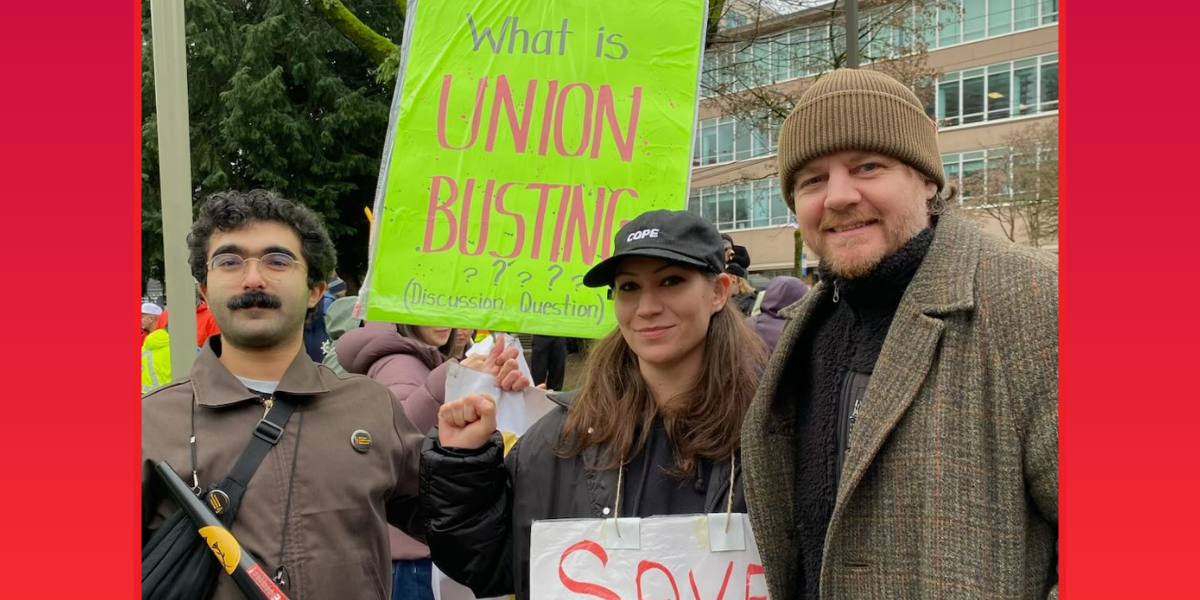
With the 2026 Vancouver municipal election coming up in October, Spring’s Lisa Dee spoke with socialist city council candidate Sean Orr (pictured above, right) about his vision for the city, the relationship between movements and city hall, and what it will take to build a Vancouver that works for everybody.
Lisa Dee: I saw you gave a shout out to Mamdani when he won the election. What do you like about him and his campaign, and do you have any similar approaches yourself?
Sean Orr: Yeah, absolutely. It was so inspiring. And it just shows with so much going on in this world that we can’t retreat to the center. We can’t let them shift the Overton Window further and further and further. And we’ve seen that happen so many times with progressive governments. We’ve seen that here in British Columbia, obviously, perennially. We see that with the Democrats in the States. And we’ve seen it with Keir Starmer in the UK, this capitulation with Blairite concessions constantly. And it’s so great to see somebody run such a bold campaign, fearless and unabashedly socialist and say, we’re not afraid of that word, and we’re not afraid to stick to our roots and stick to our guns on that. So it was incredibly inspiring.
There are other examples, of course. Emily Lowen’s leadership run for the B.C. Green Party was great, as was Katie Wilson’s win in Seattle. Also going back to Bernie Sanders and Kshama Sawant, there have been inspiring moments. And I think we need something like that. I think a couple of the contenders for the leadership of the federal NDP have kind of taken some pages from that book as well. So yeah, we definitely wanted to do the same thing and run a similar kind of campaign.
I jokingly said we paved the way for Mamdani, obviously tongue in cheek. But it’s the same spirit in that we’re noticing that neoliberalism has tendrils in almost every institution, and we have to fight back against that. And a lot of times it can seem daunting. A lot of times neoliberalism seems like the path of least resistance, or the lesser of two evils, but it gets us nowhere in the end. We have to be bold, and we have to be rooted in our principles, and we have to embrace democratic socialism, in my opinion.
LD: So what about the coming year? Aside from, of course, re-election, do you have any priorities for the coming year?
SO: I think there’s gonna be all eyes on Vancouver in terms of FIFA and how that rolls out. And obviously, I’m going to be concerned for issues around displacement, protecting our most marginalized people, sex workers and people in the Downtown Eastside, but also making sure that there’s enough information out there for fans who are coming over around the issues of poison drugs, and making sure they’re informed. There are potential issues around ICE in the US and players and fans moving back and forth across the border. There are also issues around domestic violence increases that we’ve seen in these kinds of world tournaments. So, yeah, lots of concerns around FIFA. That’s the big thing that’s looming over all of us.
LD: Yeah, that makes sense. And I wondered about the other progressive counselors—OneCity, maybe some of the Green Party—do you find that you have common ground with anybody else on council?
SO: Oh, for sure. We’re all in this situation where we’re basically the official opposition. We’re all on the north side of City Hall, so we call ourselves the North Siders. It’s cute, you know. And obviously there’s lots that we disagree about. But in this moment, I think it’s important to be unified, as much as we can. Obviously, we’re not always going to be unified, and I’ve been the single “no” vote on a couple of things, like the [new million dollar] “Vancouver” sign, or retroactively awarding the police $17 million, or the Broadway Safeway towers project that had no affordable housing in it. There have been a couple times of where I’ve been on my own, but I think we’re focused on the goal, and that’s flipping the Council in 2026.
It’s been great to work with Lucy [Maloney of One City] and Pete [Fry of the Green Party] and to a certain extent Rebecca Bligh [of Vote Vancouver] as well. Not a progressive, I don’t think in the classical sense, but I think she sees the writing on the wall in terms of her participation with the ruling party [ABC], and she took a stand against pausing supportive housing. And it was great. I think for Vancouver, nobody wants to see the left squabbling about minor things.
But I think another really important point is the idea of keeping the door open for movements that are on the street, and if I can be a lightning rod for that, or if I can support that. We’re coming up against the limitations of electoral politics, and especially in municipal politics. We do have a little bit more freedom than other municipalities with our Vancouver Charter, but there’s just so much that we can’t do. There’s so much that we need other levels of government to do, and that’s why keeping an ear to the ground and having that open door and listening to those movements on the ground is so important, because that’s where democracy happens, right? As cliché as that sounds, that’s where the demands are heard.
LD: I recall Jean Swanson had what they call an ‘inside-outside’ strategy. Does that inform any of what you’re trying to do? I saw you give a shout out to people in the movement in your social media posts. What do you see as the role of the social movements or those outside City Hall in making gains?
SO: I think a lot of it is understanding the limitations of both. There are going to be limitations from inside City Hall, and there are going to be limitations in the streets. [The key is] finding out where those limitations can be smoothed over in terms of where we can take that and run with it, and where we [City Hall] can’t do anything and it has to be large scale mass mobilization.
In such a big city like Vancouver, there are so many overlapping crises that are going on at once that I want to be vocal on, even if it’s outside my jurisdiction: the poison drug supply, the Mental Health Act, decriminalization, and of course affordable housing and supportive housing. So I’m not afraid to talk about bigger things. Canada has, or should have, a role in terms of world events and shipping arms to Israel, and this sort of tacit support of ICE and that whole apparatus. And we have a lot of ties with that military industrial complex in Canada, and then the environment as well.
There are a few things we can do as a city, and we can be a leader, but we’re up against this kind of reactionary backlash that says cities should just be for filling potholes and collecting your garbage, and we should dim our light and not step outside of our jurisdiction. I think that’s a little misguided. I think people look to Vancouver, and always have, as a progressive place, a place where Greenpeace and Adbusters [began]. I remember hearing when Libby Davis would put up “You’re now entering a nuclear-weapons-free zone” signs. Well, that’s not our jurisdiction yet. But it is: I remember as a kid, I asked my parents [about the signs], and we went on marches about it, you know? And that led me to where I am today, in a sense. That’s the importance of that sort of advocacy and representation.
LD: If there are people outside of City Hall who want to support what you’re doing, is there a way that they can plug in and get involved? What would you suggest?
SO: I think COPE was in a place where maybe it didn’t have its capacity built out, but we definitely want to be a place that fosters those movements, even just getting people together.
We have a social night called Left Wings every second Wednesday, just getting people in the same room, and there are people from different parties. We’ve had Emily Lowen in there, we’ve had Avi Lewis there, Tanille Johnson, Pete Fry, Lucy Maloney. It’s a way where we can have those conversations.The left tends to take itself very seriously, and tends to do this kind of purity test: who gets to be left, and who gets to be progressive, that kind of thing. I think if we can have a place where we let that guard down, and we can talk about what we have in common rather than what differences we have, I think we’d be in a better place as a city and even across the board, as a country.
A lot of these people also volunteer on federal and provincial campaigns. It’s just great to hear what’s going on. I think historically, it’s been the province, those electoral district associations that have kind of played that role. I know Avi Lewis is talking about using constituency offices as this movement building kind of thing. I think there’s room for that in Vancouver. And, yeah, I think COPE is doing very well right now in terms of building out that capacity. So…join COPE!
LD: That’s useful, because sometimes people don’t think of political parties existing between elections. So hopefully COPE isn’t like that?
SO: I think we were maybe, at some point, I think we’ve been very conscious that we had a very short time. We only have 18 months, you know, between elections. That was really on our mind, that we were going to build out that capacity, and strengthen our networks, and really get re-acquainted with the labour movements and really support a lot of the labour movements that are going on. We’re trying to show up on the picket lines: we did that with postal workers, airport workers, with the BCGEU. Anything that we can do to lend support and mobilize our team, that’s what we’ve been trying to do these last few months. So hopefully we can keep that going.
LD: That’s super important. Is there anything else you want to add?
SO: Maybe that’s another thing to add: so often you have that kind of political knowledge, or the institutional knowledge, and you kind of keep it to yourself, because that’s your ticket to being elected or whatever. In this case, no. We need to also create our own higher-information voters and keep people engaged and make people realize how much of their daily life is affected by municipal decisions, and have that transparency and an open door. You know, I’m pretty active on social media, probably too much so. But I do talk to people on Instagram. I think there’s a demystifying thing there, where I’m just a regular person, and I’m here to listen to folks.
Author

Did you like this article? Help us produce more like it by donating $1, $2, or $5. Donate